Black Spot on a Tooth: What It Means and What to Do Next


A black spot on a tooth is usually a stain, tartar buildup, or early decay, and only a dental exam tells you which one for certain. If the spot is new, painful, or changing shape, call your dentist now. If it’s small, stable, and painless, a routine check within a couple of weeks is reasonable.
Before you book anything, run a quick self-check:
Does it feel rough, soft, or sticky when you run your tongue over it?
Has it grown or darkened over the past few weeks or months?
Does the tooth react to sweets, cold air, or hot drinks?
Pro Tip: If the spot is hard, smooth, and hasn’t changed in years, it’s less urgent. Any new sensitivity or softness means you shouldn’t wait.
Key Takeaways
A black spot on a tooth is most often a stain, tartar, or early decay, and only tactile probing plus X-rays can tell them apart with confidence.
Point | Details |
Texture beats color | Softness, stickiness, or a visible pit matter more than how dark the spot looks. |
Watch for change | Growth, new sensitivity, or spreading over weeks signals active decay. |
X-rays catch hidden decay | Bitewings reveal subsurface lesions that a visual check alone will miss. |
Arrested lesions can stabilize | Fluoride and hygiene can harden early spots, but cavitated enamel needs a filling. |
Mersal Dental offers same-day answers | Digital X-rays and conservative treatment are available in one visit at Mersal Dental. |
Table of Contents
What Causes a Black Spot on a Tooth
Black spots come from several distinct sources, and the cause changes what you should do about it. Extrinsic stains from coffee, red wine, tobacco, or berries sit on the enamel surface. They’re cosmetic, and a cleaning usually clears them. Tartar, or hardened plaque, darkens near the gumline over time and needs professional scaling to remove, since brushing alone won’t touch it.
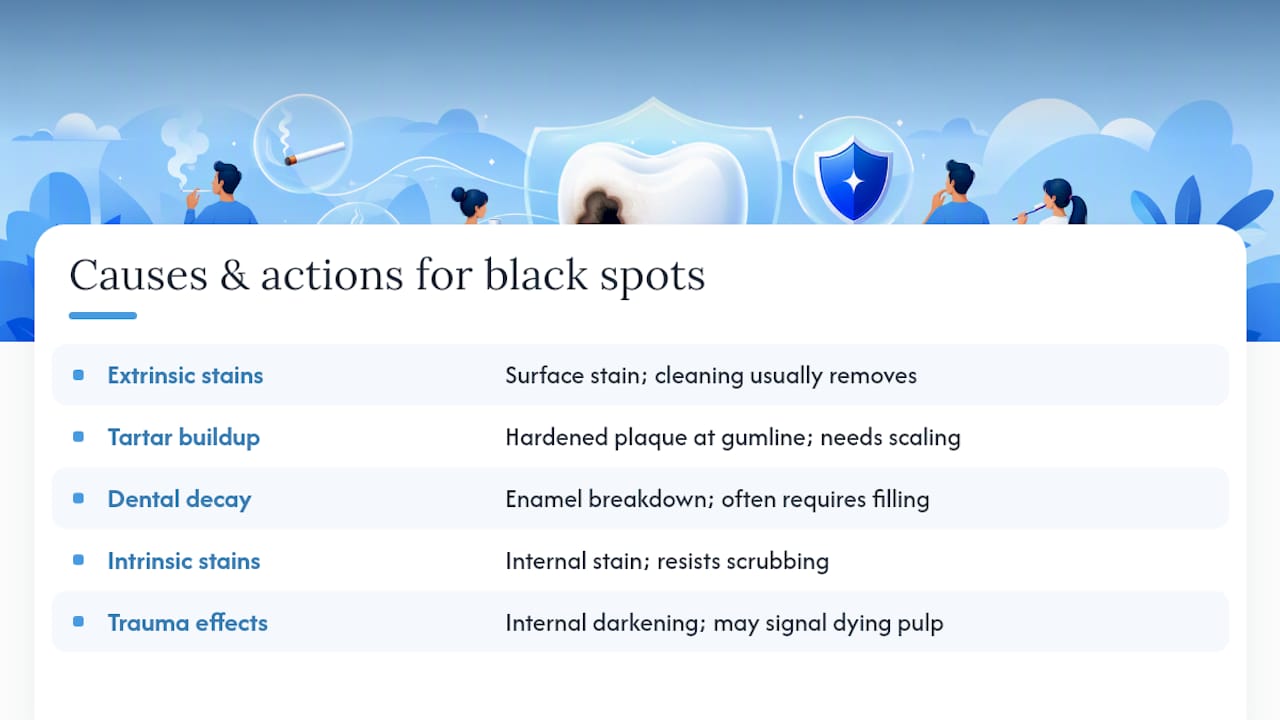
Dental decay is different. Caries appears as a dark spot where the enamel has already broken down, and it often needs a filling before it spreads. Intrinsic stains, caused by fluorosis, tetracycline exposure in childhood, or old trauma, sit inside the tooth structure rather than on its surface, so no amount of scrubbing changes the color. Some patients also develop an amalgam tattoo, a bluish gray or black smudge in the gum or nearby tooth tissue from old silver fillings.
Trauma matters too. A tooth that took a hard knock years ago can slowly darken from the inside as the nerve tissue breaks down, which sometimes signals a dying pulp.
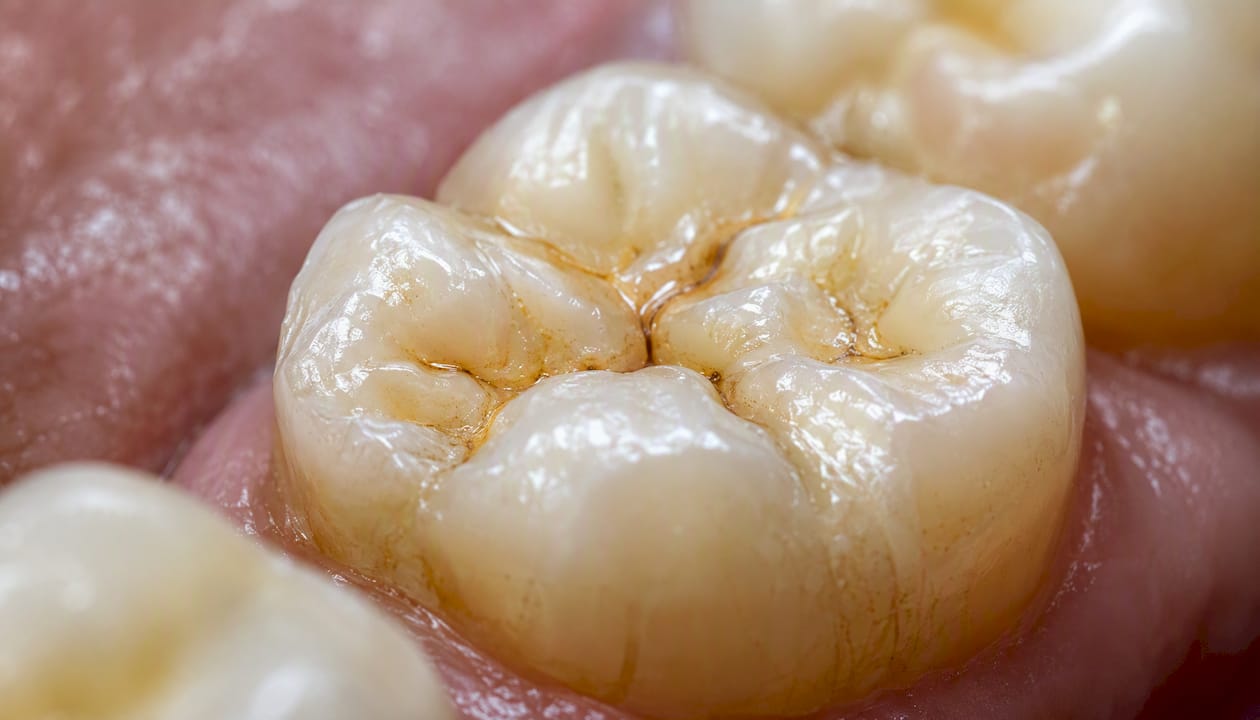
Molars deserve a special mention here. The pits and fissures on their chewing surfaces can be narrower than a toothbrush bristle, which traps plaque and stain in spots your brush physically cannot reach, even with a solid daily routine.
Pro Tip: A dark spot that showed up gradually near old dental work is often just staining. One that appeared quickly and feels different to the touch deserves a same-day look.
How to Tell if It’s a Cavity
Color alone doesn’t tell you much. A tooth can look black from a coffee stain or from active decay, and the two require completely different responses. What matters more is texture, sensitivity, and whether the spot is changing.
Check if the area feels soft or catches your fingernail or a strand of floss.
Look for a visible pit, dip, or hole rather than a flat discoloration.
Note any sensitivity to cold, heat, or sweets when you eat or drink.
Watch whether the spot has gotten larger or darker over the past several weeks.
Pay attention to location. Spots between teeth or on a chewing surface are harder to monitor safely and worth a professional look sooner.
Use a mirror, good lighting, and a clean fingernail or piece of floss to check gently. Never dig at the spot with a pin, knife tip, or anything sharp. Aggressive scraping can chip enamel and won’t tell you anything a dentist’s explorer can’t determine safely.
Pro Tip: A hard, smooth spot that’s looked the same for years is more likely a stain or an arrested lesion. A newly darkened area that hurts or feels rough is worth booking soon.
How Dentists Diagnose a Black Spot
A short exam combined with bitewing X-rays usually settles the question in one visit. Dentists don’t rely on eyesight alone, because visual appearance can’t reliably separate a stain from actual decay, according to a Journal of the American Dental Association review on caries detection that recommends pairing visual and tactile exams with radiographs for accuracy.
The process typically includes:
A visual inspection under bright light and magnification.
Gentle probing with a dental explorer to test whether the surface is soft, sticky, or catches the tip. Softness generally means active decay, while a hard surface points to a stain or old, arrested lesion.
Flossing through contact points to catch decay hiding between teeth.
Bitewing X-rays, which reveal subsurface lesions and shadows invisible to the naked eye.
Transillumination or digital detection tools for harder-to-read cases.
Research on caries detection and management shows that catching decay early through this combination limits how far it spreads and reduces the need for extensive restorative work later. That’s part of why a dentist might choose to monitor a spot rather than treat it immediately: the X-ray and tactile findings, not the color, drive that decision.
Treatment Options by Cause and Severity
Treatment scales with what’s actually happening under the surface, not with how the spot looks.
Surface stain or mild tartar: A professional cleaning and polishing removes it, often in one visit. Whitening should only happen after a dentist confirms there’s no decay underneath, since whitening does nothing for cavities and can mask a problem.
Early or small cavity: A conservative composite filling, sometimes completed the same day, stops progression before it reaches the nerve.
Larger decay: A bigger filling, inlay, onlay, or a crown restores structural strength once too much tooth is compromised for a simple filling.
Deep infection reaching the nerve: Root canal therapy clears the infection, typically followed by a crown to protect the weakened tooth. Extraction becomes the option only when the tooth can’t be saved.
Cosmetic intrinsic staining: Microabrasion, bonding, or veneers address discoloration that sits inside the enamel rather than on it.
High-risk fissures: Sealants and topical fluoride can arrest early demineralization before it becomes a true cavity.
Cause | Typical treatment | Time and recovery |
Surface stain or tartar | Cleaning and polishing | One visit, no downtime |
Small cavity | Composite filling | Often same-day, minimal recovery |
Deep decay or infection | Root canal plus crown | One to two visits, mild soreness after |
Can a Black Spot Go Away on Its Own?
Sometimes, but not always. Surface stains lift with a professional cleaning, and an early, non-cavitated lesion can remineralize and harden with better hygiene and fluoride. Once enamel actually cavitates into a hole, though, it cannot heal itself and needs a filling.
This distinction between arrested decay and active decay is exactly what a dentist checks for with an explorer and X-rays. An arrested lesion is often watched at each cleaning rather than treated right away.
Pro Tip: Ask your dentist to flag any spot they’re monitoring in your chart. A tracked pattern over two or three visits tells you far more than a single snapshot.
How to Lower Your Risk of New Black Spots
Daily hygiene, fluoride, and diet changes do most of the preventive work here. The American Dental Association recommends brushing twice daily with fluoride toothpaste and flossing once a day as the foundation of cavity prevention.
Brush twice daily with fluoride toothpaste and floss every day, including between back molars.
Use a fluoride mouthrinse if your dentist recommends one for your risk level.
Cut back on sugary or sticky snacks and rinse your mouth with water after coffee, tea, or wine.
Quit tobacco products, which stain enamel and raise decay risk.
Stay hydrated. A dry mouth loses natural protection against bacteria.
Regular professional cleanings, topical fluoride treatments, and sealants on deep molar grooves round out the picture for anyone prone to staining or decay.
Red Flags: When to See a Dentist Now
Severe pain, swelling, fever, a rapidly enlarging spot, sudden looseness, or sensitivity that disrupts eating or sleep all mean don’t wait. Book an emergency visit the same day these appear.
If the spot is suspicious but you feel nothing unusual, a routine visit within one to two weeks is fine. Left untreated, an infection can spread beyond the tooth and become far harder to manage.
What Not to Do Before Your Appointment
Don’t try to drill, dig, or scrub the spot with sharp tools or abrasive pastes at home. These methods risk permanently damaging enamel and won’t tell you anything useful about what’s actually happening beneath the surface. If you’re using a whitening product, skip it until decay has been ruled out.
What Happens at Your Dental Visit
Most exams take five to fifteen minutes and combine a visual check, gentle probing, and X-rays only when needed. Expect a quick review of your dental history, a look under bright light, floss checks between teeth, and a clear explanation of what your dentist sees before any treatment starts.
If a filling or cleaning is appropriate, Mersal Dental often handles it the same day, along with digital X-rays and emergency slots when a spot needs urgent attention.

Pro Tip: Bring a note of when you first noticed the spot and whether it’s changed. That timeline alone helps a dentist decide between watching it and treating it right away.
A Dentist’s View on Black Spots and Patient Worry
Most black spots we see turn out to be stains, tartar, or small lesions that respond well to conservative care. Deciding between watchful waiting and active treatment comes down to what the explorer and X-ray actually show, not how alarming the spot looks to the patient sitting in the chair.
Our approach favors quick diagnostics and the least invasive option that solves the problem, with clear cost and time expectations before anything begins.
Get a Fast, Honest Diagnosis at Mersal Dental
You don’t have to guess whether that spot is a stain or something that needs a filling. Mersal Dental offers same-day exams and digital X-rays right in Lower Town Ottawa, so you get an answer in one visit instead of living with uncertainty for weeks.

Our team handles everything from routine cleanings and conservative fillings to crowns and emergency extractions, with direct insurance billing and acceptance of both CDCP and IFHP public programs. Multilingual staff are on hand to walk you through your options in plain language, whatever your comfort level with dental visits. If a spot is causing pain or spreading, our emergency care line is built for exactly that. Otherwise, browse our full range of services and book a diagnostic visit whenever it suits your schedule.
Sources
This article is general information, not a substitute for advice from a qualified doctor. Consult a qualified healthcare professional about your own circumstances before acting on anything here.
Recommended
Comments