Chipped Tooth Repair: Your Complete Treatment Guide
- Mayde Mersal
- Aug 6
- 13 min read


If you just chipped a tooth, see a dentist promptly within a day or two. Most chips are treatable without major intervention — the repair path depends on how much tooth structure is lost and whether the nerve is involved.
Here is what you are likely looking at, from least to most involved:
Enamel smoothing or polishing — for tiny surface chips with no sensitivity
Composite bonding — for small to moderate chips, usually one visit
Porcelain veneer — for cosmetic front-tooth repairs with moderate damage
Dental crown — for large chips or structurally weakened teeth
Root canal + crown — when the pulp (nerve) is exposed or infected
Extraction + bridge or implant — for severe fractures where the root is compromised
Tonight, before your appointment:
Rinse gently with warm salt water.
If you have the fragment, keep it moist in milk or saliva in a small container.
Cover any sharp edge with dental wax or a piece of sugar-free gum.
Apply a cold compress to your cheek for swelling and take ibuprofen for pain (unless contraindicated).
Pro Tip: Bring the fragment to your appointment even if it looks too small to reattach. Dentists can sometimes bond the original piece back, which improves both fit and appearance.
Table of Contents
What is a chipped tooth, and how is it different from a crack?
A chip removes a piece of enamel — the hard outer layer of the tooth. What remains is a clean break with a missing section. A crack, by contrast, extends into the tooth without necessarily removing material. Cracks can run into the dentin or even the root, making them harder to detect and sometimes more serious.
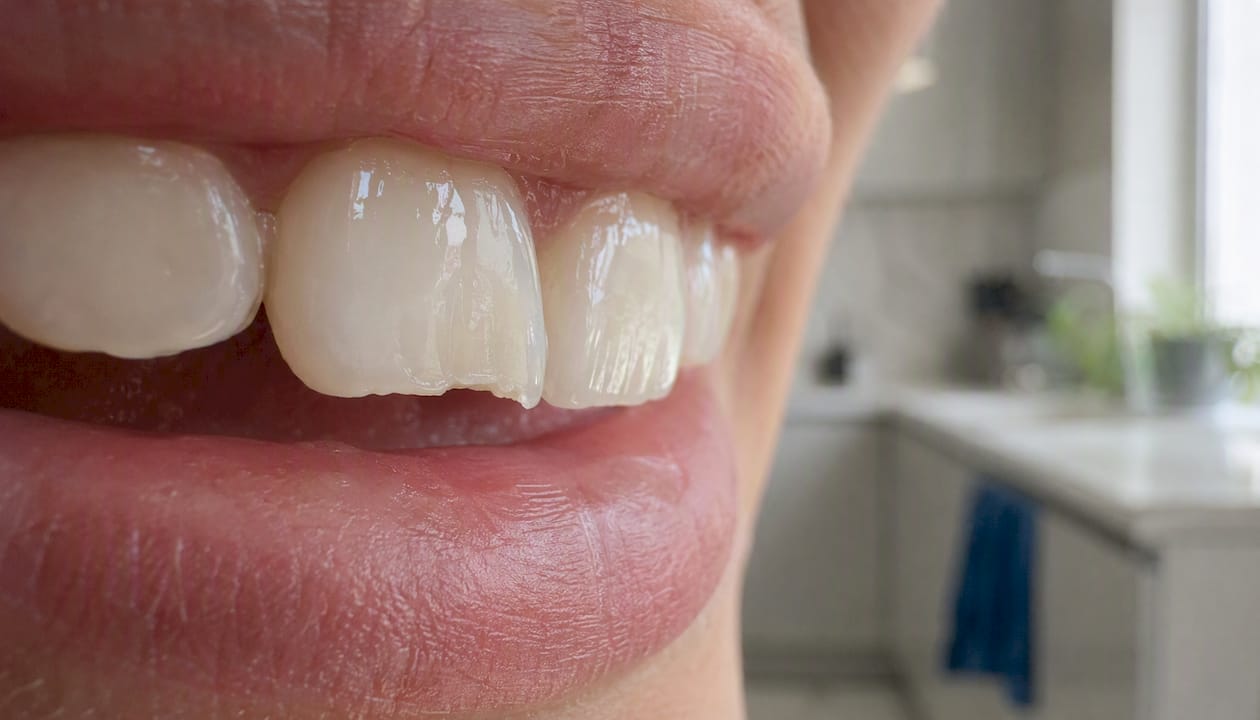
The distinction matters because treatment follows the depth of damage, not just how it looks.
Types of chips, in plain language
Small enamel chip: Only the outer surface is affected. Often no pain, sometimes a rough edge. Polishing or bonding usually resolves it.
Fractured cusp: A larger piece breaks off, typically on a back tooth. Sensitivity when biting is common. A crown is often the right fix.
Large fracture exposing dentin or pulp: The break reaches the inner layers. Pain is usually present. Root canal treatment may be needed before the tooth can be restored.
Why location changes everything
Front teeth carry the aesthetic load. A small chip on an upper incisor is highly visible, so cosmetic outcome drives the treatment choice. Back teeth (molars and premolars) handle chewing forces, so structural durability takes priority. A dentist weighing options for a chipped molar will think differently than one treating a chipped front tooth — even if the chip size looks similar.
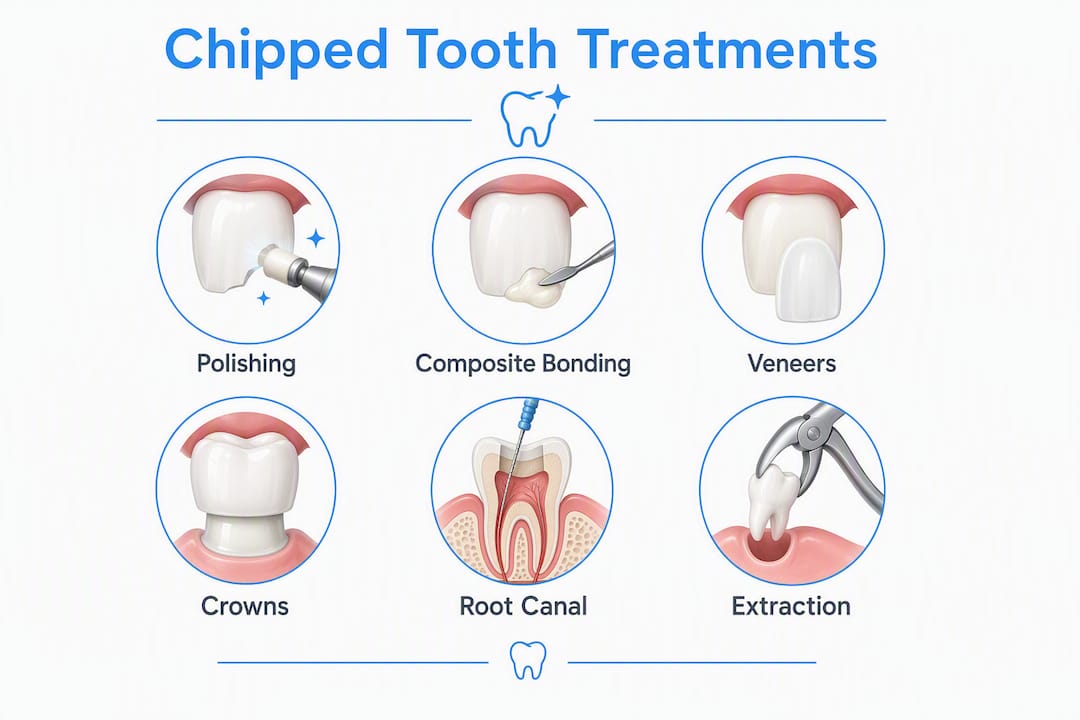
Pro Tip: Tell your dentist exactly which tooth and where the chip is before the exam. That single detail shapes the whole conversation about repair options.
Chip type | Depth | Typical repair |
Small enamel chip | Enamel only | Polishing or composite bonding |
Fractured cusp | Enamel + dentin | Crown or large bonding |
Pulp-exposing fracture | Into nerve | Root canal + crown |
Root-involved fracture | Below gumline | Extraction + bridge or implant |
What are the symptoms and causes of a chipped tooth?
Common causes
Trauma: A fall, sports collision, or blow to the face is the most direct cause.
Biting hard objects: Ice, hard candy, popcorn kernels, and bones are frequent culprits.
Bruxism (teeth grinding or clenching): Chronic grinding wears enamel thin and makes chips far more likely, often during sleep.
Tooth decay or large fillings: Decay weakens the tooth structure from the inside. A tooth with a large old filling has less natural enamel to protect it.
Age-related enamel wear: Enamel thins gradually over decades, raising the risk of chips even from ordinary chewing.
Symptoms to watch for
A visible notch, rough edge, or missing piece of tooth
Sensitivity to hot, cold, or sweet foods and drinks
Pain when biting or chewing
A sharp edge that cuts the tongue or cheek
Swelling or bleeding around the gum near the tooth
Even a chip that causes no pain can expose inner layers and lead to decay or infection over time. No pain does not mean no problem.
Quick self-check: minor or possibly serious?
Ask yourself these questions. If any answer is yes, treat it as urgent:
Is there strong, persistent pain that does not ease with ibuprofen?
Is there visible swelling of the face or gum?
Is there bleeding that will not stop?
Does the tooth feel loose or displaced?
Is there difficulty opening your jaw or breathing?
If none of those apply, you likely have time to schedule a next-day appointment rather than heading to an emergency room. Still, do not wait beyond 48 hours.
What should you do right now? First aid for a chipped tooth
Acting quickly reduces the risk of further damage and keeps your options open for repair.
Cover sharp edges — with dental wax (available at most pharmacies) or a small piece of sugar-free gum. This protects your tongue and cheek from cuts.
When to go to the ER instead of waiting
Go to an emergency room or call 911 if you experience:
Heavy, uncontrolled bleeding from the mouth
Facial trauma with possible jaw fracture
Difficulty breathing or swallowing
Signs of a serious infection: fever, significant facial swelling, or difficulty opening your mouth
For everything short of those warning signs, contact a dental office for a same-day or next-day appointment. A prompt dental assessment within 24–48 hours is the standard recommendation to prevent infection and further structural damage.
Pro Tip: If you are managing tooth sensitivity while waiting for your appointment, avoid temperature extremes. Room-temperature water and soft foods at room temperature are the safest choices.
How does a dentist evaluate a chipped tooth?
Knowing what to expect at the appointment makes the visit less stressful. Here is the typical diagnostic process:
Visual exam: The dentist inspects the chip, checks the edges, and looks for signs of decay or gum involvement.
Bite check (occlusion): You will be asked to bite down on a thin piece of articulating paper so the dentist can see where the chip affects your bite.
X-rays: Bitewing or periapical X-rays show whether the fracture extends toward the root and whether there is bone loss or decay below the gumline. In complex cases, 3D cone beam imaging may be used.
Pulp testing: A cold stimulus or electric pulp tester checks whether the nerve is still alive and responding normally. This is painless and takes seconds.
Sensitivity probing: The dentist may gently probe around the tooth to check for tenderness that suggests deeper involvement.
The dentist will also ask how the chip happened, when it occurred, whether you saved the fragment, and whether you have had any pain or sensitivity since. That history, combined with the exam findings, determines which repair path makes the most sense.
What are your treatment options for a chipped tooth?
Treatment is tiered by severity: a tiny enamel chip needs very different care than a fracture that reaches the pulp. Here is a severity-ordered breakdown of every major option.
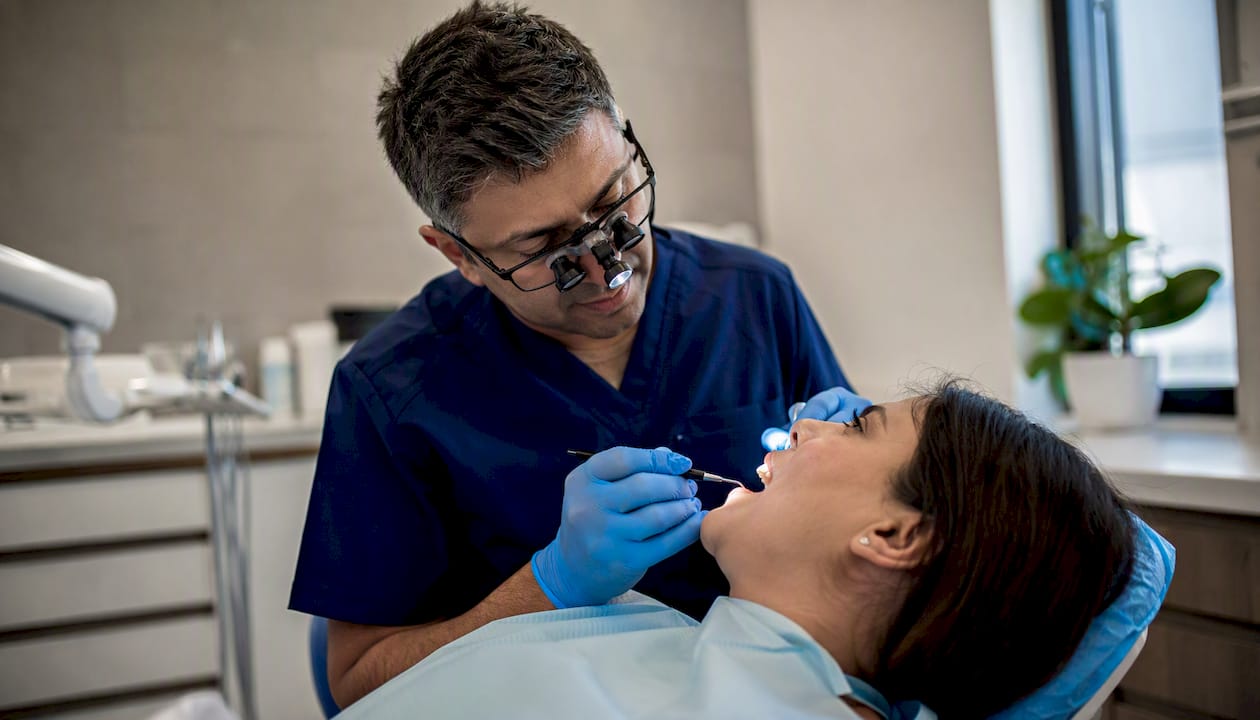
Enamel smoothing (polishing)
For very small chips that leave a rough edge but no exposed dentin, a dentist can simply smooth and polish the surface. No anesthesia, no drilling, one short visit. It is the most conservative option available.
Composite bonding
Composite bonding uses tooth-colored resin sculpted directly onto the tooth to restore its shape and appearance. It is the most common repair for small to moderate chips and is usually completed in a single visit. The resin is matched to your tooth color, hardened with a curing light, and polished smooth.
Pros: Fast, affordable, no tooth reduction required, reversible. Cons: Less durable than porcelain; may stain or chip again over time; typically lasts 5–10 years with good care.
Dental veneers
Veneers are thin porcelain or resin shells bonded to the front surface of a tooth. They are primarily a cosmetic solution for front teeth with moderate chips or visible damage. Lab-made veneers require two visits (impressions, then placement); some practices offer same-day options.
Pros: Natural appearance, stain-resistant porcelain, long-lasting with proper care. Cons: Requires light enamel removal, higher cost than bonding, not suitable for back teeth.
Dental crown
A crown fully encases the tooth above the gumline and is the right choice when a large portion of the tooth is lost or the remaining structure is too weak to hold a filling or veneer. Crowns protect structurally compromised teeth and restore full chewing function. Traditional crowns require two visits; some clinics with chairside CAD/CAM technology can deliver a crown in a single appointment.
Pros: Maximum structural protection, durable (10–15+ years), works on front and back teeth. Cons: Requires significant tooth reduction, higher cost, more invasive than bonding or veneers.
Root canal + crown
When a fracture exposes or infects the pulp, root canal treatment removes the damaged nerve tissue and seals the canal. A crown is then placed to restore the tooth. This is a multi-visit process but saves the natural tooth.
Pros: Eliminates infection, preserves the tooth, restores function. Cons: Multiple visits, higher total cost, tooth becomes more brittle over time without a crown.
Extraction + bridge or dental implant
When a fracture extends below the gumline and the root cannot be saved, extraction is necessary. The tooth can then be replaced with a dental bridge or an implant. Implants are the most durable long-term solution but require several months for osseointegration (the implant fusing with the jawbone) before the final crown is placed.
Pros: Permanent solution, implants preserve bone, bridges are faster. Cons: Implants are the most expensive option and require the longest timeline; bridges involve preparing adjacent teeth.
Pro Tip: Ask your dentist whether a same-day crown is available at their practice. Chairside CAD/CAM technology can cut a multi-week process down to a single afternoon.
Dimension | Bonding | Veneer | Crown | Root canal + crown | Implant |
Chip severity | Minor to moderate | Moderate (cosmetic) | Large or structural | Pulp-exposed | Root-compromised |
Best tooth location | Front or back | Front teeth | Front or back | Any | Any |
Cosmetic outcome | Good | Excellent | Very good | Good (with crown) | Excellent |
Durability | typically several years | often a decade or more | usually a decade or longer | long-term lifespan (with crown) | long-lasting with implants |
Typical U.S. cost ranges widely depending on treatment type and complexity | |||||
Visits / time | 1 visit | 2 visits (or same-day) | 1–2 visits | 2–3 visits | Several months |
Invasiveness | Minimal | Low | Moderate | Moderate to high | Surgical |
How much does chipped tooth repair cost in the U.S.?
Cost is one of the first questions patients ask, and the range is genuinely wide. Procedures vary from a few hundred dollars for bonding to several thousand for implants, depending on the treatment, materials, and your location.
Treatment | Typical U.S. cost range | Visits needed |
Enamel polishing | lower-cost treatment | 1 |
Composite bonding | moderate cost | 1 |
Porcelain veneer | higher cost, multiple visits | 2 (or 1 with CAD/CAM) |
Dental crown | moderate to higher cost, 1–2 visits | |
Root canal | moderate to higher cost, 1–3 visits | |
Root canal + crown | combined procedure, multiple visits | |
Dental implant (full) | higher cost, multiple visits over months | multiple visits needed |
What drives the price up or down?
Material: Porcelain costs more than composite resin; zirconia crowns cost more than PFM (porcelain-fused-to-metal).
Lab vs. same-day: In-office CAD/CAM crowns and veneers skip the lab fee and the temporary restoration, which can reduce cost and time.
Tooth location: Front teeth often require more cosmetic precision, which adds to the fee.
Geographic region: Urban practices in high-cost cities typically charge more than suburban or rural offices.
Complexity: If decay removal, a buildup, or a post is needed before the crown, that adds to the total.
Insurance and out-of-pocket costs
Most dental insurance plans cover a portion of restorative work. Bonding and crowns for structural reasons are often partially covered; purely cosmetic veneers usually are not. Check your plan’s annual maximum and whether a waiting period applies to major restorative work. If you are uninsured, ask your dental office about payment plans or financing options — many practices offer them.
How do dentists decide which repair is right for you?
The decision follows a clear logic, moving from the least invasive option that will actually hold to more involved solutions when needed.
Assess the depth of damage. Is the chip limited to enamel, or does it reach dentin or pulp? X-rays and pulp testing answer this.
Evaluate the tooth’s remaining structure. A tooth with less than half its crown intact usually needs a crown, not bonding.
Consider location and function. Front tooth? Cosmetic outcome matters. Back molar? Durability under chewing load is the priority.
Factor in patient goals and budget. A patient who wants the fastest fix at the lowest cost may choose bonding even knowing it will need replacement sooner. Another patient may prefer a crown for long-term peace of mind.
Recommend conservative to definitive. Dentists generally start with the least invasive option that meets the clinical need.
Three brief case examples
Case 1 — Small front tooth chip: A patient chips the corner of an upper central incisor during a fall. No sensitivity, no pain. The pulp test is normal. The dentist recommends composite bonding: one visit, matched to tooth color, minimal enamel preparation. The patient leaves with a restored smile the same day.
Case 2 — Back tooth cusp fracture: A molar cusp breaks off while chewing. There is sensitivity to cold and mild pain when biting. X-rays show no root involvement. The dentist recommends a crown: the remaining structure is too weak for bonding, and the tooth needs to handle significant chewing force. A same-day CAD/CAM crown is placed in one visit.
Case 3 — Large fracture with pulp exposure: A patient presents with a large fracture on a premolar and throbbing pain. The pulp is exposed and shows signs of infection. The dentist performs root canal treatment over two visits, then places a crown. The tooth is saved and fully functional.
The key trade-off in most cases is upfront cost versus long-term durability. Bonding costs less today but may need replacement over time. A crown costs more upfront but typically lasts many years. For back teeth under heavy load, the crown often costs less over a decade when you account for the likely need to redo bonding.
Pro Tip: If your dentist recommends a crown and you are concerned about cost, ask specifically whether a same-day option is available. It can reduce the total number of visits and, in some cases, the overall fee.
How can you prevent chipped teeth in the future?
Prevention is straightforward once you know the main risk factors.
Wear a mouthguard for contact sports. A custom-fitted guard from your dentist offers better protection than a store-bought boil-and-bite version.
Stop chewing ice, hard candy, and popcorn kernels. These are among the most common causes of chips in otherwise healthy teeth.
Cut hard foods into smaller pieces. Apples, crusty bread, and raw carrots are fine to eat — just reduce the force needed to bite through them.
Address bruxism with a night guard. If you grind or clench at night, a custom night guard distributes the force evenly and protects enamel. Ask your dentist about getting fitted; the process takes one appointment.
Treat cavities promptly. Decay weakens tooth structure from the inside. A small filling placed early is far less costly than a crown placed after the tooth fractures.
Use fluoride toothpaste. Fluoride remineralizes enamel and keeps it stronger over time.
Schedule regular checkups. A dentist can spot early decay, worn enamel, and cracked tooth syndrome before a chip happens.
Pro Tip: If you have had one chip, ask your dentist to check for signs of bruxism at your next visit. Many people grind without knowing it, and a night guard is one of the most cost-effective preventive investments in dentistry.
Key Takeaways
Prompt dental care within 24–48 hours is the single most important step after chipping a tooth — it keeps all repair options open and prevents infection.
Point | Details |
See a dentist within 24–48 hours | Prompt assessment prevents infection and preserves more repair options. |
Save the fragment | Keep it moist in milk or saliva; your dentist may be able to bond it back. |
Treatment tiers by severity | Options range from polishing and bonding to crowns, root canals, and implants. |
Costs vary widely | Bonding and fillings are typically in the low hundreds of dollars, while crowns, veneers, and implants can reach into the thousands, depending on treatment and complexity. |
Mersaldental offers same-day care | Emergency assessments, crowns, bridges, and implants are available at Mersaldental in Ottawa. |
What we see at Mersaldental — and what it means for you
Most chipped teeth we treat fall into two categories: the small cosmetic chip a patient ignored for weeks until sensitivity set in, and the larger fracture that happened suddenly and needed same-day attention. Both are manageable. The difference is almost always how quickly the patient came in.
What strikes us most in practice is how often patients assume a chip is harmless because it does not hurt. Pain is not a reliable indicator of severity. A chip that exposes dentin can allow bacteria to reach the pulp over weeks or months, turning a one-visit bonding case into a root canal and crown. Catching it early is genuinely the better outcome for everyone.
We also see patients who have delayed care because they were unsure what treatment would cost or whether their insurance would cover it. That uncertainty is understandable. Our approach is to walk through the options clearly, explain the trade-offs between cost and longevity, and let you make an informed choice. There is rarely only one right answer. A patient with a chipped front tooth who needs it fixed today for a job interview has different priorities than someone planning a staged restoration over several months.
What we do not do is push the most expensive option when a conservative one will hold. Composite bonding is a genuinely good repair for many chips. So is a well-placed crown for a back tooth under load. The goal is always the treatment that fits your tooth, your function, and your life.
Chipped tooth care at Mersaldental in Ottawa
A chipped tooth does not have to mean a long wait or multiple appointments spread over weeks.

At Mersaldental, we offer same-day emergency assessments and same-day restorations for patients who need prompt care. Whether your chip needs a quick bonding repair or a full crown or bridge restoration, our team handles it in one place, with direct insurance billing and acceptance of the Canadian Dental Care Plan (CDCP) and IFHP. We accept new patients and can often see urgent cases the same day you call.
If you are in the Ottawa area and need an assessment, book your appointment at Mersaldental or contact us directly for emergency care. We will assess the damage, walk you through your options, and get you comfortable as quickly as possible.
Useful sources and further reading
The information in this article is general in nature. An in-person dental assessment is always required to determine the right treatment for your specific situation. The sources below are reliable starting points for further reading.
Fractured tooth/cracked tooth — Cleveland Clinic: Detailed clinical overview of fracture types, symptoms, and treatment options from a major academic medical center.
Broken Tooth Repair — Penn Dental Medicine: Patient-focused guidance on repair options and why even painless chips warrant evaluation.
Four Options For Fixing A Chipped Tooth Fast — Colgate: Consumer-friendly breakdown of bonding, veneers, crowns, and other common repairs.
How much does it cost to fix a chipped tooth without insurance? — Aflac: U.S. cost ranges for common chipped tooth treatments with and without dental insurance.
Chipped tooth — Healthline: Practical first-aid guidance and overview of treatment options reviewed by dental professionals.
How does a dentist fix a chipped tooth? — Dental Made Easy: Clear explanation of the differences between veneers and crowns and when each is appropriate.
Mersal Dental Care — Ottawa: Clinic landing page for booking, emergency care inquiries, and information on accepted insurance programs.
This article is for general informational purposes only and does not constitute professional dental advice. Always consult a licensed dentist (DDS or DMD) to evaluate your specific situation and confirm the appropriate treatment.
Recommended
Comments