Dental Crown Cost: What U.S. Patients Actually Pay


A single dental crown in the United States typically costs several hundred to a few thousand dollars for the crown itself, according to current patient-facing price data. Without insurance, most patients pay somewhere in that range out of pocket. With a typical dental plan covering crowns as a major restorative service at roughly 50% after your deductible, your share often lands near half the crown fee (typically $400–$900 if the crown itself is $800–$1,800), though annual maximums can cap what insurance actually pays.
Two quick scenarios to frame your budget:
Uninsured patient, mid-range crown: A porcelain-fused-to-metal crown at the national midpoint costs roughly a mid-range price out of pocket, all in.
Insured patient (typical major coverage, common annual max, deductible already met): On a crown at this midrange, insurance pays about half, leaving you to pay roughly the same amount. If your annual max is nearly exhausted, you may pay the full price.
The CDT code family (D2710–D2799 for tooth-colored restorations, D2710–D2930 for metal-based) maps each material to a different national median, and state-level cost-of-living multipliers can push prices significantly above or below the national figure. Material choice, your location, and whether you need add-on procedures like a core buildup or root canal are the three biggest levers on your final bill.
Table of Contents
How much does a dental crown cost by material?
Material is the single largest price driver for a crown. Here is a clear breakdown of what patients typically pay, along with the clinical context for each option.
Material | Typical Price Range | Best Use | Aesthetics | Durability / Lifespan | Typical Replacement Cost | Procedure Time |
All-ceramic / E.max (lithium disilicate) | $1,000–$2,000 | Front teeth, premolars | Excellent color match | about a decade or more | $1,000–$2,000 | 2 visits or same-day |
Zirconia | $1,000–$2,500 | Front and back teeth | Very good to excellent | 20 years | $1,000–$2,500 | 2 visits or same-day |
Porcelain-fused-to-metal (PFM) | $800–$1,600 | Back teeth, bridges | Good (metal line visible) | about a decade or more | $800–$1,600 | 2 visits |
Gold / metal alloy | $800–$1,800 | Molars, bruxers | Poor (visible metal) | 20–30+ years | $800–$1,800 | 2 visits |
Stainless steel | roughly $400–$900 | Primary teeth, temporaries | Poor | Short-term | N/A (temporary) | 1 visit |
Same-day CEREC | $1,000–$2,300 | Front and back teeth | Good to excellent | 10–20 years | $1,000–$2,300 | 1 visit |
Key material notes:
E.max (lithium disilicate) is the preferred choice for front teeth because its translucency closely mimics natural enamel. It is slightly less strong than zirconia under heavy bite forces.
Zirconia has become the modern standard for back teeth. It is highly biocompatible and strong enough for molars, and newer monolithic zirconia options have improved aesthetics considerably.
PFM crowns are a reliable, cost-effective option, though the thin metal collar at the gumline can become visible over time as gums recede.
Gold crowns are gentle on opposing teeth and rarely fracture. Their longevity is unmatched, but most patients avoid them on visible teeth.
Same-day CEREC crowns are milled chairside from a ceramic block. They save you a second appointment, though pricing varies by practice and is not always lower than a lab-fabricated crown.
Pro Tip: Paying more upfront for zirconia or gold on a molar can lower your cost per year over a decade. A $1,600 zirconia crown lasting 20 years costs $80 per year. A $900 PFM crown replaced at 10 years costs $90 per year, plus the inconvenience of retreatment.
What drives the final price of your crown?
The crown fee your dentist quotes reflects several overlapping factors. Understanding them helps you interpret competing quotes fairly.
Material and lab fees. As shown above, material is the largest single variable. Beyond material, whether your dentist uses an in-house milling machine or sends the case to an outside dental lab affects cost. Lab fees typically add a sizable amount to the practice’s overhead, and that cost is passed along.
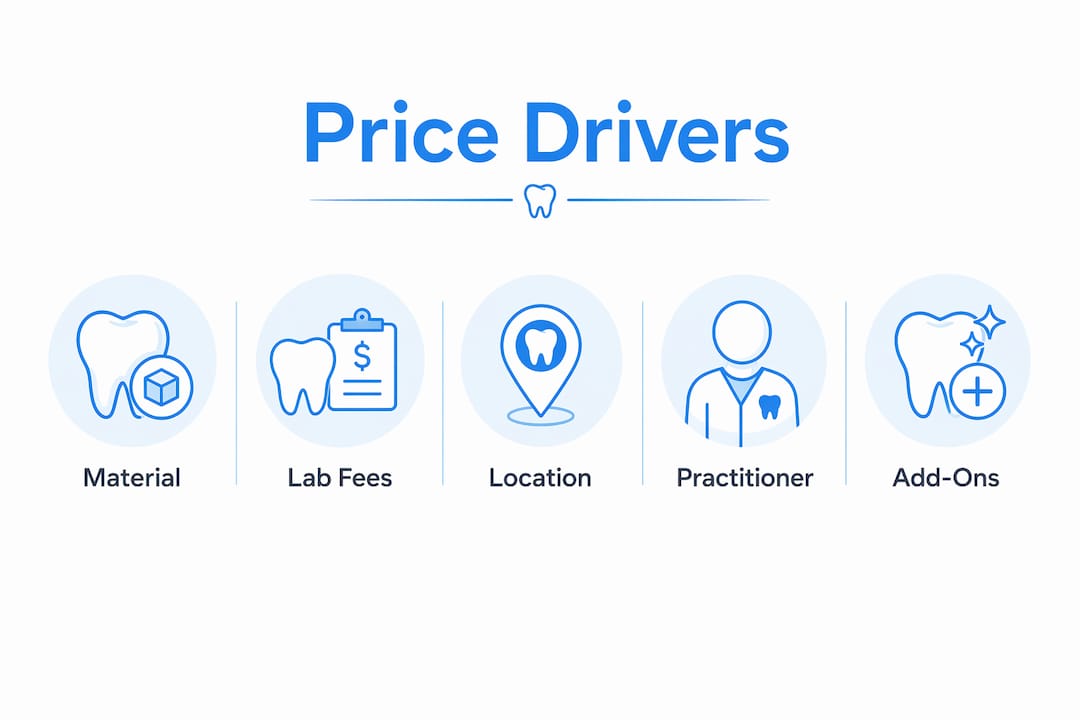
Geographic location. High-cost metros like New York City and San Francisco can run 30–45% above what the same CDT code costs in a lower-cost rural market. State-level relative price parity (RPP) multipliers explain much of this variation. A D2740 all-ceramic crown with a national median near $1,338 might cost $1,700 in Manhattan and $950 in a mid-size Midwestern city.

Practitioner type. A prosthodontist (a specialist in restorations) typically charges more than a general dentist for the same crown. For a straightforward crown on a healthy tooth, a skilled general dentist is usually sufficient. Complex cases, such as a crown on a short or heavily damaged tooth, may genuinely benefit from specialist involvement.
Tooth position. Front teeth (incisors, canines) often require more precise shade matching and aesthetic work, which can add to the lab fee. Molars require stronger materials to handle bite forces. Neither is universally more expensive, but the clinical demands differ.
Practice overhead. A downtown office with digital scanning, CBCT imaging, and a full-time treatment coordinator carries higher overhead than a suburban solo practice. That overhead is reflected in fees.
Add-on procedures. A quoted crown fee almost never includes the cost of a core buildup, post and core, root canal, or crown lengthening. Those are separate line items that can significantly increase your total. See the next section for typical ranges.
How dental insurance usually affects what you pay
Most dental plans classify crowns as major restorative services and cover roughly half of the plan’s allowed amount after your deductible. Annual maximums commonly cap what the insurer pays in a calendar year.
Key insurance concepts to know:
Annual maximum: Once your plan pays out its maximum (often $1,500), you pay 100% of remaining costs that year. If you need a crown and a root canal in the same year, the maximum can be exhausted quickly.
Deductible: Most plans require you to meet a deductible (often $50–$150) before major coverage kicks in.
Waiting periods: Many plans impose a 6–12 month waiting period before major restorative benefits apply. If you enrolled recently, a crown may not be covered yet.
Frequency/replacement limitations: Most plans will not cover a replacement crown on the same tooth for 5–7 years.
LEAT (Least Expensive Alternative Treatment): Some insurers apply this rule, meaning if a filling is deemed an acceptable treatment, they will only reimburse at the filling rate even if your dentist recommends a crown. Always verify your plan’s LEAT clause before assuming full major-service coverage.
In-network vs. out-of-network: In-network dentists have negotiated fee schedules, so the allowed amount is lower and your 50% share is smaller. Out-of-network dentists may charge above the allowed amount, leaving you responsible for the balance.
Example cost scenario:
Item | Fee | Insurance pays (50%) | Your share |
Crown (D2740) | $1,400 | roughly half the crown fee | roughly half the crown fee |
Core buildup (D2950) | roughly $400–$900 | $150 | $150 |
Total | $1,700 | roughly $400–$900 | roughly $400–$900 |
Assumes deductible is already met, annual max is $1,500, and no LEAT clause applies. If only $500 of the annual max remains, insurance pays $500 and you pay $1,200.
Pro Tip: Before agreeing to treatment, ask your dentist’s office to submit a pre-treatment estimate (also called a predetermination or preauthorization) to your insurer. This gives you a written breakdown of what the plan will pay before any work begins, so there are no surprises at checkout.
Other procedures that commonly add to your total bill
A crown fee covers tooth preparation, impressions or digital scanning, a temporary crown, lab fabrication, and final cementation. It does not cover the procedures below, which are billed separately and can significantly increase your out-of-pocket cost.
Common add-on procedures and why they arise:
Core buildup (D2950): When a tooth has lost significant structure to decay or a large old filling, the dentist builds up a foundation before placing the crown. Deep decay or a fractured cusp usually triggers this.
Post and core (D2952/D2954): After a root canal, the hollow root canal space may need a post inserted to anchor the core buildup. Required when little natural tooth structure remains above the gumline.
Root canal (D3310–D3330): If the tooth’s nerve is infected or the pulp is exposed, a root canal is needed before the crown. This is the most expensive add-on and the most common reason a simple crown becomes a complex case.
Crown lengthening (D4249): When a tooth fractures below the gumline, a periodontist may need to surgically expose more tooth structure before a crown can be placed.
Temporary crown (D2999): Usually included in the crown fee, but some practices bill it separately, particularly for complex cases requiring an extended temporary phase.
CBCT imaging (D0364–D0368): Cone beam CT imaging may be ordered to assess bone levels or root anatomy before complex restorative work. Billed separately.
Add-on Procedure | Typical U.S. Price Range |
Core buildup | moderate price range |
Post and core | moderate price range |
Root canal (anterior) | moderate to higher price range |
Root canal (molar) | higher price range |
Crown lengthening | moderate to higher price range |
Temporary crown (if separate) | lower price range |
CBCT imaging | moderate price range |
A heavily damaged tooth requiring a crown plus buildup and root canal can total $2,500–$3,600, according to patient-facing cost data. Always ask whether your quote is for the crown only or the complete restoration.
How long do crowns last and what does replacement cost?
A well-placed crown on a properly prepared tooth can last many years. Gold crowns are known to have longer documented lifespans in some cases. Quality crowns are genuinely a long-term investment, not a short-term fix.
Typical lifespan by material:
Zirconia: often lasts well over a decade with proper care
E.max / all-ceramic: often lasts about a decade or more; slightly more prone to chipping under heavy forces
PFM: generally lasts about a decade or more; metal substructure is durable but porcelain veneer can chip
Gold / metal alloy: known for very long lifespans; rarely fractures
Same-day CEREC ceramic: typically lasts about a decade or more depending on material block and fit
Common reasons crowns need replacement:
Wear or fracture of the porcelain layer (especially in patients who grind their teeth)
Recurrent decay at the crown margin if oral hygiene lapses
Gum recession exposing the margin and creating a cosmetic or functional issue
Crown loosening due to cement failure
Replacement costs mirror original crown costs. If you paid $1,400 for a zirconia crown today, expect a similar range when it eventually needs replacement, adjusted for inflation and any changes in your tooth’s condition.
Pro Tip: If you grind your teeth, a night guard is one of the most cost-effective investments you can make after a crown. Bruxism is a leading cause of premature crown fracture. A custom night guard usually costs a few hundred dollars and can add years to a crown’s life.
Practical ways to lower or finance the cost
Dental crown prices are not fixed. Several legitimate strategies can reduce what you pay or spread the cost without delaying care you need.
Lower-cost options:
Dental school clinics: Supervised dental students place crowns typically at significantly lower costs compared with private practices. Treatment takes longer and requires more appointments, but the clinical quality is supervised by licensed faculty.
Community health centers: Federally Qualified Health Centers (FQHCs) offer sliding-scale fees based on income. Find one at findahealthcenter.hrsa.gov.
Discount dental plans: These are not insurance. You pay an annual membership fee and receive negotiated rates at participating dentists. Savings vary widely, so compare the discounted crown fee against the membership cost before enrolling.
Choose the right material for the clinical need: Not every tooth needs the most expensive option. A gold crown on a second molar that no one sees may cost less than a zirconia crown and last longer.
Financing options:
CareCredit: A healthcare credit card offering promotional deferred-interest periods (often 6–24 months). Useful if you can pay the balance before the promotional period ends. If you carry a balance past that date, retroactive interest applies.
In-office payment plans: Many practices offer their own installment arrangements, sometimes interest-free for shorter terms. Ask the front desk directly.
HSA/FSA: Health Savings Accounts and Flexible Spending Accounts accept dental crown costs as qualified medical expenses. Using pre-tax dollars effectively reduces your cost by your marginal tax rate.
CDCP and IFHP programs: If you qualify for government assistance programs, Mersaldental accepts both the Canadian Dental Care Plan and IFHP, which can substantially reduce out-of-pocket costs for eligible patients.
Scheduling tactic: If you need two crowns, consider placing one before December 31 and the second in January to use two separate annual insurance maximums. Ask your dentist about phased treatment and whether the clinical situation allows it.
Pro Tip: Delaying a crown because of cost often leads to a more expensive outcome. A tooth that needs a crown today may need a root canal and buildup in six months if decay progresses. Financing the treatment now is almost always less expensive than treating the emergency later.
Crown vs. implant: which makes more financial sense?
When a tooth is severely damaged, patients sometimes face a choice between saving it with a crown (and possibly a root canal) versus extracting it and placing a dental implant. The financial comparison is not as straightforward as it first appears.
Upfront cost comparison:
Option | Typical Upfront Cost | Long-Term Replacement | Notes |
Crown only | moderate to mid-range cost | similar cost at replacement after many years | Assumes healthy tooth structure |
Crown + root canal + buildup | higher total cost | similar at replacement | Complex but tooth-preserving |
Extraction + implant + abutment + crown | higher upfront cost | implant body rarely replaced | Higher upfront, potentially lower long-term |
When a crown is the right choice:
The tooth has sufficient healthy root structure and bone support
The root canal has a good prognosis
The patient wants to preserve natural tooth structure
Budget constraints make the lower upfront cost necessary
When an implant may be the better long-term investment:
The tooth is non-restorable (root fracture, severe bone loss)
A root canal has failed and retreatment is not viable
The patient is planning long-term and wants to avoid repeated crown replacements
Adjacent teeth are healthy and should not be used as bridge anchors
For a deeper look at the clinical and financial tradeoffs, the bridge or implant comparison covers the decision in detail. You can also review dental implant cost ranges to build a side-by-side budget estimate.
What the treatment timeline looks like
Understanding the timeline helps you plan around work, travel, and insurance benefit years.
Standard two-visit workflow:
Visit 1 (Prep appointment): The dentist removes decay, shapes the tooth, takes a digital scan or physical impression, places a temporary crown, and sends the case to the lab.
Lab turnaround: Typically about one to several weeks for a traditional dental lab. Some practices use premium labs with faster turnaround.
Visit 2 (Seating appointment): The temporary is removed, the permanent crown is tried in, adjusted, and cemented.
Same-day CEREC workflow:
The dentist scans the tooth digitally, designs the crown on-screen, and mills it chairside from a ceramic block. The entire process takes 1–2 hours in a single appointment. No temporary crown is needed, and there is no lab wait.
Does same-day cost more? Sometimes. Practices that have invested in CEREC equipment may charge a convenience premium. Others pass along lab-fee savings. The price range for same-day crowns typically falls between $1,000–$2,300, overlapping with traditional lab-fabricated options. Same-day is not always available for every clinical situation, particularly when significant gum tissue management is needed.
Pro Tip: When calling to schedule, ask directly: “Do you offer same-day crowns, and if so, can you give me a price comparison between same-day and lab-fabricated for my specific tooth?” A practice that offers both should be able to give you a direct comparison on the estimate.
Exactly what to ask before agreeing to treatment
Getting a clear, itemized estimate before treatment begins is the single most effective way to avoid a surprise bill. Here is what to ask for and how to ask it.
Your pre-treatment checklist:
[ ] Written estimate with each procedure listed as a separate line item
[ ] CDT code for every procedure (e.g., D2740 for all-ceramic crown, D2950 for core buildup)
[ ] Tooth number documented on the estimate
[ ] Lab or manufacturer information for the crown material (relevant for warranty and quality)
[ ] Confirmation of whether the quote is “crown only” or “complete restoration”
[ ] Expected timeline from prep to seating
[ ] Whether a preauthorization will be submitted to your insurer before treatment begins
Questions to ask the front desk:
“Can I get a written estimate with CDT codes for every procedure before I schedule?”
“Will you submit a predetermination to my insurance so I know what they’ll cover in advance?”
“Is the quoted fee for the crown only, or does it include the buildup and any other procedures?”
“Is this dentist in-network with my plan?”
Questions to ask the dentist:
“Is there any chance I’ll need a root canal before the crown? If so, what’s the likelihood and the additional cost?”
“What material are you recommending for this tooth and why?”
“Do you offer same-day crowns, and is that an option for my case?”
A CDT-coded written estimate plus insurer preauthorization is the most reliable way to prevent a multi-part treatment from producing an unexpected bill. Ask for both in writing before any preparation begins.
Pro Tip: When the preauthorization comes back from your insurer, read it carefully. It will show the allowed amount, your estimated patient portion, and any clauses (like LEAT) that reduce coverage. If the insurer applies a LEAT clause, ask your dentist to submit a narrative explaining why a crown is clinically necessary rather than a filling.
Key Takeaways
A dental crown in the U.S. typically costs $800–$1,800 for the crown itself, but total treatment for a damaged tooth can reach $2,500–$3,600 when a root canal and buildup are needed.
Point | Details |
Typical crown price range | A single crown runs $800–$1,800; total complex treatment can reach $2,500–$3,600. |
Biggest cost drivers | Material choice, geographic location (up to 30–45% variation), and add-on procedures like root canals drive the largest price swings. |
Insurance reality | Most plans cover roughly half of the plan’s allowed amount for major restorative work; annual maximums often cap what the insurer actually pays. |
Financing options | CareCredit, HSA/FSA funds, in-office payment plans, and dental school clinics ($400–$800) are all legitimate ways to reduce or spread the cost. |
Mersaldental | Mersaldental offers crowns with direct insurance billing and same-day treatment options in Ottawa, making it straightforward to get an itemized estimate and confirm coverage before treatment begins. |
Why cost transparency matters more than the crown itself
Patients often come in focused on the crown price, and that is completely understandable. But in our experience, the cases that cause the most financial stress are not the ones where the crown was expensive. They are the ones where the patient was quoted a crown fee, agreed to treatment, and then discovered at checkout that the buildup, the root canal, and the temporary were all separate charges they had not anticipated.
The clinical quality of a crown matters enormously. A well-fitting, properly cemented crown on a clean margin can last 20 years. A poorly adapted crown placed on a compromised tooth may fail in two. But the single thing that most consistently determines whether a patient feels good about their experience is whether they understood the full cost before the first drill touched their tooth.
We believe every patient deserves a written, CDT-coded estimate that covers every foreseeable procedure, a preauthorization from their insurer if they have coverage, and a clear answer to the question: “Is this the complete cost, or could there be more?” That is not a high bar. It is just honest care.
Mersaldental is ready to help you plan your crown treatment
If you have been putting off a crown because you are not sure what it will cost or how your insurance applies, we can help you get clarity before you commit to anything.
At Mersaldental, we offer crown and bridge treatments with direct insurance billing, so you are not left guessing about your out-of-pocket costs. We accept most major dental plans, bill your insurer directly, and can help you understand your coverage before treatment begins. We also accept the CDCP and IFHP programs for eligible patients. Same-day treatment options are available for patients who need efficient, comfortable care without multiple trips.
We are accepting new patients at our downtown Ottawa location. Contact us to request an itemized estimate, confirm your insurance benefits, or book a consultation. Getting a clear picture of your costs is the first step, and we make that part easy.
Trusted sources and tools for further research
Use these resources to check national averages, state-level pricing, and official clinical guidance before your appointment.
Public and clinical resources:
ADA Health Policy Institute (ada.org) — Publishes dentist fee surveys and dental spending data by procedure and region.
Cleveland Clinic: Dental Crowns (clevelandclinic.org) — Clear clinical overview of crown types, indications, and what to expect from the procedure.
FDA: Dental Cone Beam CT (fda.gov) — Official guidance on CBCT imaging used in complex restorative planning.
Medicare.gov: Dental Services (medicare.gov) — Explains what traditional Medicare covers (and does not cover) for dental procedures.
CDC: Dental Visits FastStats (cdc.gov) — National data on dental utilization and access to care.
For localized cost estimates:
Ask your dentist’s office for a written estimate with CDT codes before scheduling.
Request a predetermination from your insurer to see your exact out-of-pocket before treatment.
Visit Mersaldental’s services page for information on what we offer and how to book a consultation.
Recommended
Comments