Dental Implant Cost in the U.S.: 2025–2026 Guide

Updated: Jul 22

How much does a dental implant cost?
A complete dental implant, meaning the titanium post, abutment, and crown together, carries a nationwide median cost of $4,000. That figure, however, tells only part of the story. Where you live and who places the implant can shift your final bill by thousands of dollars.
Regional pricing from a 2025 survey of 278 U.S. dental practices shows just how wide that spread is:
Minneapolis: among the highest median total costs nationally
Chicago: higher-than-average median cost
San Francisco: near the national median cost
Philadelphia: slightly below national median
Denver: slightly below national median
Houston: lowest median cost among surveyed cities
Provider type moves the needle just as much as geography. Specialist-performed implants carry a median cost of $3,400, compared to $4,800 when a general dentist performs the surgery. That 29% difference is largely explained by higher case volume and efficient surgical workflows among specialists.
Quick note on state-level pricing: CareCredit’s per-state data tracks the implant post alone, without the crown. Alabama averages $1,790 for the post; Hawaii reaches $3,565. Add crown costs, which can vary by material and provider, to get a more realistic total for your state.
What goes into the price of a dental implant?
The sticker price you see advertised often covers only the implant fixture. A complete treatment involves several separately billed components, and knowing each one helps you read a quote accurately.
Core components:
Implant post (fixture): $1,000–$2,500. This is the titanium or zirconia screw placed into the jawbone.
Abutment: $300–$800. The connector piece between the post and the crown.
Crown: $1,000–$3,000. The visible tooth-shaped cap, available in porcelain-fused-to-metal, monolithic zirconia, or layered all-ceramic.
Common add-on procedures that raise the total:
3D CBCT imaging: $200–$500
Tooth extraction: $200–$700
Bone graft: $300–$3,000 (or $549–$5,148 per site depending on the specific CDT procedure billed)
Sinus lift: $1,500–$5,000 for upper rear teeth
Sedation: $200–$1,200
A complex case requiring bone grafting, a sinus lift, and sedation can add several thousand dollars on top of the base implant cost. Some practices bundle everything into one quoted price; others bill each component separately. Always request an itemized treatment plan before you sign anything.
What factors affect how much you pay?
Beyond the components themselves, several external factors shape what you’ll actually be quoted.
Key pricing variables:
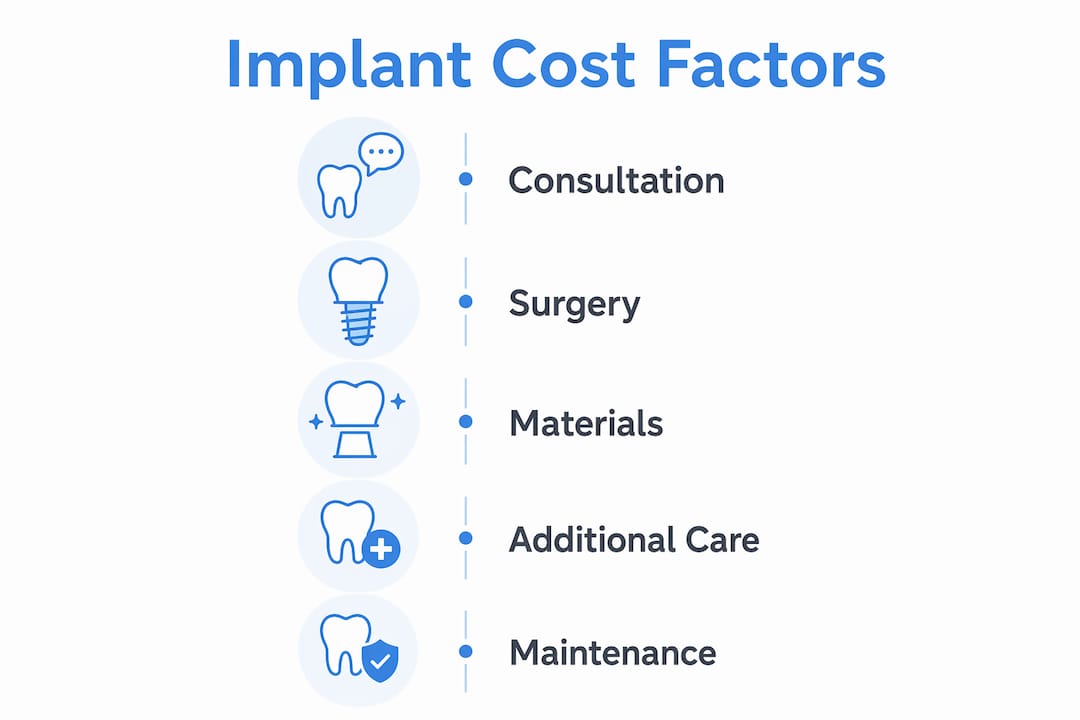
Geographic location: Major metro areas run 30–60% higher than mid-sized cities. A single-tooth implant priced at $3,000 in a rural practice can reach $5,500 in a coastal urban market.
Provider type: Specialists (oral surgeons, periodontists) tend to charge less per case than general dentists, as noted above.
Procedure complexity: Patients with bone loss or active gum disease require preparatory work that adds both time and cost. If bone loss affects your jaw, grafting is often unavoidable.
Materials: Zirconia posts cost $500–$1,500 more than titanium for a single-tooth case. Crown material choice also affects the final price.
Insurance coverage: Many plans classify implants as elective. Some plans cover 50% of the implant or crown cost, but annual maximums of $1,000–$2,500 mean most patients still pay a significant portion out of pocket.
Financing: CareCredit and similar health financing programs let patients spread costs over time, which is worth exploring if paying in full upfront isn’t realistic.
A Flexible Spending Account (FSA) through your employer can also offset costs, since dental implants qualify as an eligible medical expense under FSA guidelines.
What does the implant procedure actually involve?
The dental implant process is not a single appointment. It unfolds in stages, and understanding the timeline helps you plan both your schedule and your budget.
Typical treatment steps:
Consultation and imaging: Your dentist or oral surgeon takes X-rays or a 3D CBCT scan to assess bone volume and plan placement.
Extraction (if needed): A damaged tooth is removed before or at the same time as implant placement.
Bone grafting (if needed): If bone volume is insufficient, grafting is performed and allowed to heal before the implant is placed.
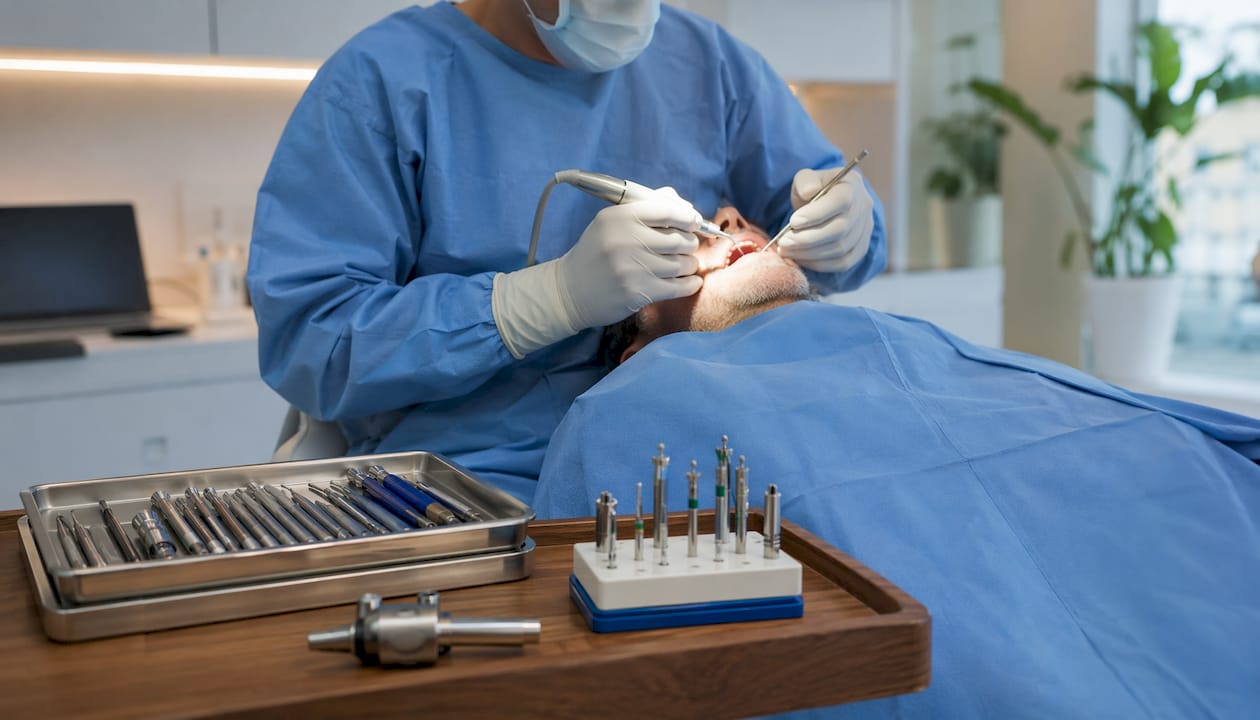
Implant placement: The titanium post is surgically inserted into the jawbone under local anesthesia or sedation.
Osseointegration (healing): The implant fuses with the bone over several months. This stage cannot be rushed.
Abutment and crown fitting: Once the implant is stable, the abutment is attached and the final crown is placed.
The full treatment timeline spans several months from first consultation to final restoration. Each stage adds a fee, which is why the total cost often surprises patients who were quoted only the implant post price.

Expert guidance on getting a fair price
The single most useful thing you can do before committing to treatment is ask for a complete, written quote that lists every line item.
Providers offering all-in-one pricing that bundles the oral surgeon, prosthodontist, and lab fees into a single number make financial planning much simpler and reduce the risk of unexpected bills arriving weeks after surgery.
Pro Tip: Use a dental implant cost estimator to benchmark the quote you receive against typical U.S. ranges for your region and implant type before you agree to treatment.
How much does full-mouth implant restoration cost?
Replacing every tooth in both arches is a major investment. Costs vary widely based on the restoration type chosen.
Restoration type | Typical cost range |
All-on-4 (per arch) | generally ranges in the mid- to high five-figure range |
All-on-6 / All-on-8 (per arch) | tends to cost more than All-on-4 due to additional implants |
3-on-6 (per arch) | varies widely depending on case complexity and materials |
Implant-retained denture (per arch) | covers a range from lower-cost removable to higher-cost fixed options |
Full-mouth (both arches, fixed) | typically involves a significant investment that can reach into the higher five figures or more |
All-on-4 uses four implants per arch to support a fixed prosthesis, making it one of the more cost-effective full-arch options. All-on-6 and All-on-8 use more implants for added stability and suit patients with better bone quality or heavier bite forces. Full-mouth reconstruction using individual crown-on-implant restorations sits at the top of the range, often $60,000–$90,000 when combined with zirconia prosthetics and advanced grafting. If you currently wear dentures and are considering an upgrade, implants with dentures is a common starting point worth discussing with your provider.
How do implants compare to other tooth replacement options?
Dental implants cost more upfront than bridges or dentures, but the long-term picture is different.
Option | Typical cost | Lifespan |
Single dental implant | $3,000–$5,500 | 15+ years with proper care |
Implant-supported bridge | $4,000–$15,000 | 10–15 years |
Traditional dental bridge | $2,500–$5,000 | 10–15 years |
Full dentures | $1,500–$3,000 | 5–10 years |
A traditional bridge requires grinding down the two healthy teeth on either side of the gap. Dentures need periodic relining and replacement. Implants, by contrast, preserve the jawbone and function like natural teeth. The bridge vs. implant decision often comes down to bone health, budget, and how long you want the solution to last.
Long-term maintenance costs and warranty considerations
An implant is not a one-time expense. Ongoing care affects both the longevity of the implant and your total lifetime cost.
Routine professional cleanings twice a year remain necessary, and your dentist will monitor the implant site at each visit. Crown replacement is the most common long-term cost: crowns typically last 10–15 years before they need to be replaced, at a cost of $1,000–$3,000 depending on material. The titanium post itself, if properly integrated, can last a lifetime.
Some practices offer warranties on the implant post or the prosthetic components. Ask specifically what the warranty covers, for how long, and whether it transfers if you move or change providers. A warranty that covers only the lab-fabricated crown is very different from one that covers the surgical placement. Patients with gum disease face a higher risk of peri-implantitis, an infection around the implant that can lead to failure if untreated, so ongoing periodontal maintenance is particularly important for that group.
Key Takeaways
The nationwide median dental implant cost is $4,000 for a complete single-tooth restoration, but specialist providers, regional pricing, and bundled billing can shift your actual cost by thousands of dollars in either direction.
Point | Details |
National median cost | A complete implant (post, abutment, crown) costs a median of $4,000 nationwide. |
Specialist pricing advantage | Specialists charge a median of $3,400 vs. $4,800 for general dentists, a 29% difference. |
Regional variation | — |
Full-mouth restoration range | Full-mouth fixed restorations often cost $60,000–$90,000 when using zirconia and advanced grafting, while all-on-4 per arch typically falls in the mid- to high five-figure range. |
Request itemized quotes | Ask for a written breakdown covering post, abutment, crown, imaging, grafting, and sedation. |
Ready to get a clear, honest quote?
We welcome patients at Mersaldental who want straightforward answers about implant pricing before committing to treatment. Our team offers direct insurance billing, accepts the CDCP program, and provides same-day consultations for patients in the Ottawa area. Book a consultation and get a complete, itemized estimate so you know exactly what to expect. You can also explore our CDCP and IFHP programs to see whether government coverage applies to your situation.
Recommended
Comments