How Often Do You Really Need Dental X-Rays?

There is no single schedule for dental X-rays. Frequency depends on your age, your caries risk, and what your dentist finds during an exam, and many healthy adults do not need X-rays every year.
Here is the baseline most patients can expect, based on caries risk and clinical guidelines:
Children (higher risk): typically require more frequent X-rays; lower risk children need them less often.
Teens: may require dental X-rays more frequently based on cavity risk.
Adults with active decay or dental work in progress: often need X-rays at shorter intervals.
Low-risk adults with healthy, stable teeth: usually need dental X-rays less frequently.
Bitewing X-rays are the only type with a defined interval range tied to caries risk. Panoramic and full-mouth images do not follow a routine schedule at all. The ADA’s 2026 guidance is direct on this point: X-rays should be ordered only when the results are expected to change your care, a principle known as ALARA (As Low As Reasonably Achievable). Bring this up at your next cleaning. Ask your dentist which risk category you fall into and why.
Key Takeaways
Dental X-ray frequency should always track caries risk and clinical findings rather than a fixed calendar, with bitewings the only exam type carrying a standard interval range.
Point | Details |
No universal schedule | Intervals depend on age, caries risk, and exam findings, not a fixed yearly rule. |
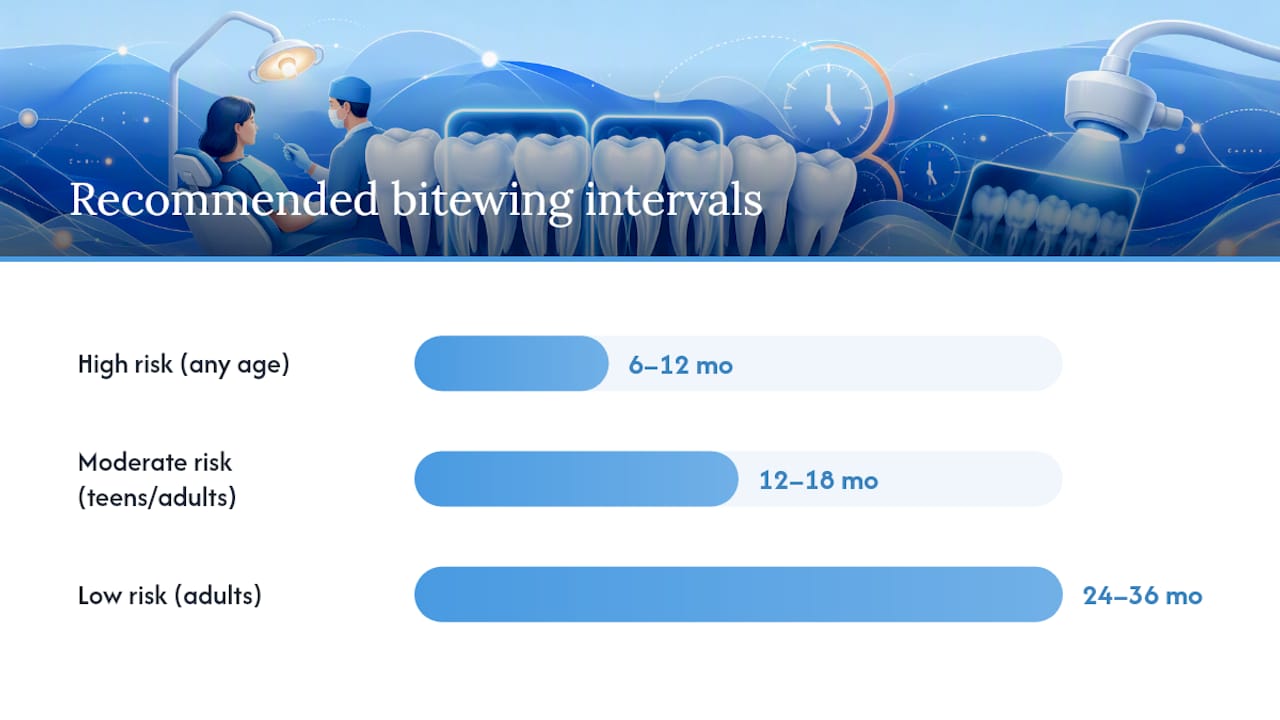
Bitewing ranges by risk | High risk: 6 to 12 months; moderate: 12 to 18 months; low risk: 24 to 36 months. |
Panoramic images are situational | Ordered only for a specific diagnostic reason, never on a routine repeat schedule. |
Digital imaging lowers dose | Digital sensors can cut radiation exposure by roughly 40 to 60% compared to film. |
Mersaldental follows ALARA | The Ottawa clinic uses digital imaging, direct insurance billing, and CDCP/IFHP acceptance. |
Table of Contents
What Determines Dental X-Ray Frequency?
Your dentist isn’t guessing when they recommend X-rays on a certain timeline. They’re weighing several concrete risk factors, and understanding them helps you evaluate whether a recommendation makes sense for you.
Caries risk sits at the top of the list. A patient with a history of multiple cavities, visible demineralization, a sugar-heavy diet, inconsistent brushing, low fluoride exposure, or dry mouth from medication faces a higher risk of new decay forming between visits. Orthodontic hardware also raises risk, since brackets and wires trap plaque in spots a toothbrush can’t reach easily. Someone with none of these factors and a clean exam history can often go longer between images.
Age changes the calculus, too. Children and teens have developing dentition. New teeth erupt, baby teeth are lost, and jaw growth shifts tooth positions, so closer monitoring catches problems while they’re still small and easy to treat. Adults with stable, fully erupted teeth and no active disease need far less frequent imaging. Older adults often fall somewhere in between: their natural teeth are stable, but existing crowns, bridges, and fillings can fail over time and sometimes warrant a look sooner than the routine schedule would suggest.
Symptoms override the calendar. Pain, swelling, a cracked tooth, or a restoration that looks like it’s failing on visual exam are all reasons to image now, regardless of when the last set of bitewings was taken. This is diagnostic imaging responding to a specific clinical question, not routine surveillance.
One factor that works in your favor: if you have recent, high-quality images already on file, your dentist may not need new ones at all. Bringing prior films to a new provider, or having your old office transfer them digitally, can spare you an unnecessary exposure.
Recommended Intervals by Age and Risk Group
Bitewing intervals map fairly closely to caries risk, and the ADA’s radiographic examination guidelines treat this as the one imaging type with a defined range worth memorizing:
High caries risk (children and adults): bitewings every 6 to 12 months. This applies to anyone with active decay, multiple recent fillings, or poor plaque control. The short interval catches new cavities while they’re still small enough to treat with a filling instead of a crown or root canal.
Moderate caries risk: bitewings every 12 to 18 months. This is a common category for teens with braces or adults with a mixed history of good and problem years.
Low caries risk: bitewings every 24 to 36 months. A patient with no cavities in years, solid home care, and no risk factors on the list above fits here. Some low-risk adults may go even longer if their clinical exam stays clean.
Panoramic X-rays and full-mouth series (FMX) don’t follow a fixed interval at all. A dentist orders a panoramic image for a specific reason: wisdom tooth evaluation, implant planning, jaw pain investigation, or a baseline before orthodontic treatment. Once that question is answered, there’s no routine reason to repeat it on a schedule.
A few scenarios make this concrete:
Scenario one: a healthy adult at a routine recall visit. No pain, no new restorations, clean exam for the past three years. This patient likely falls into the low-risk bitewing interval, once every 24 to 36 months, and probably doesn’t need a panoramic image at all unless something specific comes up.
Scenario two: an adult who just had two new cavities filled. This shifts them into the moderate or high-risk category depending on the rest of their history. Expect bitewings closer to the 12-month mark, at least until a couple of clean checkups reset the risk assessment.
Scenario three: a child with active decay, or a teen mid-treatment in braces. Both fit the high-risk category. Expect bitewings every 6 to 12 months, plus targeted images if a specific tooth is flagged during the exam.
Is Dental X-Ray Radiation Actually Something to Worry About?
Short answer: modern dental imaging carries a small dose, and that dose keeps shrinking as clinics upgrade equipment. ALARA is the governing principle behind every radiograph a dentist orders. It requires that imaging be justified by a real diagnostic need and optimized to use the lowest dose that still produces a usable image, a standard echoed in Health Canada’s radiological protection guidance.
Digital imaging has changed the math substantially. Switching from conventional film to digital sensors cuts radiation dose by roughly 40 to 60%, and dental radiographs typically represent a small fraction of a person’s total annual radiation exposure from all sources combined.
Clinics that follow current best practices reduce dose several ways at once:
Digital receptors instead of film, cutting exposure nearly in half in many cases.
F-speed film or digital sensors, the fastest receptors compatible with a diagnostic image.
Rectangular collimation, which shapes the X-ray beam to the size of the receptor instead of blasting a wider circular field.
Thyroid collars and lead aprons, standard shielding for the thyroid gland and torso during exposure.
None of this means radiographs are handed out casually. It means the ones a dentist does order are calibrated to answer a specific question with the smallest reasonable dose, and a well-equipped clinic can tell you exactly which of these measures they use.
How Dentists Decide, and What to Ask Before Saying Yes
Every recommendation for a new X-ray follows a workflow, even when it happens fast during a routine cleaning. Your dentist reviews your medical and dental history, examines your mouth, checks whatever prior images are already on file, and weighs your current caries risk against what a new image would actually reveal. If the expected diagnostic benefit doesn’t clear that bar, the guidance from the ADA is that the X-ray shouldn’t be ordered at all.
You have a real say in this conversation. Four questions worth asking at your next visit:
“What will this X-ray show that changes my treatment plan?”
“Do you already have my prior images on file, or from my last dentist?”
“Are you using digital, low-dose imaging?”
“Given my risk level, is it reasonable to wait until my next visit?”
Pro Tip: If you’re switching dentists, ask your previous office to transfer your X-rays digitally before your first visit. A same-day request usually takes minutes and can save you an unnecessary exposure on day one.
Special Situations That Change the Schedule
A few circumstances pull patients off the standard interval entirely, and it’s worth knowing which ones apply to you.
Children and teens: ongoing eruption and jaw growth mean dentists monitor more closely, since problems caught early during development are far easier to treat.
Pregnancy: elective dental radiographs are generally postponed, though necessary imaging proceeds with shielding and clinical judgment when a real issue needs diagnosis.
Implants and orthodontic planning: these require baseline images upfront for treatment planning, then specific follow-up images tied to milestones rather than a routine calendar.
Dental trauma or emergencies: a cracked tooth, an injury, or sudden swelling calls for imaging right away, independent of when the last routine set was taken.
How Mersaldental Applies This Guidance
Mersaldental is a full-service family dental office in downtown Ottawa, and we build our imaging decisions around the same evidence-based framework covered above. A few things that matter for how this plays out in your appointment:
We accept new patients and offer same-day and emergency dental care, so urgent imaging needs don’t wait for a routine slot.
We bill insurance directly and accept CDCP and IFHP, which affects what imaging is covered and when.
Our team uses digital imaging and follows ALARA principles when deciding what to order and how often.
Our patient education resources, including why dental X-rays matter and what causes tooth pain when biting down, go deeper on specific clinical scenarios.
What Patients Consistently Get Wrong About X-Ray Frequency
The biggest misconception isn’t about radiation risk. It’s the assumption that X-rays are an automatic part of every checkup, like a cleaning or a fluoride treatment. They aren’t, and treating them that way skips the actual clinical reasoning behind the recommendation.
The conventional advice patients hear, “get X-rays once a year,” oversimplifies a decision that should be individualized. A low-risk adult with a clean exam history and no symptoms often doesn’t need annual imaging, and the PMC pediatric exposure data makes the same point for children: exposure should scale to actual risk, not a default interval applied to every patient the same way.
What should patients prioritize first? Ask your dentist to explain your specific risk category, not just accept a recommended date on the calendar. A good clinician will walk you through why they’re proposing a particular interval, and a good patient should feel comfortable asking for that explanation before agreeing to imaging that isn’t clearly justified.
Book Your Next Cleaning and Imaging Review With Mersaldental
If you’re unsure where you fall on the risk scale, or it’s simply been a while since your last set of images, that question is best answered in the chair, not by guessing at a schedule online.
Mersaldental follows the same evidence-based approach covered in this guide: digital imaging, ALARA-aligned decisions, and X-rays ordered only when they’ll actually change your treatment plan. We accept new patients, bill most insurance plans directly, and accept both CDCP and IFHP, so cost rarely has to be a barrier to getting the right imaging at the right time. Same-day and emergency appointments are also available if pain or an injury means imaging can’t wait for a routine slot.
Ready to find out where you stand? Book an appointment with Mersaldental and ask your dentist to walk you through your personal risk assessment at your next visit.
Frequently Asked Questions
Do I need dental X-rays every time I get a cleaning? No. Most low-risk adults only need bitewing X-rays every 24 to 36 months, not at every cleaning. Your dentist will tell you if your exam findings warrant new images sooner.
How often should children get dental X-rays? Children at higher caries risk typically need bitewings every 6 to 12 months, while lower-risk kids may go 12 to 24 months between images, largely because of ongoing tooth eruption and growth.
Are dental X-rays safe during pregnancy? Elective dental radiographs are usually postponed during pregnancy, but necessary imaging can proceed with proper shielding and your dentist’s clinical judgment if a real dental problem needs diagnosis.
What’s the difference between bitewing, panoramic, and full-mouth X-rays? Bitewings check for cavities between back teeth and follow a caries-risk-based interval. Panoramic and full-mouth images capture a wider view for planning purposes, like implants or wisdom teeth, and are ordered only when clinically needed, not on a routine schedule.
Can I refuse a recommended dental X-ray? You can discuss it with your dentist, especially if you have recent prior images or feel your risk doesn’t justify new exposure. Ask what the image would show and how it would change your care before deciding.
This article is general information, not a substitute for advice from a qualified doctor. Consult a qualified healthcare professional about your own circumstances before acting on anything here.
Sources
Recommended
Comments