Dentist Direct Billing: Pay Less at Your Appointment


Dentist direct billing lets your dental office submit your insurance claim electronically so you typically pay only your patient portion at the visit. The clinic handles the paperwork, the insurer adjudicates the claim in real time when possible, and the covered amount goes straight to the clinic. You walk out paying only what your plan does not cover, with no forms to mail and no waiting weeks for a reimbursement cheque.
The main benefits are straightforward:
Less paperwork. The clinic submits the claim on your behalf.
Faster processing. Electronic submissions often adjudicate in minutes rather than days.
No large upfront payment. You pay only your patient portion at the appointment when the insurer pays the clinic directly.
Clearer cost picture. An eligibility check before treatment helps estimate your copay and deductible.
Pro Tip: Call the clinic before your appointment to confirm they offer electronic direct billing for your specific insurer, and have your insurance card ready. That one call prevents most billing surprises.
Table of Contents
What does dental direct billing actually mean?
Direct billing is an administrative arrangement where the dental clinic submits your insurance claim electronically to your insurer on your behalf. If your insurer permits it, the insurer pays the clinic directly for the covered portion, and you pay only the remainder at the visit.
What it does not do is change your plan’s terms. Your coverage rules, annual maximums, and exclusions stay exactly the same. Direct billing only changes who files the claim and who receives the insurer’s payment. A procedure your plan does not cover will still be your responsibility, whether the claim is submitted by you or by the clinic.
Key terms you will see:
Assignment of benefits: Your written authorization allowing the insurer to pay the clinic instead of you.
Adjudication: The insurer’s process of reviewing the claim and deciding what it will pay.
Explanation of Benefits (EOB): The document the insurer sends showing what was billed, what was allowed, and what you owe.
Remittance advice: The payment summary sent to the clinic confirming what the insurer paid.
Patient portion: The amount left after the insurer’s payment, which you pay at the clinic.
Pro Tip: Ask the clinic for a copy of your EOB after every visit. It is your best tool for tracking remaining annual maximums and catching billing errors early.
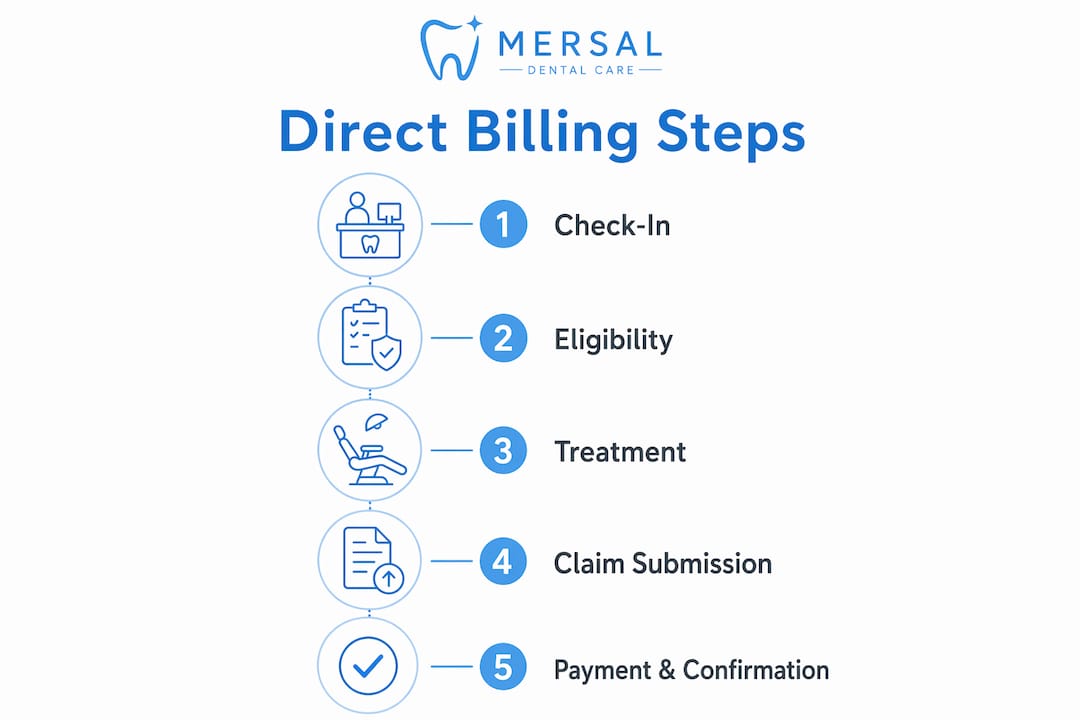
How does direct billing work at the dentist, step by step?
The process follows a clear sequence before, during, and after your appointment.
Pre-visit eligibility check. You provide your insurance details when booking. The clinic runs an electronic eligibility check to confirm your policy is active and to surface expected copays, deductibles, and coverage limits before treatment begins.
Treatment and claim coding. After your procedure, the clinic assigns the correct dental procedure codes and submits the claim electronically to your insurer.
Adjudication. The insurer reviews the claim and returns one of three outcomes: approved, denied, or held for manual review.
Payment. If approved and your plan allows assignment of benefits, the insurer pays the clinic directly. You pay the remaining balance before leaving.
Post-visit documentation. The clinic provides your receipt and, when available, a copy of the EOB so you can confirm what was paid.
Timing matters here. Eligibility checks are often near-instant. Most routine claims adjudicate quickly, but certain procedure codes — such as those for X-rays or treatments requiring proof of necessity — can trigger a manual review that delays payment by days or even weeks. When that happens, the clinic may ask you to pay the full estimated amount at the visit and reimburse you once the insurer responds.
Pro Tip: If your claim is held for review, ask the clinic for the specific procedure code that was flagged. You can then call your insurer directly to find out what supporting documentation will resolve the hold fastest.

What should you bring to make direct billing smooth?
Preparation on your end is what makes the process work. The clinic can only submit an accurate claim if you supply accurate information.
Bring to every appointment:
Your insurance card with group number, policy number, and certificate number
A photo ID
Your employer’s HR contact or benefits plan booklet if you are unsure of your coverage details
Do before the appointment:
Call your insurer or HR department to confirm your coverage is active and check your remaining annual maximum, especially before major treatments
Tell the clinic about any recent plan changes, such as a new employer, a new policy, or a change in the policyholder’s name
Disclose any secondary insurance so the clinic can coordinate benefits correctly
Pro Tip: Because privacy rules limit what a clinic can see about your plan, the clinic cannot independently verify your remaining annual maximum. Confirm that number with your insurer or HR before any treatment that costs more than a routine cleaning.
Keeping your policy information current is the single most effective thing you can do to prevent delays. An outdated group number or a lapsed policy is the most common reason a direct-billing submission fails on the first attempt.
Which insurers are commonly billed and how do provincial rules affect you?
Most major Canadian dental insurers support electronic direct billing. Carriers such as Sun Life, Manulife, Great-West Life (Canada Life), Blue Cross, and Desjardins are routinely billed electronically by dental offices across the country. That said, a minority of plans require the insurer to reimburse the policyholder directly, even when the clinic attempts to assign benefits. Always confirm with both your insurer and the clinic before assuming the payment will go straight to the office.
Provincial differences can affect your experience in a few practical ways:
Government program interactions. Patients covered under the Canadian Dental Care Plan (CDCP) or the Interim Federal Health Benefits (IFHP) program follow specific billing pathways. Clinics experienced with these programs, like Mersaldental, can guide you through the process. You can read more about CDCP and IFHP coverage at Mersaldental’s program page.
Provincial fee guides. Each province publishes a dental fee guide that many insurers use as a benchmark for reimbursement. If your dentist charges above the provincial fee guide rate, the difference is your responsibility regardless of direct billing.
Assignment of benefits rules. Some provincial regulations or specific insurer contracts affect whether assignment of benefits is permitted for certain plan types.
Key insight: Confirming whether your insurer permits direct payment to the clinic is a separate question from confirming whether the clinic accepts your insurance. A clinic can be “in network” with an insurer and still have that insurer send reimbursement to you rather than to the office. Ask both parties before your appointment.
What happens if the insurer denies the claim or won’t pay the clinic?
If the insurer denies the claim or does not permit direct payment to the clinic, you are responsible for the full amount at the time of service. The clinic will provide an itemized receipt so you can file for reimbursement on your own or pursue an appeal.
Immediate steps when a claim is denied:
Request your EOB from the insurer and review it carefully for dates, procedure codes, and the reason for denial
Check whether the denial is due to a coverage exclusion, an exceeded annual maximum, a missing preauthorization, or a coding issue
Ask the clinic whether the code can be corrected or whether supporting clinical documentation can be added to a resubmission
How to appeal:
Gather the EOB, the clinic’s itemized receipt, and any clinical notes the dentist can provide.
Contact your insurer’s claims department and ask for the formal appeal process and deadline.
Submit the appeal with all documentation before the deadline. Thorough, prompt documentation improves the outcome.
Ask the clinic to assist with a letter of dental necessity if the denial was based on medical-necessity questions.
Appeals supported by thorough documentation and submitted promptly have a meaningfully better chance of success. Do not wait.
Pro Tip: Keep a folder, physical or digital, with every EOB, receipt, and claim confirmation. If you need to appeal or coordinate benefits with a secondary insurer, having that paper trail ready saves significant time.
How much will you pay, and how long does adjudication take?
Your out-of-pocket amount at the clinic depends on three things: your deductible (the fixed amount you pay before insurance kicks in), your coinsurance rate (the percentage of covered costs you share with the insurer), and whether the service is covered at all under your plan.
A simple example of how the math works:
Item | Amount |
Insurer pays (coinsurance applies) | $144 |
Patient responsibility | $56 |
The clinic collects $56 from you at the visit and bills the insurer for $144. If your annual deductible has not been met, that amount comes off the top first.
On timing: eligibility checks run in seconds. Routine claim adjudication is often near-instant for electronic submissions. More complex claims, or those flagged for manual review, can take days to weeks. When a hold occurs, the clinic typically collects the full estimated amount from you and refunds the insurer’s portion once payment arrives.
Why do direct-billing claims fail, and how can you prevent it?
Most claim failures come down to preventable administrative issues, not coverage problems.
Common failure causes:
Outdated or incorrect policy, group, or certificate numbers
Exceeded annual maximums (the clinic cannot see your remaining balance due to privacy restrictions)
Non-covered services submitted without a preauthorization
Procedure coding errors or mismatches between the treatment and the code used
Insurer policies that prohibit assignment of benefits for that specific plan
How to prevent delays:
Verify your policy details with HR or your insurer before every appointment, not just the first one
Ask about preauthorization requirements for crowns, implants, or orthodontic work before the treatment date
Disclose any prior treatments from the same benefit year, especially if you have seen another provider
Tell the clinic immediately if you have secondary coverage so they can coordinate benefits in the correct order
The biggest misconception patients carry into a direct-billing appointment is that the clinic can see everything about their plan. It cannot. Privacy rules mean the office works with what you provide, which is why your preparation directly affects how smoothly the claim goes through.
How do you find a dentist that bills insurance directly?
Not every clinic that “accepts insurance” also offers electronic direct billing. Those are two different things, and it is worth confirming before you book.
Where to look:
Check the clinic’s website for explicit mention of “direct billing” or “electronic insurance billing”
Search your insurer’s provider directory, which sometimes flags clinics that submit claims electronically
Call the clinic directly and ask specifically about direct billing, not just insurance acceptance
What to ask when you call:
Do you offer electronic direct billing to insurers?
Do you accept assignment of benefits for [your insurer’s name]?
What insurance information should I bring to my first appointment?
Do you bill the CDCP or IFHP?
A short call script you can use:
“Hi, I’m looking to book an appointment and I have coverage through [insurer name]. Do you offer direct billing to them, and do you accept assignment of benefits? What information should I bring?”
Listen for a clear “yes” on direct billing and a specific answer about what to bring. A vague “we work with most insurers” is not the same as a confirmed direct-billing arrangement for your plan.
Pro Tip: If you are a new patient, ask the clinic to run an eligibility check before your first appointment. Many offices will do this over the phone with your insurance details so you arrive knowing your estimated patient portion.
Key Takeaways
Direct billing is a payment arrangement, not a coverage guarantee. Bring accurate insurance details, confirm assignment of benefits with your insurer, and prepare for a possible patient portion at every visit.
Point | Details |
Direct billing definition | The clinic submits your claim electronically; you pay only the amount your insurer does not cover. |
What to bring | Insurance card with group, policy, and certificate numbers, plus a photo ID. |
Confirm assignment of benefits | Some insurers pay the policyholder, not the clinic. Verify this before your appointment. |
Claim denial response | Review your EOB, gather documentation, and submit a formal appeal before the insurer’s deadline. |
Mersaldental in Ottawa | Mersaldental offers direct insurance billing, accepts CDCP and IFHP, and supports same-day and emergency cases. |
Why direct billing matters more than most patients realize
At Mersal Dental, we see the difference direct billing makes every day. Patients who arrive prepared with their insurance details, who have confirmed their coverage is active, and who understand their plan’s limits leave the clinic with far fewer surprises. The ones who struggle are almost always dealing with outdated information, not coverage gaps.
What most guides do not say clearly enough is this: direct billing is a partnership. We handle the submission, the coding, and the follow-up with the insurer. But we can only work with what you bring us. A lapsed policy number or an unconfirmed annual maximum creates delays that no amount of clinic efficiency can fix on the spot.
We also think patients underestimate the value of asking questions before treatment, not after. Calling your insurer to confirm your remaining maximum before a crown or a root canal takes five minutes and can save you a significant out-of-pocket surprise. We are always happy to give you an estimated breakdown before we begin, but the insurer’s final adjudication is what determines your actual cost.
For patients covered under the CDCP or IFHP, the process has its own steps, and we have experience with both programs. If you are unsure whether you qualify or how those programs interact with private coverage, we can walk you through it. Good dental care should be accessible, and understanding your billing options is part of that.
Mersal Dental makes direct billing straightforward for Ottawa patients
Mersaldental, located in lower town Ottawa, handles direct insurance billing for most major Canadian carriers and accepts both CDCP and IFHP patients. Whether you need a routine cleaning, a same-day extraction, or emergency dental care, our team submits your claim electronically and walks you through your patient portion before treatment begins.

Bring your insurance card, group number, and policy number to your appointment. If you have secondary coverage or are enrolled in a government dental program, let us know when you book so we can prepare the right billing pathway for you. For restorative work like crowns and bridges that often require preauthorization, we can help you understand what documentation your insurer needs before the procedure date.
Ready to book or have a question about your coverage? Schedule your appointment online or contact us directly at mersaldental.ca. We are accepting new patients and are glad to help you make sense of your benefits before you sit in the chair.
Useful sources for further reading
The following sources were used to build this guide and are worth consulting if you want to verify specific details about direct billing, appeals, or program interactions.
LegalClarity: What Does Direct Billing Mean and How Does It Work? — Covers adjudication outcomes, EOB interpretation, and the appeal process. Useful if a claim has been denied and you need to understand your next steps.
Insuranceopedia: Direct Billing Definition — Plain-language definition of direct billing and how electronic submissions speed payment. Good starting point for patients new to the concept.
Dental2: Direct Insurance Billing — Explains how clinics run eligibility checks and what information they need from patients before treatment.
PoCo Dental Group: How Direct Insurance Billing Works — Detailed explanation of hold-for-review scenarios, itemized receipts, and what happens when a claim is flagged. Practical for patients facing a delayed adjudication.
Dolphin Dental: Dental Insurance and Finances — Addresses privacy limitations on clinic access to plan data and why patients must confirm annual maximums directly with their insurer or HR.
For oral health guidance and general dental care tips, the esmile dental resource library is a useful reference for patients who want to maintain their coverage by keeping up with preventive care.
Recommended
Comments