5 Signs You Need a Root Canal and What to Tell Your Dentist in Ottawa

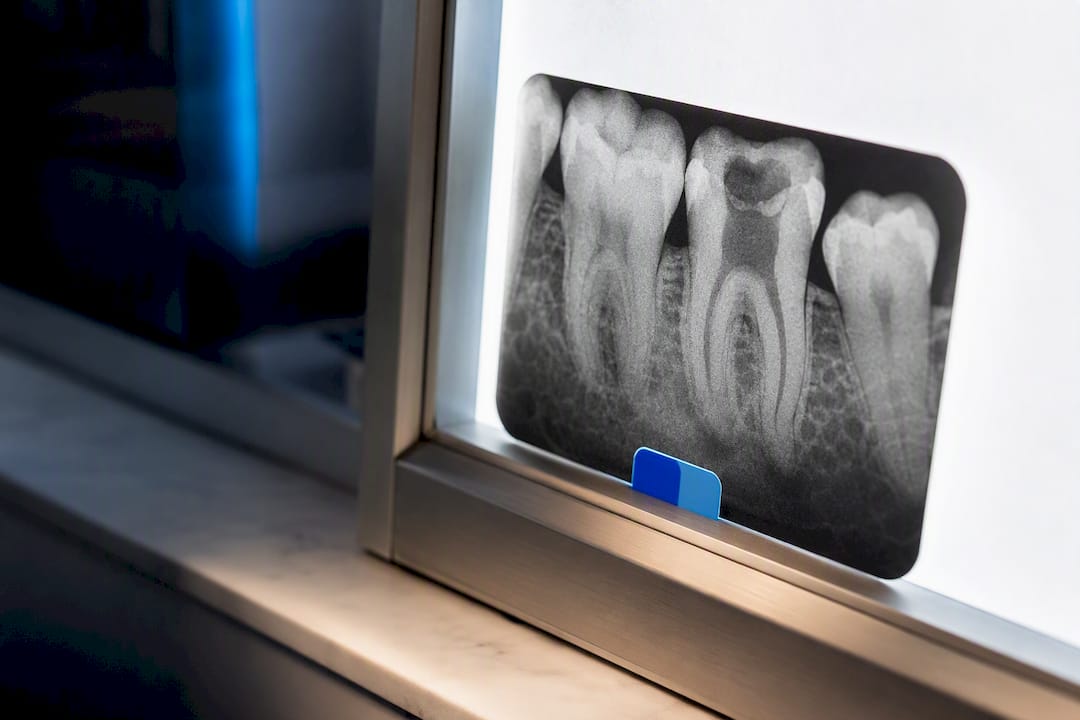
If you have severe or lingering tooth pain, sensitivity that stays after hot or cold is gone, a bump on your gums, or a tooth that’s darkened, a root canal is likely on the table. Only a dentist can confirm it with a clinical exam and an X-ray. If swelling, fever, or facial pain comes with it, treat that as urgent and get seen right away.
TL;DR:
About 3 to 6 percent of root canal patients experience severe pain shortly after treatment, while around 5.3 percent report lingering pain at six months.
Sudden relief from persistent tooth pain could indicate nerve death and ongoing infection, which may spread if untreated.
Most root canal treatments are completed in one or two visits using local anesthesia, with complex cases handled by specialists like endodontists.
Diagnosis involves clinical exams, imaging such as X-rays, and sometimes CBCT scans, especially when symptoms are ambiguous or the tooth appears normal during examination.
Immediate treatment is critical if systemic symptoms like facial swelling, fever, or difficulty breathing occur, indicating spreading infection requiring urgent care.
Table of Contents
What Are the Warning Signs You Need a Root Canal?
The most reliable signs of needing a root canal show up as pain that won’t quit, but not every warning sign feels dramatic. Here’s what we watch for when a patient describes tooth trouble:
Severe or persistent pain when chewing, or an ache that lingers even at rest
Lingering sensitivity to hot or cold that sticks around well after the stimulus is gone
A pimple-like bump on the gums, known as a fistula, which signals a draining infection
Tooth darkening, often a sign the pulp inside has died
Deep, persistent aching in the jaw or face that doesn’t trace back to an obvious cause
Each of these points to bacteria reaching the pulp, the soft tissue inside your tooth packed with nerves and blood vessels. Once bacteria get in there, the tooth typically can’t heal on its own.
Here’s the part most people miss: if that pain suddenly vanishes, don’t assume you dodged a bullet. Sudden relief can mean the nerve has died, and a dead nerve doesn’t hurt anymore even while infection keeps spreading into the surrounding bone. We’ve seen patients wait weeks after their pain disappeared, only to come in with a swollen jaw.
Not every problem tooth hurts at all. Deep decay or a quiet infection can sit undetected until a routine X-ray catches it, which is exactly why skipping checkups lets small problems turn into big ones. If any of this sounds familiar, our guide to root canal warning signs breaks down each symptom in more detail.
What Does a Root Canal Actually Involve?
A root canal removes infected or inflamed pulp from inside your tooth, cleans and disinfects the canals, then fills and seals the space so bacteria can’t get back in. Most cases finish with a crown to protect what’s left of the tooth structure. The entire goal is saving your natural tooth rather than pulling it and starting over with an implant or bridge.
Here’s the typical sequence, whether you see a general dentist or get referred to an endodontist for a complex case:
Numbing the area with local anesthesia, so the procedure feels similar to getting a filling
Placing a dental dam to isolate the tooth and keep the area dry and sterile
Removing the infected pulp and shaping the canals with fine instruments
Disinfecting and filling the canals with a rubber-like material to seal them
Restoring the tooth, usually with a temporary filling first, then a permanent crown
Most patients finish in one or two visits. A general dentist handles straightforward cases; an endodontist, a specialist in root canal work, typically takes on teeth with curved or extra canals, or cases that failed a first attempt.
Pro Tip: The pain people fear almost always comes from the infection itself, not the treatment. With modern anesthesia, the procedure feels a lot like sitting through a routine filling.
How Do Dentists Diagnose the Need for a Root Canal?
Diagnosis starts with a hands-on exam before any imaging happens. Your dentist checks several things in sequence:
Visual inspection for visible decay, cracks, or discoloration
Palpation around the tooth and gums to feel for swelling or tenderness
Percussion testing, a gentle tap on the tooth to check for pain that signals inflammation at the root tip
Probing for sinus tracts, the small openings that indicate a draining infection
Pulp vitality or thermal testing to see how the nerve responds to cold or electrical stimulation
X-rays do the heaviest lifting in confirming what the exam suggests. They reveal deep decay, dark shadows around the root tip called periapical radiolucency, and other root pathology invisible to the eye. In tougher cases, a dentist may order a CBCT scan, a 3D X-ray, to map out canal anatomy before treatment. This matters because a tooth can feel completely normal during the exam and still need treatment based purely on what the X-ray shows.
Root Canal Alternatives, Risks, and Cost Considerations
Saving the natural tooth is usually the preferred path, but it isn’t the only option. If the tooth is too damaged from decay or fracture, extraction becomes the main alternative, typically followed by an implant, a bridge, or a removable partial denture.
Root canal plus crown: keeps your natural tooth and bite, generally the lowest long-term cost per tooth
Extraction alone: cheaper up front but leaves a gap that can shift neighboring teeth over time
Extraction plus implant: preserves jawbone density but takes more visits and more upfront cost
Bridge or partial denture: quicker to complete, but requires ongoing maintenance and can put stress on adjacent teeth
Before committing to any path, get a written estimate and confirm what your insurance actually covers. If cost is tight, ask about staged treatment. Retreatment is occasionally needed if a canal was missed the first time or a restoration fails, but this isn’t the norm for most patients who complete standard treatment.
What’s Recovery Like After a Root Canal?
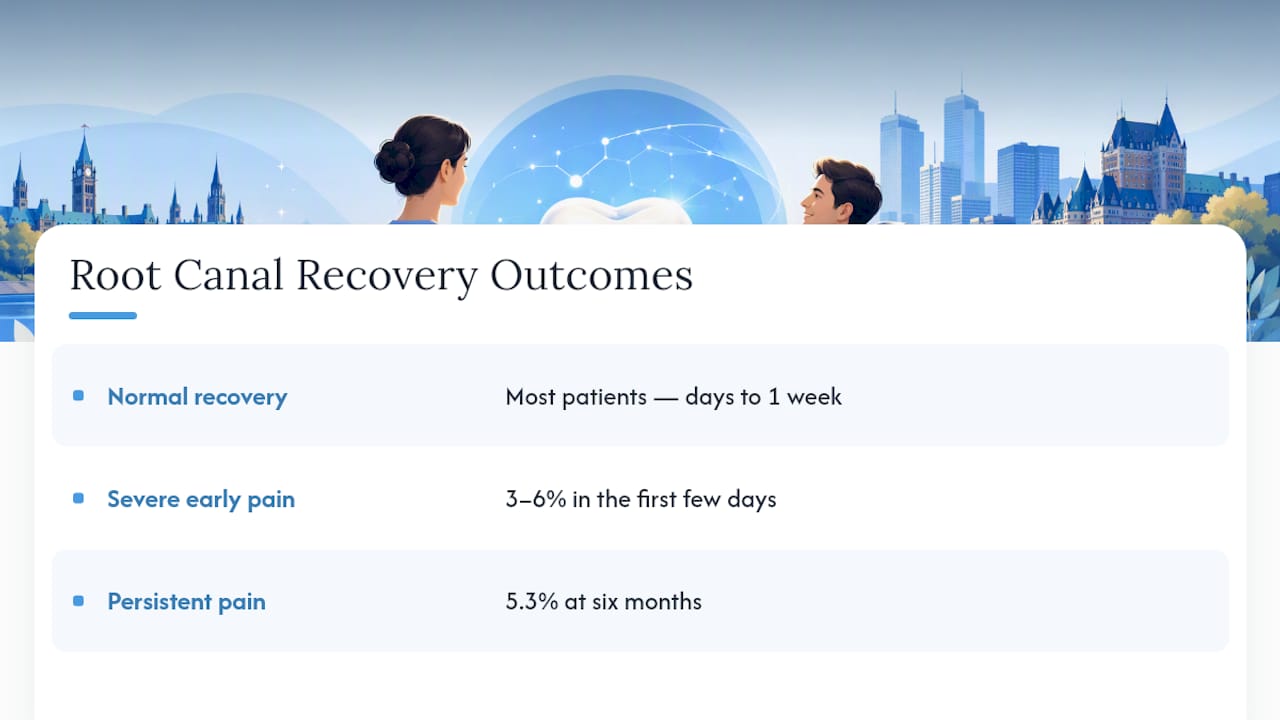
Most patients feel back to normal within a few days to a week. Mild soreness around the gum and jaw is expected as the area settles.
Complication rates are lower than most people assume. Clinical research shows roughly 3 to 6% of patients report severe pain in the first few days, and persistent pain at six months affects about 5.3% of cases. For most people, that means recovery is straightforward.
When pain does linger, it’s often something simple. A high temporary filling or slightly uneven bite is a common culprit, and it’s a five-minute fix at the dentist’s chair, not a sign of failed treatment. Ligament soreness from the instruments used during the procedure can also linger a few extra days.
Pro Tip: Stick to over-the-counter pain relievers as directed, avoid chewing on the treated tooth until it’s fully restored, and call your dentist if pain worsens instead of easing after a few days.
When Should You Treat This as a Dental Emergency?
Some symptoms can’t wait for the next available appointment. Call an emergency dental clinic or go to emergency services if you notice:
Rapidly increasing facial swelling, especially near the eye or jawline
Fever paired with tooth pain or swelling
Difficulty breathing or swallowing
Infection that seems to be spreading fast, not staying localized to one spot
Antibiotics alone won’t resolve the underlying infection. If your pain is intense but none of these systemic signs are present, request an urgent same-day or next-business-day dental appointment instead of waiting out a routine booking.
How Mersal Dental Handles Root Canal Visits
Our dental office provides root canal diagnosis and treatment, crown placement, and same-day emergency appointments for patients dealing with sudden or severe symptoms. Insurance billing and questions about coverage are addressed before treatment starts.
Before your visit, jot down when the pain started, what triggers it, and bring any prior X-rays if you have them along with your insurance details. At your first appointment, expect a clinical exam, X-rays, a clear explanation of your options, and a treatment plan scheduled around what works for you.
Our Take on Root Canal Anxiety and What Actually Matters
Most of the fear around root canals comes from outdated reputation, not current reality. The procedure itself is rarely the painful part. The infection that gets you into the chair is. That distinction gets lost in casual conversation, and it leads people to delay care out of dread when delay is exactly what makes things worse.
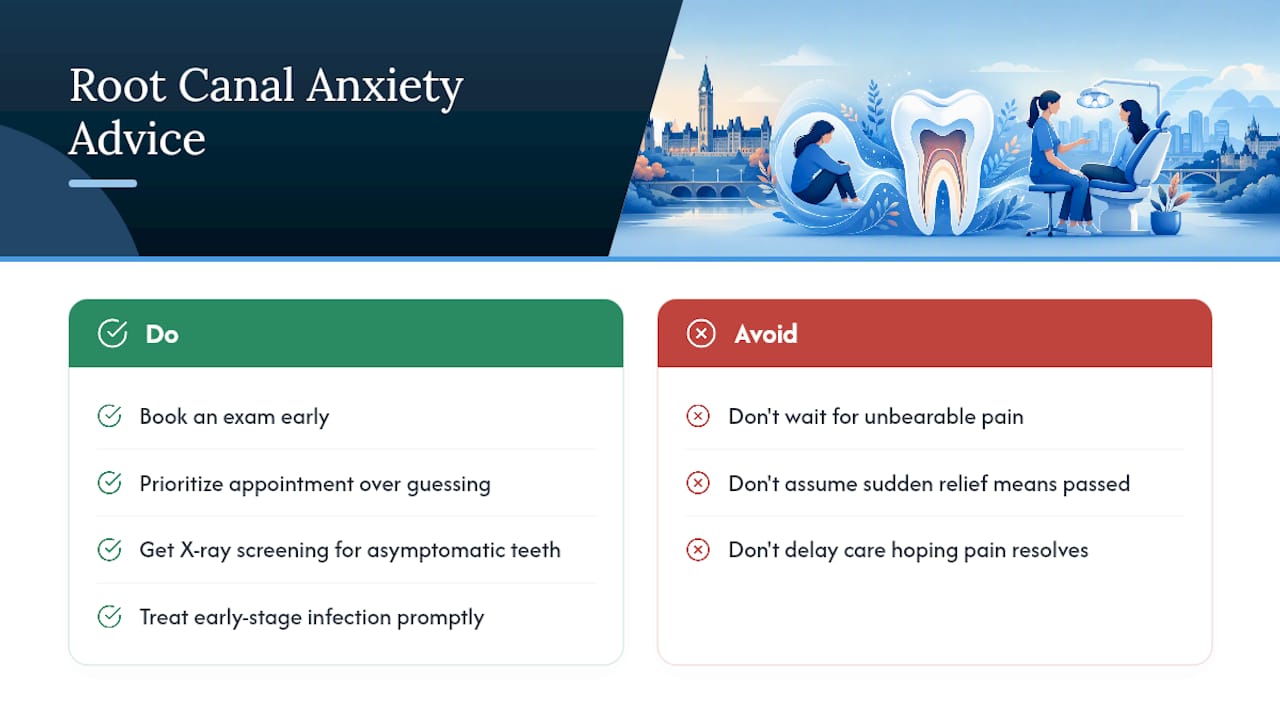
The bigger issue we see isn’t overtreatment. It’s undertreatment born from waiting too long, hoping pain will resolve on its own, or assuming sudden relief means the problem passed. Conventional advice tends to focus heavily on “signs to watch for,” which is useful, but it underweights the asymptomatic cases where an X-ray catches a problem before you’d ever feel it.
If we had one piece of advice: don’t wait for pain to become unbearable before booking an exam. A tooth with early-stage infection is easier, faster, and cheaper to treat than one that’s progressed to visible swelling. Prioritize the appointment, not the guessing game.
— Mersal
Book Your Root Canal Consultation With Mersaldental
If any of the symptoms above sound familiar, waiting rarely improves the outcome. Mersaldental gives you a same-day path to diagnosis in downtown Ottawa, with emergency appointments available when pain shows up without warning.

We handle direct insurance billing on the spot, and accept CDCP and IFHP, so you know your coverage before treatment begins rather than after the invoice arrives. Bring your insurance information and any prior dental records to your first visit, and we’ll take an X-ray, walk you through what we find, and lay out your options clearly, including root canal treatment or, if the tooth can’t be saved, crown and bridge restoration afterward. Reach out through our booking page to schedule an exam or request a same-day emergency slot.
This article is general information, not a substitute for advice from a qualified doctor. Consult a qualified healthcare professional about your own circumstances before acting on anything here.
Sources
FAQ
What are the signs you need a root canal?
Severe or persistent pain, lingering sensitivity to hot or cold, a bump on the gums, tooth darkening, and deep jaw aching are the main signs, though some infections show no symptoms at all until an X-ray catches them.
Why don’t dentists like doing root canals?
Most dentists don’t dislike the procedure itself. Complex cases with curved canals or prior failed treatments take more time and precision, which is why those get referred to an endodontist rather than handled chairside.
Is it possible I don’t need a root canal?
Yes. Sensitivity from a high filling, a cracked filling, or gum irritation can mimic root canal symptoms, which is exactly why an exam and X-ray, not guesswork, should confirm the diagnosis.
Why do dentists push for a root canal over extraction?
Saving your natural tooth generally preserves your bite and jawbone better than extraction, and it’s usually the more cost-effective option over time compared to an implant or bridge, according to Mayo Clinic.
Recommended
Comments