Why OHIP Won't Pay for Fillings and 3 Public Options in Ontario

No, OHIP does not cover routine dental care performed in a dentist’s office. Cleanings, fillings, crowns, root canals, and most extractions all fall outside its mandate. The only exception is certain oral and maxillofacial surgery performed in a hospital under strict conditions. If you need routine care, programs like the Canadian Dental Care Plan, Healthy Smiles Ontario, and a dental office like Mersaldental can help you find a path forward.
TL;DR:
OHIP generally does not cover routine dental procedures such as cleanings, fillings, crowns, root canals, or extractions in a dental office, with rare exceptions for hospital-based oral surgery.
Most in-hospital oral surgeries that OHIP funds are limited to complex or medically necessary procedures like jaw fractures or tumor removal, excluding dental implants and cosmetic surgeries.
Public programs such as the Canadian Dental Care Plan, Healthy Smiles Ontario, and the Interim Federal Health Program offer coverage for routine dental care, but eligibility and accepted providers vary.
Private insurance, employer plans, or out-of-pocket payments remain the primary options for those not covered by public programs or OHIP, with costs for major procedures increasing significantly.
Confirm coverage details with your dental provider before treatment to avoid surprise bills, ensuring they accept your program and offer direct billing options.
Table of Contents
What OHIP Covers for Dental Care and Where the Line Is Drawn
OHIP was built to fund medically necessary physician and hospital services, not the kind of preventive dentistry most of us think of when we hear “dental care.” That distinction has existed since the program’s earliest days, and it explains why so many Ontario residents get surprised at the front desk. OHIP generally does not cover routine dental care, and that exclusion applies no matter how much pain you’re in or how urgent the problem feels.
Here is what stays off OHIP’s list, according to the province:
Routine cleanings and checkups
Fillings for cavities
Crowns
Root canals
Most tooth extractions
Dental implants, which the Schedule of Benefits for Dental Services states are never insured, regardless of the circumstances
A nonprofit settlement resource sums up the practical reality well: the answer to whether OHIP covers dental services is generally no, with coverage reserved for hospital-based surgery in complex or medically fragile cases. If your dentist’s office quoted you a price for a filling or a crown, that quote is accurate. OHIP was never going to pay part of it.
When OHIP Will Pay for In-Hospital Oral Surgery
The narrow exception matters if you’re facing something more serious than a cavity. OHIP can cover specific oral and maxillofacial surgeries when they happen in a hospital, and when a physician or oral surgeon determines the procedure is medically necessary rather than cosmetic or routine.
The kinds of cases that may qualify include:
Repairing a fractured jaw from an accident or injury
Removing tumors or cysts from the jaw or oral cavity
Reconstructive surgery following trauma or disease
Medically necessary tooth removal, particularly when a patient’s health condition requires hospital-level monitoring
Dental implants remain excluded even in these situations. The Schedule of Benefits is explicit on that point, and it’s worth knowing before you assume hospital coverage extends to tooth replacement.
Most of these procedures need prior approval before they happen. Your oral surgeon or hospital typically submits documentation tied to specific billing codes in the Schedule of Benefits, and approval hinges on medical necessity, not patient preference. When a patient is medically fragile and needs complex monitoring during a procedure, OHIP may cover the hospital stay and operating room time alongside the surgery itself, though professional fees can still vary based on the specifics of the case.
One more thing worth knowing: showing up at an emergency room with a toothache won’t get you a filling or an extraction. ER visits are covered as hospital care, but staff there generally manage pain and prescribe antibiotics rather than perform definitive dental work. You’ll likely walk out with a prescription and a recommendation to see a dentist, not a fixed tooth.
Public Programs That Actually Cover Routine Dental Care
If OHIP won’t pay for your filling, three other programs might. Each has its own eligibility rules, and none of them work quite like provincial health insurance.
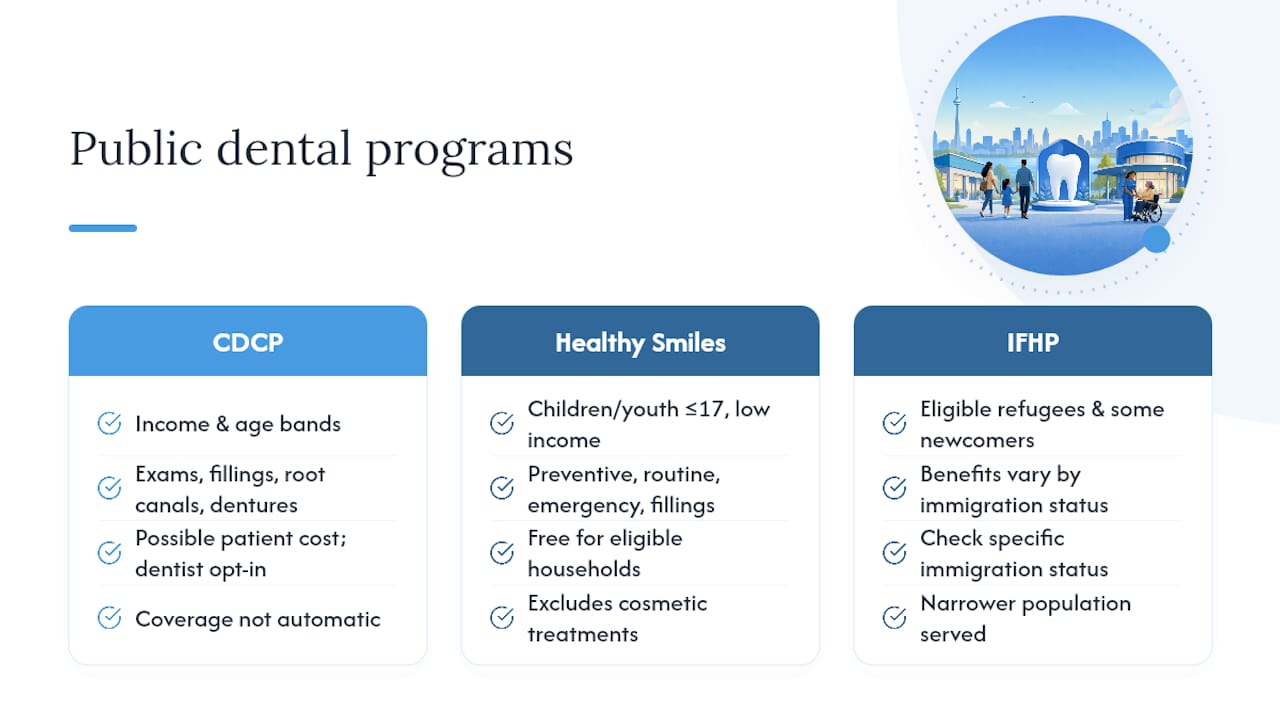
The Canadian Dental Care Plan (CDCP) is the newest and broadest option. It covers exams, fillings, root canals, and dentures for Canadians who meet income and age criteria, and depending on household income, some patients pay a portion of the cost themselves. Coverage isn’t automatic just because you qualify. Every dentist chooses whether to participate, so confirming that your office accepts CDCP patients is a step you can’t skip. Our guide to CDCP eligibility for families walks through the income bands in plain terms.
Healthy Smiles Ontario fills a different gap. It provides free preventive, routine, and emergency dental care for children and youth 17 and under from lower-income households, covering everything from cleanings to fillings. Cosmetic treatments like braces or whitening aren’t included.
The Interim Federal Health Program (IFHP) serves a narrower population: eligible refugees and some newcomers to Canada. Its dental benefits differ from both CDCP and provincial programs in scope and eligibility, so newcomers should check their specific status rather than assume CDCP rules apply. Our breakdown of IFHP dental coverage covers who typically qualifies.
Where someone qualifies for both CDCP and a provincial program, CDCP generally coordinates as one part of the payment picture rather than duplicating coverage, which is another reason to confirm details directly with your dental office before booking.
What to Do When OHIP and Public Programs Don’t Cover You
Plenty of Ontario residents don’t qualify for CDCP, Healthy Smiles, or IFHP, and still need a filling or a crown. A few paths remain open.
Private dental insurance typically covers a percentage of routine work, often with waiting periods and annual maximums, and it rarely covers major procedures like implants without a higher premium tier
Employer-sponsored plans work similarly to private insurance and can often be used alongside CDCP, though your provider needs to know both to coordinate billing correctly
Paying out of pocket remains common, and costs climb fast for crowns, root canals, or implants compared to cleanings and simple fillings
The ER can manage a dental emergency’s pain, but it isn’t a substitute for seeing a dentist for the actual repair
A resource like this guide to comparing private healthcare options can help you weigh insurance plans against employer benefits before you commit to one.
How to Confirm Your Coverage Before You Book
Getting a straight answer before your appointment saves you from a surprise invoice. Here’s the order to work through it:
Check your eligibility for CDCP, Healthy Smiles Ontario, or IFHP through their official portals
Call your dental office directly and ask whether they accept your specific program
Ask about direct billing so the office bills the program instead of you paying upfront and waiting for reimbursement
If your case might qualify as medically necessary hospital surgery, ask your dentist or physician about starting the prior approval paperwork early
Have your OHIP number, CDCP eligibility letter, and any private insurance card ready when you call. Our page on direct billing explains how that process typically works in practice.
Pro Tip: Ask the front desk two specific questions: “Do you accept direct billing for my program?” and “What will I owe out of pocket after coverage?” Getting a dollar figure before treatment, not after, is what actually prevents surprise bills.
A Local Dentist’s Perspective on Coverage Confusion
We see the CDCP and OHIP confusion daily in our Lower Town Ottawa office. Patients often assume one program covers everything, so we walk through eligibility and confirm participation before any work begins. Our team accepts public dental programs, offers convenient billing options, and provides prompt emergency care so a coverage question never delays urgent treatment.
— Mersal
How Mersal Dental Helps You Sort Out Coverage and Get Treated
We help Ottawa residents by confirming dental coverage acceptance before your appointment, billing programs directly when possible, and seeing emergency cases promptly, so a cracked tooth or an infection doesn’t sit on a waiting list while you sort out paperwork.
Our Lower Town Ottawa office handles the routine work OHIP won’t touch, from cleanings to extractions, and we accept CDCP and IFHP patients alongside private insurance and direct payment. If you’re unsure which program applies to you, our CDCP and IFHP programs page breaks down eligibility in plain language, and our front desk will verify your specific coverage before you’re charged a cent. Call our office or book online to confirm your coverage and schedule an appointment.
Sources
Recommended
Comments