Stop the Six Month Rule: How Canadian Clinics Schedule Dental Checkups


There is no universal six-month rule. The right interval depends on your gum health, tartar buildup, past cavities, and habits like smoking, and it should be set by your dentist, not a calendar reminder. Most healthy adults land somewhere between once and twice a year, but some need a checkup every 3 to 4 months, while others do fine every 12 to 24 months. Confirm your specific interval at your next visit.
TL;DR:
Patients with gum disease or risk factors like smoking and dry mouth generally require checkups every 3 to 4 months for effective management.
Healthy adults with good home care and no history of periodontal disease can often extend their recall intervals to 12 to 24 months.
Dentist assessments based on pocket depths, tartar buildup, and decay influence personalized scheduling more than fixed six-month intervals.
Systematic reviews show little benefit for routine cleanings beyond 6 or 12 months for healthy adults, but more frequent visits improve outcomes for periodontal patients.
Dentists prioritize clinical signs such as bleeding, sensitivity, swelling, or loose restorations over calendar schedules to determine timely visits.
Table of Contents
How Often Dental Checkups Should Happen Depends on Your Risk Level
The six-month standard everyone grew up hearing wasn’t pulled from a clinical trial. It became common practice decades ago partly because it was easy to remember and easy to schedule, not because researchers proved it was the ideal number for every mouth. The Canadian Dental Association has been explicit about this: there is no single mandated frequency, and recall should be built around your individual oral health needs, including gum condition, tartar accumulation speed, and dental history.
That means two people can walk out of the same clinic with completely different next-appointment dates, and both are correct. A patient with a clean bill of gum health might safely stretch to 12 months. A patient managing early periodontal disease might need to come back in 3 months. Here’s how risk generally breaks down:
Higher-risk patients who typically need more frequent visits (every 3 to 4 months) include people with active gum disease, smokers, those with uncontrolled diabetes, anyone dealing with chronic dry mouth (xerostomia), and patients who build up tartar quickly or already carry multiple restorations.
Lower-risk patients with strong home hygiene, few or no fillings, and no periodontal history often do well on a 12 to 24 month schedule, according to a systematic review of recall intervals.
Typical-risk patients, which describes most adults, tend to fall somewhere between 6 and 12 months.
The clinical reasoning is straightforward. Gum disease progresses through inflammation that can be tracked and interrupted with more frequent cleanings. Dry mouth reduces the saliva that normally buffers acid and washes away bacteria, so decay risk climbs. Smoking masks bleeding gums, one of the earliest warning signs dentists look for, which is another reason smokers often get shorter recall windows.
What Actually Happens at a Checkup, and Why Timing Matters
A checkup is not just a cleaning. It typically includes an oral exam, periodontal probing to measure the depth of the pockets around each tooth, full charting, scaling to remove plaque and tartar, an oral cancer screening, and a decision about whether new x-rays are needed. You can see a full breakdown of what a standard hygiene appointment covers before you go in.
That periodontal probing step is where recall timing actually gets decided, informed by the advantages of advanced dental care detailed in this guide to soins bucco-dentaires avancés. Pocket depths under 3 millimeters with no bleeding usually signal healthy tissue and support a longer interval. Deeper pockets, bleeding on probing, or new decay found on exam push the next visit closer, sometimes to 3 or 4 months, so the problem can be caught before it advances. Whether cleaning stays preventive or shifts into deeper periodontal therapy (root planing, for example) hinges on those same measurements. X-rays aren’t automatic at every visit either; your dentist weighs your cavity history and risk level before ordering them, a decision explained further in this guide to x-ray frequency.
What the Research Actually Shows About Recall Intervals
A 2020 systematic review examined trials running 2 to 4 years and found little to no difference in outcomes between patients on a fixed 6-month schedule, a risk-based schedule, or longer recall intervals, for many adult oral health measures. That finding sounds like it undercuts the traditional six-month visit, and in a sense it does for lower-risk adults. But the same review is clear that the picture changes for periodontal patients, where shorter, more frequent maintenance visits still show real value in controlling inflammation and pocket depth.
Cochrane’s own review of routine scaling and polishing found that fixed 6-month or 12-month cleanings made little or no difference to gingivitis, probing depths, or oral-health-related quality of life over 2 to 3 years in adults without severe periodontitis, according to the Cochrane review on scale and polish frequency.
That is not an argument for skipping cleanings. It’s evidence that a fixed calendar interval isn’t doing the clinical work people assume it is for healthy adults, while it remains genuinely important for anyone with gum disease. The certainty of this evidence is also limited by study design. Trials rarely run past 4 years, and earlier work on recall patterns notes wide variability across countries in how dentists actually schedule patients, which makes broad conclusions harder to pin down. That gap is exactly why clinical judgment, not a blanket rule, still drives the decision in the chair.
How Your Dentist Actually Sets Your Next Appointment
Your dentist is weighing several inputs at once: pocket depths across your whole mouth, your history of cavities, how fast tartar builds back up after a cleaning, medications that dry your mouth or affect healing, systemic conditions like diabetes, whether you smoke, and how well you’re realistically able to keep up with home care. None of that shows up on an insurance card, and a research note on recall scheduling specifically warns against letting your insurance plan’s coverage cycle be the thing that decides your interval. Coverage and clinical need are two different questions.
You can walk into any appointment and ask for a personalized answer instead of a guess. Six questions worth asking:
What did my gum measurements show this visit, and how do they compare to last time?
Am I building tartar faster or slower than average?
Do I have any early decay you’re watching?
Does anything I’m taking or any condition I have affect my risk?
Based on that, what interval do you actually recommend for me?
What would make you want to see me sooner than that?
Pro Tip: Keep a simple running note on your phone of anything dental related between visits: bleeding when you floss, tooth sensitivity, a filling that feels off. Hand that log to your hygienist at your next visit. It gives them real data instead of your memory, and it often changes the recall date they set.
Sample Recall Schedules to Discuss With Your Dentist
These numbers are starting points for conversation, not prescriptions:
Low-risk adult: every 12 to 24 months
Typical adult: every 6 to 12 months
Periodontal maintenance patient: every 3 to 4 months
Children and adolescents: follow pediatric-specific guidance, since evidence on optimal intervals for younger patients is more limited than for adults
Shorten any of these if you’ve had recent treatment, active decay under watch, post-surgical healing to monitor, or an emergency visit that needs a follow-up. A dentist who has actually examined your mouth always outranks a chart like this one.
How Mersal Dental Applies Risk-Based Scheduling
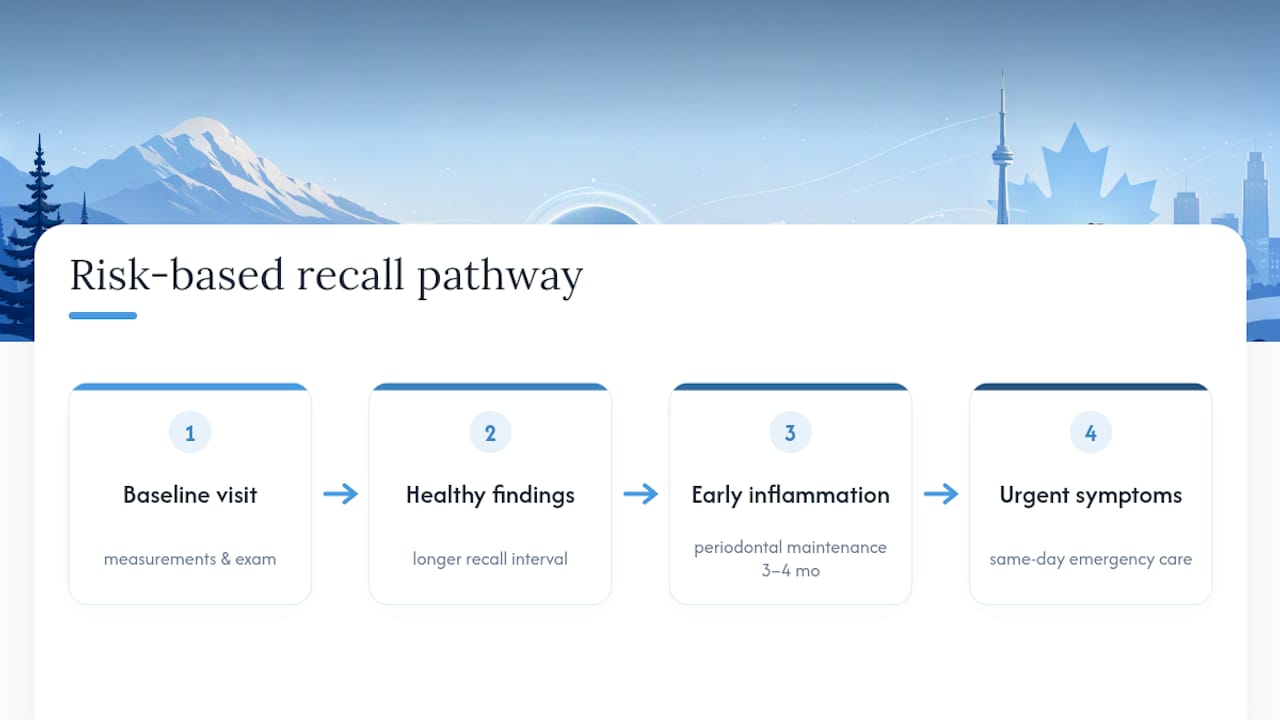
We set your next recall date during your hygiene appointment, based on what is found in your mouth that day: gum measurements, tartar patterns, and any new areas of concern, rather than a fixed number applied to everyone. Our hygiene appointments build a baseline the first time we see you, then adjust from there.
If probing shows early gum inflammation, patients may be shifted toward periodontal maintenance visits every 3 to 4 months. If the exam is clean and home care is strong, the next visit is spaced out accordingly. Emergency patients can be seen the same day when something can’t wait for a scheduled recall, so a change in the mouth between visits doesn’t have to sit unaddressed.
What Major Dental Associations Say Around the World
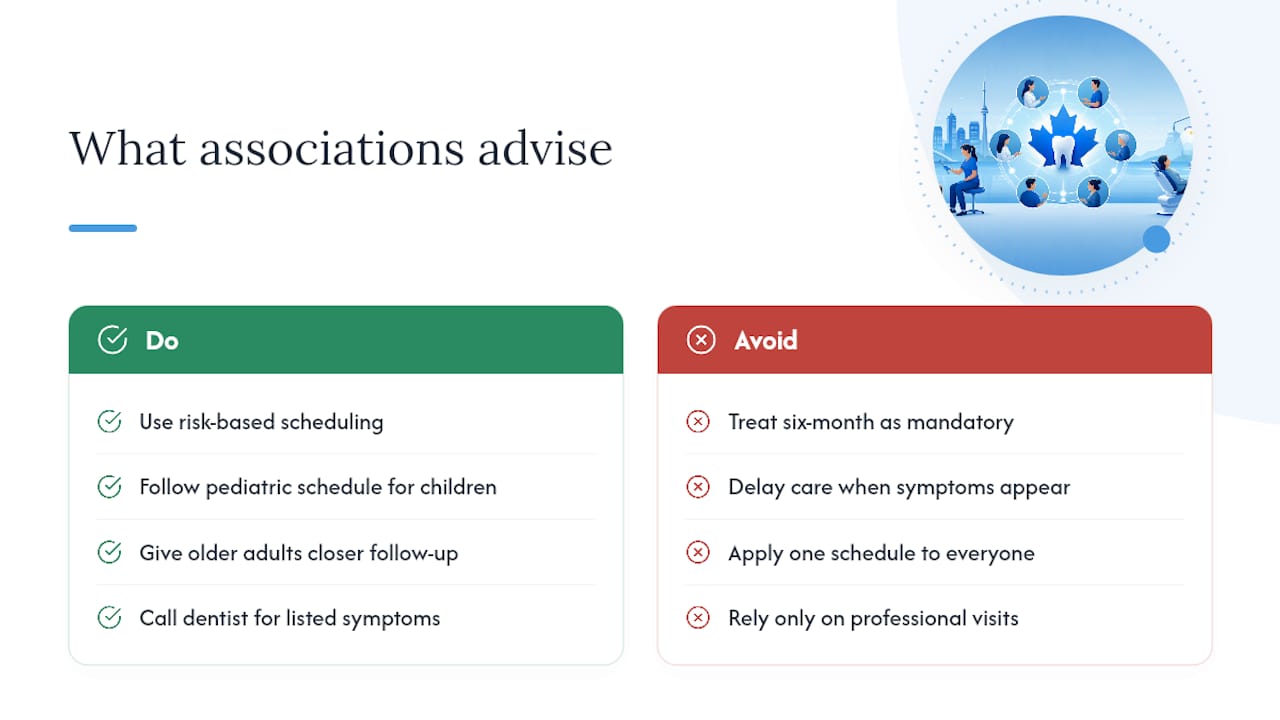
Professional guidance has converged on the same core idea even though wording differs by country. The Canadian Dental Association rejects a fixed six-month mandate in favor of individualized care based on oral health status. Public health guidance from agencies like the CDC similarly frames professional visits as one part of a personalized prevention plan that also depends on daily brushing and flossing at home.
Clinical practice across many health systems has been moving the same direction for years: away from blanket six-monthly recall and toward risk-based scheduling that puts resources where they matter most, closer surveillance for higher-risk patients, longer gaps for lower-risk ones. Age matters inside this framework too. Children’s developing teeth and evolving hygiene habits usually call for the schedule a pediatric dentist sets rather than adult norms. Adults settle into the risk-based ranges already covered above. Older adults often need closer attention again, since medications, receding gums, and existing restorations tend to raise risk with age.
A few signs mean you shouldn’t wait for your scheduled date at all: bleeding gums that don’t resolve, a tooth that’s suddenly sensitive to hot or cold, visible swelling, a filling or crown that feels loose, or any pain that lasts more than a day or two. Those warrant a call regardless of when your next cleaning is booked.
Why the “Six Months for Everyone” Advice Falls Short
The evidence doesn’t support treating every patient the same, and it never really did. What the six-month rule got right is that most adults benefit from at least annual professional monitoring. What it got wrong is applying a single number to people whose gum health, decay history, and habits vary enormously. A smoker with early periodontal changes and a lifelong non-smoker with clean gum measurements are not the same clinical case, and scheduling them identically wastes the higher-risk patient’s window for early intervention.
The more useful shift for readers is to stop asking “is six months right?” and start asking “what does my own risk profile call for?” That’s a better question, and it’s one your dentist can actually answer with data from your own mouth: pocket depths, bleeding patterns, tartar speed. Prioritize getting that individual assessment over memorizing a generic interval. The number that matters is the one built from your own chart, not the one printed on a reminder postcard.
— Mersal
Book a Personalized Recall With Mersal Dental
Getting your own risk-based schedule starts with one visit. New patients are accepted, and direct insurance billing along with CDCP coverage is handled to minimize paperwork for patients.

Bring your insurance information, a list of current medications, and any recent x-rays if you have them from a previous dentist. If you’re not sure where to start, our page on what a cleaning appointment involves walks through the booking process and what to expect in the chair.
Services offered include hygiene appointments that set personalized recall dates, periodontal maintenance for patients who need closer monitoring, same-day and emergency care, and multilingual staff with support for uninsured patients through public programs.
Book your hygiene appointment with Mersal Dental and get a recall schedule built around your own mouth, not a generic calendar reminder.
This article is general information, not a substitute for advice from a qualified doctor. Consult a qualified healthcare professional about your own circumstances before acting on anything here.
Sources
Recommended
Comments