Best Invisalign Alternatives in 2026: Clear Aligners and Braces

Updated: Jul 27

The best Invisalign alternatives range from professionally supervised clear aligners like ClearCorrect and SureSmile to affordable at-home kits like Byte and AlignerCo, plus fixed options like ceramic braces, lingual braces, and traditional metal braces. The right choice depends on your case complexity, budget, and how much professional oversight you want. Invisalign treatment is generally more expensive than many alternatives, which offer comparable results at a lower price point, especially for mild to moderate cases.
Option | Type | Supervision | Case Complexity | Price Range | Duration | US Availability |
ClearCorrect | Clear aligner | In-office | Mild to moderate | Typically $500–$1,500 less than Invisalign for the same case complexity | Varies by case | Wide |
SureSmile | Clear aligner | In-office | Mild to moderate | Pricing varies with complexity | Varies by case | Wide |
3M Clarity Aligners | Clear aligner | In-office | Mild to complex | Similar to Invisalign | Varies by case | Wide |
Angel Aligner | Clear aligner | In-office | Mild to complex | Pricing varies with case | Varies by case | Growing |
Candid/CandidPro | Hybrid aligner | Hybrid | Mild to moderate | $2,500–$6,000 | Varies by case | Wide |
Byte | Clear aligner | Remote only | Mild only | $1,895–$2,295 | Generally faster treatment times for mild cases | Wide |
NewSmile | Clear aligner | Remote only | Mild only | Budget-friendly pricing | About six months’ treatment typical | Wide |
AlignerCo | Clear aligner | Remote only | Mild only | Low-cost entry prices | About six months’ treatment typical | Wide |
SmileDirectClub | Clear aligner | Remote only | Mild only | Closed 2023 | N/A | N/A |
Six Month Smiles | Cosmetic braces | In-office | Front teeth only | Moderately priced | Approximately six months of treatment | Wide |
Lingual braces | Fixed braces | In-office | All complexities | Higher-cost option | Typical treatment duration 12–24 months | Wide |
Ceramic braces | Fixed braces | In-office | Moderate to complex | Mid-range pricing | Treatment duration typically 12–24 months | Wide |
Traditional metal braces | Fixed braces | In-office | All complexities | Affordable option | Treatment duration typically 12–24 months | Wide |
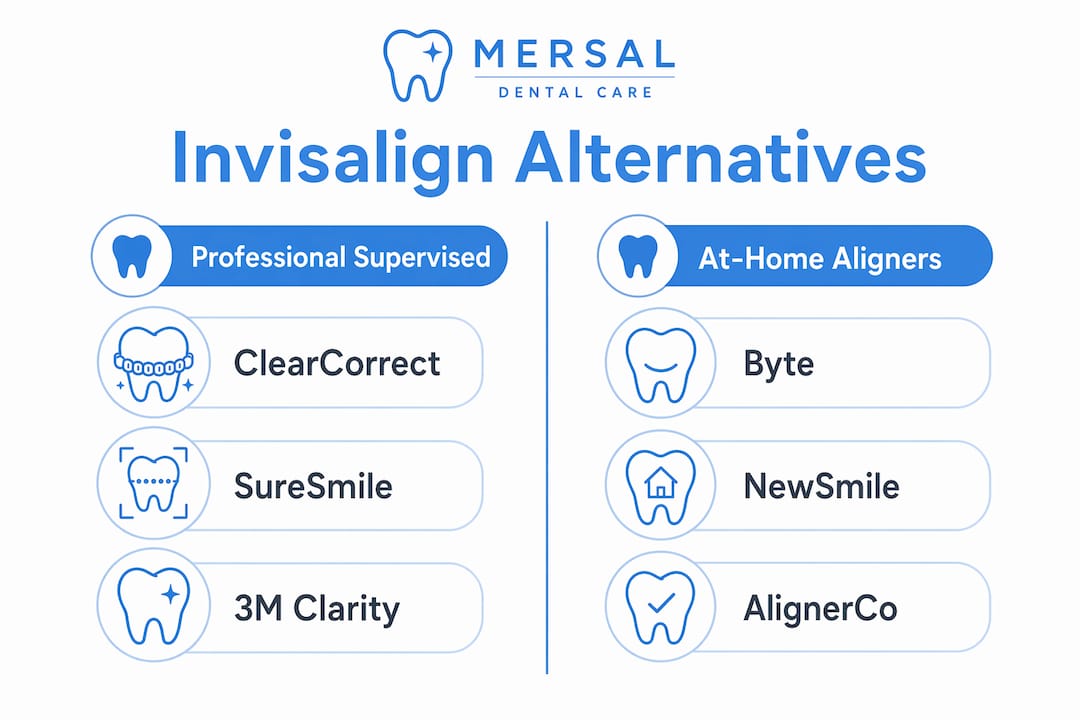
Clear aligner alternatives to Invisalign: what you need to know
Not all clear aligners are built the same. The biggest dividing line is whether a licensed professional physically examines your teeth before and during treatment. In-office clear aligners require X-rays, clinical exams, and regular checkups, which adds cost but also adds a real safety net.
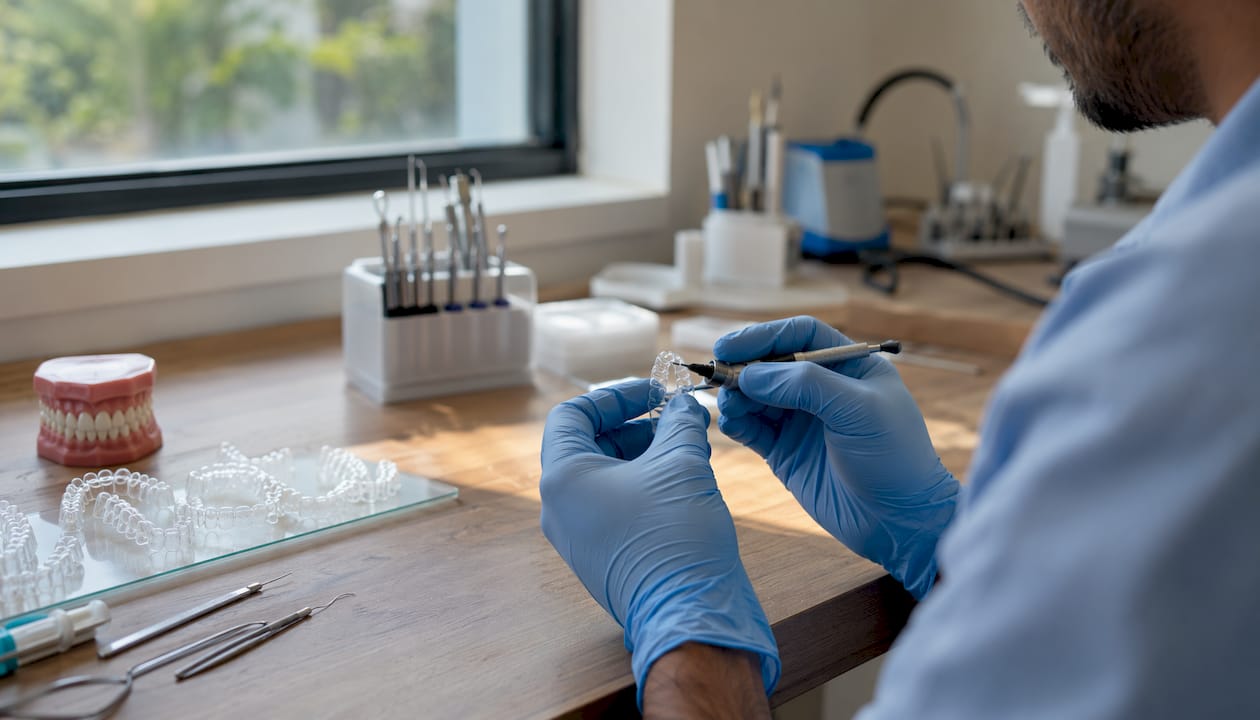
In-office clear aligners
ClearCorrect is Invisalign’s closest in-office competitor in the US. Owned by Straumann Group, it uses BPA-free multilayer polyurethane material and is prescribed by orthodontists and general dentists. ClearCorrect typically costs $500–$1,500 less than Invisalign for equivalent case complexity, without sacrificing clinical quality. Both systems use tooth-colored attachments for complex movements, and both are covered by dental insurance on the same terms as traditional braces.
SureSmile offers flexible treatment plans managed by dental professionals, with pricing that can approach at-home kit costs for minor cases. Its treatment planning software gives providers precise control over predicted tooth movements, which reduces the need for refinements after treatment ends.

3M Clarity Aligners carry the backing of 3M’s established dental materials division. The attachments are smaller than many competitors, making them easier to place discreetly, and the advanced planning software handles complex movements well. Pricing is comparable to Invisalign.
Angel Aligner has grown quickly in the US market. Its trays are smooth and flexible, with two tracks: UltraComfort for mild to moderate cases and Pro for more complex treatment. Costs run $3,500–$6,000, and most orthodontic insurance plans cover it.
CandidPro uses a hybrid model: patients start with an in-person exam at a partner dental office, then shift to remote monitoring through the CandidMonitoring app. This approach balances convenience with professional oversight and suits mild to moderate cases where patients want more supervision than a fully remote kit provides, at a price below full Invisalign.
At-home direct-to-consumer aligners
Direct-to-consumer (DTC) aligners skip the in-person exam entirely. You make impressions at home, mail them in, and receive aligners by post. No X-rays. No bite assessment. No physical exam before, during, or after treatment.
Byte costs $1,895–$2,295 and includes a HyperByte vibration device marketed to speed up tooth movement, though independent evidence supporting that claim is limited. It works best for adults with very mild crowding, healthy gums, and no bite issues.
NewSmile is one of the most affordable options, with plans ranging from $1,195–$1,895. It offers remote monitoring and a nighttime-only wear option for added discretion.
AlignerCo is among the cheapest on the market, with plans starting around $995. It suits simple cases in adults looking for a low-cost entry point, though remote oversight is no substitute for a qualified dental team.
SmileDirectClub shut down in 2023. Its collapse is a cautionary example of what can go wrong when DTC infrastructure fails and patients are left mid-treatment with no support. Anyone currently holding SmileDirectClub aligners should consult a local dentist.
Pro Tip: Before starting any at-home aligner kit, schedule a dental exam and X-rays first. Hidden gum disease or bite problems can worsen quickly under aligner pressure, and no remote photo review catches what a clinical exam does.
When traditional braces are the better choice
Fixed braces remain the most reliable option for complex orthodontic cases, and no clear aligner fully replaces them for severe crowding, significant bite correction, or precise rotational tooth movements.
Traditional metal braces use brackets bonded to teeth and connected by wires adjusted periodically to guide movement. Because they are fixed, they work continuously without depending on patient compliance. For patients with significant crowding, severe bite issues, or complex tooth movements, metal braces provide continuous, controlled force that aligners cannot fully replicate. Costs typically run $2,500–$6,000, putting them in a similar range to many aligner options.
Ceramic braces function identically to metal braces but use tooth-colored or clear brackets that blend with your smile. Adults who want a fixed solution without the look of metal brackets often find ceramic braces a practical middle ground. They are slightly more fragile than metal brackets and require careful maintenance, but they handle moderate to complex cases well. Pricing runs $3,000–$7,000.
Lingual braces are metal braces placed behind the teeth, making them nearly invisible from the front. They offer effectiveness comparable to traditional braces with the aesthetic appeal of a hidden appliance. They can take longer to adjust to and are not ideal for every case, but for adults who want full invisibility with fixed-appliance precision, they are a strong option. Costs range $5,000–$10,000.
Six Month Smiles takes a narrower approach: it uses clear or tooth-colored brackets to shift only the front teeth, focusing on cosmetic alignment rather than bite correction. Treatment typically completes in about six months at a cost of $3,000–$4,500. It is not appropriate for complex cases or back-tooth movement, but for adults who want fast, visible front-teeth improvement, it delivers.
Pros of fixed braces:
Work continuously without relying on patient wear habits
Handle severe crowding and complex bite correction
Suitable for all ages, including teens who may struggle with aligner compliance
Covered by most dental insurance plans with orthodontic benefits
Cons of fixed braces:
More visible than clear aligners (except lingual braces)
Require careful cleaning around brackets and wires
Dietary restrictions during treatment
Lingual braces carry a higher cost and adjustment period
How to choose the right treatment for your case
The single most important factor is case complexity. Mild crowding or minor spacing can often be treated with a clear aligner, whether in-office or, for very simple cases, a DTC kit. Moderate to severe crowding, bite correction, or significant rotational movements generally need fixed braces or a professionally supervised aligner system.
Key decision criteria:
Case complexity: Get a clinical evaluation before committing to any treatment. X-rays and a bite assessment reveal issues that photos and impressions miss.
Professional supervision: In-office treatments are covered by most dental insurance plans with orthodontic benefits. DTC aligners are generally not covered because they lack in-network provider supervision.
Lifestyle fit: Removable aligners require 20–22 hours of daily wear. Fixed braces work around the clock. If you know you will struggle with compliance, braces may be the more reliable path.
Budget and financing: Metal braces and ClearCorrect often offer the best cost-to-outcome ratio for moderate cases. Many dental offices offer payment plans for in-office treatments.
Treatment duration: DTC aligners like Byte market 4–6 month timelines for mild cases. In-office treatments for moderate to complex cases typically run 12–24 months.
Pro Tip: Ask your orthodontist or dentist explicitly whether your case could be treated with ClearCorrect instead of Invisalign. For many standard cases, the clinical outcome is equivalent at a meaningfully lower price.
Safety, effectiveness, and the real risks of at-home aligners
The professional dental community has raised consistent concerns about DTC aligner treatments, and those concerns are grounded in clinical reality.
In-office clear aligners use tooth-colored attachments to enhance precision tooth movement, a technique unavailable in most at-home kits. Without attachments, DTC aligners are limited in the movements they can achieve, which is why they are only appropriate for the mildest cases.
The deeper risk is what happens before treatment begins. A thorough dental exam including X-rays and bite assessment is essential before any aligner treatment. Undiagnosed periodontal disease or tooth decay can worsen rapidly under aligner pressure. No at-home impression kit or remote photo review replaces that exam.
“The American Dental Association reaffirms its opposition to direct-to-consumer dentistry that bypasses an in-person clinical examination. Orthodontic treatment without a proper diagnosis risks permanent damage to teeth, gums, and bone.” — American Dental Association
The collapse of SmileDirectClub in 2023 made this concrete. Patients mid-treatment were left without support, refinements, or recourse. The best Invisalign alternative depends on case complexity, not price alone. Fixed braces remain superior for complex malocclusions, and no DTC kit changes that.
For adults with genuinely mild cases and healthy mouths, Byte or NewSmile can deliver real value. But “mild case” is a clinical determination, not a self-assessment. See your dentist first, confirm the diagnosis, then choose your treatment.
Considering professional orthodontic care in Ottawa
If you are weighing your options and want a clear, honest assessment of what your teeth actually need, Mersaldental in downtown Ottawa offers Invisalign consultations alongside a full range of orthodontic and restorative services.
We accept new patients, offer direct insurance billing, and work with CDCP and IFHP programs, so cost barriers are lower than you might expect. Our team can take X-rays, assess your bite, and walk you through whether Invisalign, ClearCorrect, or a fixed appliance is the right fit for your case. We also provide same-day treatments and emergency care, so if a dental issue comes up during your orthodontic journey, you are covered. Learn more about our dental services or book a consultation to get a personalized treatment plan built around your actual needs.
Key Takeaways
The best Invisalign alternative is determined by case complexity first, then budget and lifestyle, with professional supervision being the single most important safety factor.
Point | Details |
Case complexity drives choice | Mild cases suit clear aligners; moderate to complex cases need fixed braces or supervised in-office aligners. |
ClearCorrect saves money | ClearCorrect typically costs $500–$1,500 less than Invisalign for equivalent case complexity with the same clinical quality. |
DTC aligners carry real risk | At-home kits skip X-rays and clinical exams, leaving undiagnosed gum disease or bite issues untreated and potentially worsened. |
Insurance favors in-office care | Dental insurance covers in-office aligners and braces; DTC treatments are generally excluded from coverage. |
Mersaldental offers in-person assessment | Mersaldental in Ottawa provides Invisalign consultations, direct insurance billing, and CDCP acceptance for patients evaluating their options. |
Recommended
This article provides a helpful overview of Invisalign alternatives and the options available for different orthodontic needs. Clear, correct aligners are worth considering for people seeking a discreet and convenient way to improve their smile.