What Invisalign Actually Costs in Canada


Invisalign in Canada typically runs CAD 3,000 to CAD 8,500 depending on how complex your case is, with most adults landing between CAD 4,500 and CAD 6,500. Insurance can make a real dent in that number. Invisalign shows sample cases where a doctor’s quote of CAD 3,400 dropped to roughly CAD 1,800 out of pocket after a private plan paid its share.
Here’s what we recommend before you commit to anything:
Book a free consult to get your specific complexity assessed
Ask for a fully itemized quote, not a bundled number
Bring your insurance card so the clinic can check coverage on the spot
Key Takeaways
Invisalign in Canada costs CAD 3,000 to CAD 8,500 depending on case complexity, and confirming inclusions at a free consult is the single most reliable way to avoid a surprise bill.
Point | Details |
Know your price band | Most adult cases fall between CAD 4,500 and CAD 6,500, with mild cases starting lower and comprehensive cases reaching CAD 8,500. |
Match tier to need | Express, Lite, Moderate, Comprehensive, and Teen plans differ mainly by aligner count and treatment length. |
Check insurance limits | Private plans often cap lifetime orthodontic coverage between CAD 1,500 and CAD 3,000, and require preauthorization first. |
Get an itemized quote | Confirm retainers, refinements, and follow-ups are included before comparing prices between clinics. |
Start with a free consult | Mersaldental offers free Invisalign consults in lower town Ottawa with direct insurance billing and CDCP/IFHP acceptance. |
Table of Contents
What Does Invisalign Cost by Treatment Tier in Canada?
Invisalign isn’t one price. It’s a family of treatment plans, each built around how many aligners your case needs and how long you’ll wear them.
Express treats minor crowding or small relapses after old orthodontic work. It usually needs seven or fewer aligners and wraps up in two to four months, often for the lowest fee on the price list.
Lite and Moderate plans handle mild-to-moderate spacing or crowding, typically running six to twelve months with a moderate aligner count. Comprehensive is the full workhorse plan for complex bite corrections, crowded arches, or significant spacing, and it can stretch to 18 months or longer with unlimited aligners over the treatment period.
Teen plans mirror Comprehensive clinically but add features like compliance indicators and free replacements for a lost aligner, since teenagers lose things.
Express: 2–4 months, smallest aligner count, lowest fee tier
Lite/Moderate: 6–12 months, mild to moderate corrections
Comprehensive: 12–18+ months, full bite correction, highest fee tier
Teen: similar scope to Comprehensive, built-in replacement allowances
Be wary of any clinic advertising a flat “starter” price well below CAD 3,000. That figure often covers only Express-level movement, not a full comprehensive plan, and the CAD 3,000–8,500 range cited by Canadian dental sources reflects what most adult cases actually require.
Why Does Location Change Your Invisalign Price?
Where you live in Canada shifts your quote more than most patients expect. Overhead, local demand, and even lab shipping costs all factor into the number a clinic hands you.
Ontario: broad range, with Toronto often at the higher end
British Columbia: similar spread, with Vancouver clinics pricing near the top
Alberta: generally comparable to Ontario, slightly more variance by city
Quebec: competitive pricing in Montreal, wider range outside major centers
Atlantic Canada: often the most affordable region nationally
Large metropolitan markets like Vancouver and Toronto tend to sit at the higher end of provincial ranges because rent, staffing, and demand run higher there. A quote from a smaller city isn’t automatically a worse deal. Ask what’s included before comparing two numbers side by side.
What Determines Your Personal Invisalign Quote?
Two identical smiles can generate two very different quotes, and the gap almost always comes down to line items most patients never think to ask about.
Clinically, your fee reflects the number of aligners required, whether you need attachments (small tooth colored bumps that help aligners grip), elastics for bite correction, and interproximal reduction (tiny amounts of enamel reshaping between teeth). More complex movement means more of all four, and each one adds cost.
On the clinic side, ask whether your quote bundles digital scans, X-rays, retainers, mid-treatment refinements, and routine follow-up visits, or whether any of those get billed separately later.
Provider experience matters too. An orthodontist with years of Invisalign cases behind them may price differently than a general dentist newer to clear aligner planning, and that gap usually reflects case-management depth rather than markup.
Number of aligners and total movement required
Attachments, elastics, and IPR needs
Scans, X-rays, retainers, and refinements included or excluded
Orthodontist vs. general dentist experience level
Pro Tip: Ask your clinic to walk you through refinements specifically. Mid-treatment adjustments are common, and knowing what they cover before you sign anything avoids a surprise bill near the finish line.
How Much Does Insurance Cover for Invisalign in Canada?
Private dental plans with orthodontic benefits typically reimburse a percentage of your treatment cost, often 50%, up to a lifetime maximum. The Canadian Association of Orthodontists puts that lifetime cap commonly between CAD 1,500 and CAD 3,000, a figure that resets rarely if ever, so if you’ve used orthodontic benefits before for yourself or a child, check what’s left.
Adult coverage is where things get tighter. Many plans restrict orthodontic benefits to dependents under a certain age, so confirm your own eligibility rather than assuming coverage that applies to your kids also applies to you.
Before treatment starts, most insurers require preauthorization, meaning your clinic submits the treatment plan and fee estimate for approval before aligners get ordered. Skipping this step is the fastest way to end up paying a bill you expected insurance to cover.
Confirm your plan’s percentage coverage and lifetime maximum
Check whether adult orthodontic benefits differ from dependent coverage
Submit for preauthorization before treatment begins
Ask about using a Health Spending Account to cover your remaining balance
If you don’t have private insurance, check your eligibility for the Canada Dental Care Plan, a federal program that may cover dental treatment for qualifying lower-income households. Covered services depend on the plan’s specific rules.
What Are Realistic Monthly Payment Options for Invisalign?
Third-party lenders exist too, though those often carry interest depending on your credit profile.
Here’s how the arithmetic typically plays out:
A CAD 4,500 treatment with a CAD 500 down payment, financed over 18 months, lands around CAD 222/month.
A CAD 6,000 treatment financed over 24 months often prices around CAD 200 to CAD 250/month depending on your down payment.
A CAD 8,000 comprehensive case with a CAD 1,000 down payment over 24 months works out to roughly CAD 292/month before any insurance reimbursement is applied.
Before signing a payment plan, ask three things: is there any interest or administration fee, does the monthly figure include retainers and refinements, and what happens to remaining payments if you need to pause treatment.
Invisalign vs. Braces: Which Is the Better Value?
Traditional metal braces generally cost somewhat less upfront than Invisalign for comparable complexity, though Invisalign Canada notes the two are often priced comparably case by case. The real difference is lived experience.
Braces are fixed, so there’s no compliance risk. Invisalign requires 20 to 22 hours of daily wear to stay on schedule.
Aligners are removable and nearly invisible, which most adults prefer for professional settings.
Braces need more frequent in-office adjustments; Invisalign check-ins are typically spaced further apart.
Hygiene is simpler with aligners since you remove them to brush and floss normally.
For severe bite issues or younger patients who may lose or forget aligners, braces can still deliver better value despite the lower sticker price.
Your Consult Checklist: What to Ask Before You Commit
Walk into your consult ready to ask direct questions and you’ll avoid the two most common surprises: hidden fees and incomplete quotes.
Request a written, itemized quote listing aligners, retainers, refinements, and follow-up visits separately.
Confirm whether final retainers and scans are bundled into the price or billed later.
Ask what the clinic’s refinement policy looks like if your teeth need extra correction mid-treatment.
Pro Tip: A rock-bottom price quoted before any exam is a red flag, not a deal. Real pricing follows a proper assessment of your case complexity, not the other way around.
Mersal Dental’s Ottawa Approach to Invisalign Pricing
Mersaldental offers free Invisalign consults at our lower town Ottawa office, along with direct insurance billing and acceptance of CDCP and IFHP for eligible patients. Our team is multilingual, which matters when you’re trying to understand a treatment plan in detail.
At your consult, we take digital scans, X-rays, and a full clinical exam to build an itemized quote specific to your case. Bring your insurance card and any questions about coverage. You’ll leave with real numbers, not a placeholder estimate.
How Long Does Invisalign Treatment Take, and Why Does It Affect Price?
Treatment length is the single biggest hidden driver behind your final cost, because most Invisalign plans are priced around aligner count, and aligner count tracks almost directly with time in treatment.
Express cases finish in two to four months. Lite and Moderate plans run six to twelve months. Comprehensive cases, the most common category for adults with real bite or crowding issues, typically take 12 to 18 months, and complex cases can push past that. Every additional month generally means additional aligners, and additional aligners is exactly what separates a CAD 3,500 quote from an CAD 8,000 one.
Timeline also affects your total financing cost indirectly. A longer treatment plan means more months of monthly payments if you’re financing, even when the per-aligner cost stays flat. It also increases the odds you’ll need a refinement round: teeth that need 18 months of movement are more likely to need a mid-course correction than teeth that need four.
One overlooked factor: your own compliance changes the timeline, and therefore the cost. Wearing aligners less than the recommended 20 to 22 hours daily slows progress, which can extend treatment past what your original quote assumed. If your case stalls, some clinics charge for extra aligner sets to get you back on track, so consistent wear is one of the few cost variables you fully control.

Ask your clinic for a realistic timeline estimate at your consult, not just a total price. A shorter timeline with a slightly higher monthly cost can sometimes beat a longer one with lower payments, once you factor in total months of financing interest or fees.
What Costs Might Show Up After Your Initial Quote?
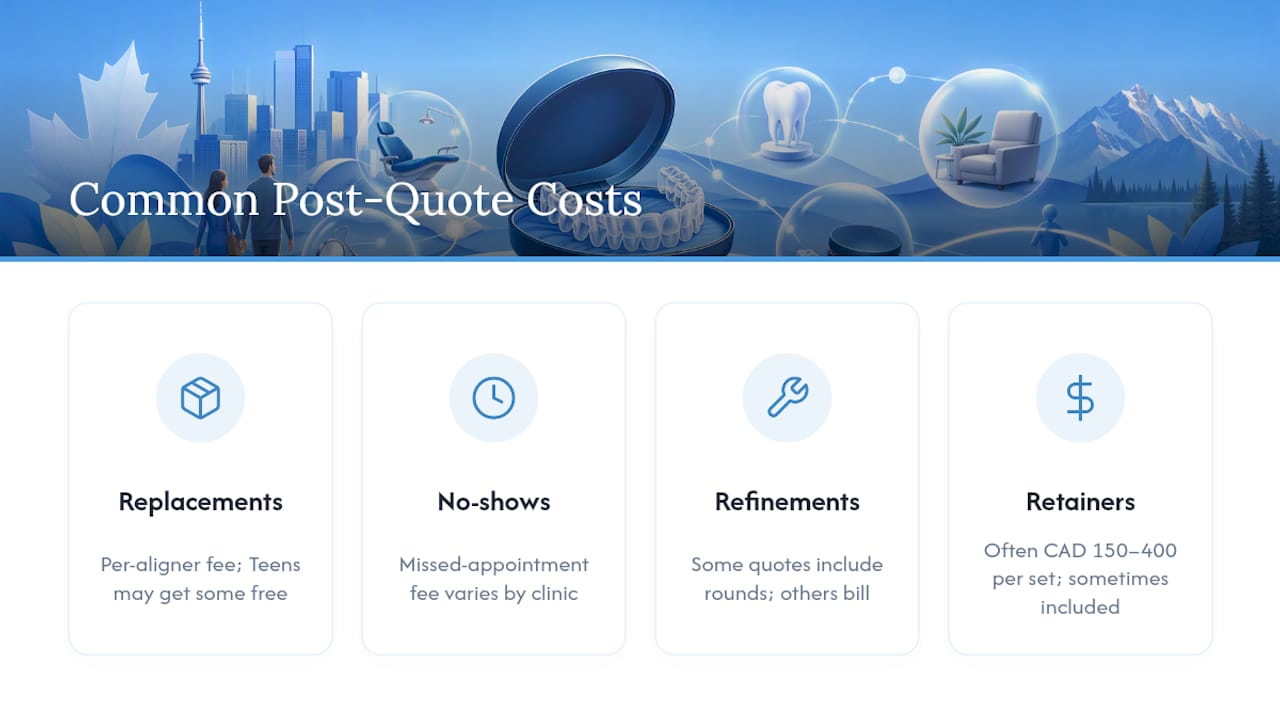
The number on your first quote is rarely the absolute final number you’ll pay, and knowing where the gaps usually appear helps you budget properly from day one.
Replacement aligners top the list. If you lose or damage a set, most clinics charge a per-aligner replacement fee, and Teen plans often build a limited number of free replacements into the price specifically because this happens so often with younger patients. Adults aren’t immune either; a lost aligner while traveling is a common real-world scenario that catches people off guard.
Missed appointment fees are increasingly common across Canadian dental clinics generally, not just for Invisalign. If you skip a scheduled check-in without enough notice, expect a fee that varies by clinic policy.
Refinements deserve their own line of scrutiny. Many comprehensive cases need at least one refinement round partway through treatment to correct movement that didn’t track exactly as planned. Some clinics include a set number of refinements in the original price; others bill each round separately. This is precisely why an itemized quote matters more than a bundled number.
Final retainers are the last common surprise. Some quotes include a first set of retainers after treatment ends; others treat retainers as a separate purchase, often CAD 150 to CAD 400 per set. Given that retainers are the only thing standing between your finished result and years of slow relapse, confirm this detail before treatment even starts, not after.
What This Guide Gets Right That Others Miss
Most cost guides hand readers a national price range and stop there, as if a number from a Halifax clinic and a Vancouver clinic mean the same thing. They don’t. The research behind this guide points to something more useful: the gap between a CAD 3,500 quote and an CAD 8,000 quote almost never comes down to the clinic overcharging. It comes down to aligner count, attachments, and whether retainers got bundled in or billed later.
The conventional advice tells patients to “shop around for the best price.” That’s backwards. Two quotes at different numbers might reflect two completely different treatment plans, not two prices for the same service. The smarter move is shopping for the most complete itemized quote, then comparing what’s actually inside it.
If we had to pick one priority for readers, it’s this: get your insurance preauthorization sorted before you sign anything. Lifetime maximums and adult coverage restrictions catch more patients off guard than any clinical surprise during treatment ever does.
— Mersal
Get an Accurate Invisalign Quote in Ottawa
Mersaldental gives Ottawa patients something most online price guides can’t: a real, itemized number based on your own teeth, not a national average. Because we bill insurance directly and accept CDCP and IFHP, your out-of-pocket estimate reflects what you’ll actually owe, not a rough guess you have to adjust later.
If you’ve read this far wondering where your case falls in the CAD 3,000 to CAD 8,500 range, the fastest way to find out is a free consult at our lower town Ottawa office. We’ll take your scans, review your coverage, and hand you a written quote that lists every line item, retainers included. Book your free Invisalign consult and get a number you can actually plan around.
This article is general information, not a substitute for advice from a qualified doctor. Consult a qualified healthcare professional about your own circumstances before acting on anything here.
Sources
Recommended
Comments