Invisalign Refinements: What to Expect and Why

Updated: Sep 10

Invisalign refinements are additional aligner sets created from a fresh intraoral scan to finish your tooth movement precisely after the initial series ends. Most patients need at least one round, so if your provider mentions them, that is not a sign something went wrong.
Quick verdict:
Expect at least one refinement round. It is a normal part of supervised Invisalign treatment, not a failure.
Refinements typically add a few months per round. Plan your timeline accordingly.
Check your contract before treatment starts. Comprehensive plans often include refinements; limited plans may not.
Table of Contents
What are Invisalign refinements, and when do they happen?
A refinement starts with a new intraoral scan taken after you finish your initial aligner series. Your clinician uploads that scan to Align Technology’s ClinCheck software, which generates a revised digital treatment plan. A fresh set of aligners is then manufactured to move your teeth from where they actually are, not where the original plan predicted they would be.
This distinction matters. The first ClinCheck is a forecast built from photos, X-rays, and a digital model of your teeth before any movement has occurred. Teeth respond to pressure in ways that vary by person, so the forecast rarely matches reality with perfect precision. Refinements let the clinician work from where your teeth actually landed, rather than from a prediction made months earlier.
Refinements most often happen near the end of treatment, once you have worn your last initial tray. In some cases, a clinician will call for a mid-treatment refinement if tracking deviates significantly before the series is complete. Either way, there is a short pause between finishing your current trays and receiving the new ones, typically a few weeks for scanning, plan review, and manufacturing.
Why do refinements happen?
Teeth do not always move on a predictable schedule. Several biological and mechanical factors can cause the initial plan to fall short of the final goal.
Biological reasons:
Bone remodeling speed varies from person to person. Some patients’ bone responds more slowly, meaning teeth lag behind the aligner’s intended position.
Tooth root anatomy affects how a tooth tips or rotates. Roots with unusual shapes or lengths resist certain movements.
Individual inflammatory response influences how quickly the periodontal ligament allows movement.
Mechanical reasons:
Tracking deviations occur when a tray no longer fits snugly against specific teeth, reducing the force applied.
Rounded tooth surfaces make rotational corrections harder to achieve with plastic alone.
Bite settling after posterior teeth contact can shift positions the plan did not anticipate.
Staging limits in the original plan sometimes mean certain movements were simply not programmed aggressively enough.
Attachments and interproximal reduction (IPR) play a key role here. Attachments are small tooth-colored bumps bonded to specific teeth to give the aligner a mechanical grip for difficult movements. During refinements, attachments are commonly removed, repositioned, or added at new locations. IPR, the careful removal of a small amount of enamel between teeth, creates space for rotations or alignment that would otherwise be impossible. These clinical tools address tracking issues, bite detailing, and small rotations that the initial series could not fully resolve.
Refinements are a diagnostic judgment, not a software error. Clinicians frequently anticipate a refinement phase as part of precision-focused treatment from the very first appointment.
How do you know if you might need refinements?
Some signs are easy to spot. If your last few trays feel loose on specific teeth, or if you notice a gap between the tray and a tooth when you press down, that is a fit issue worth reporting. Difficulty fully seating a tray, even after using chewies, is another signal.

Clinically, you might notice that a tooth still looks rotated after finishing your series, or that a gap between two teeth has not fully closed. Bite contacts that feel uneven, or a sense that your upper and lower teeth do not meet the way they should, can also indicate that refinements are needed.
Not every loose-feeling tray requires an immediate scan. Clinicians will often have you extend wear on the previous tray or test seating with chewies before deciding. Only a provider can reliably tell the difference between a minor seating issue and a true tracking failure. The practical advice: report anything unusual at your next appointment rather than waiting until the end of your series.
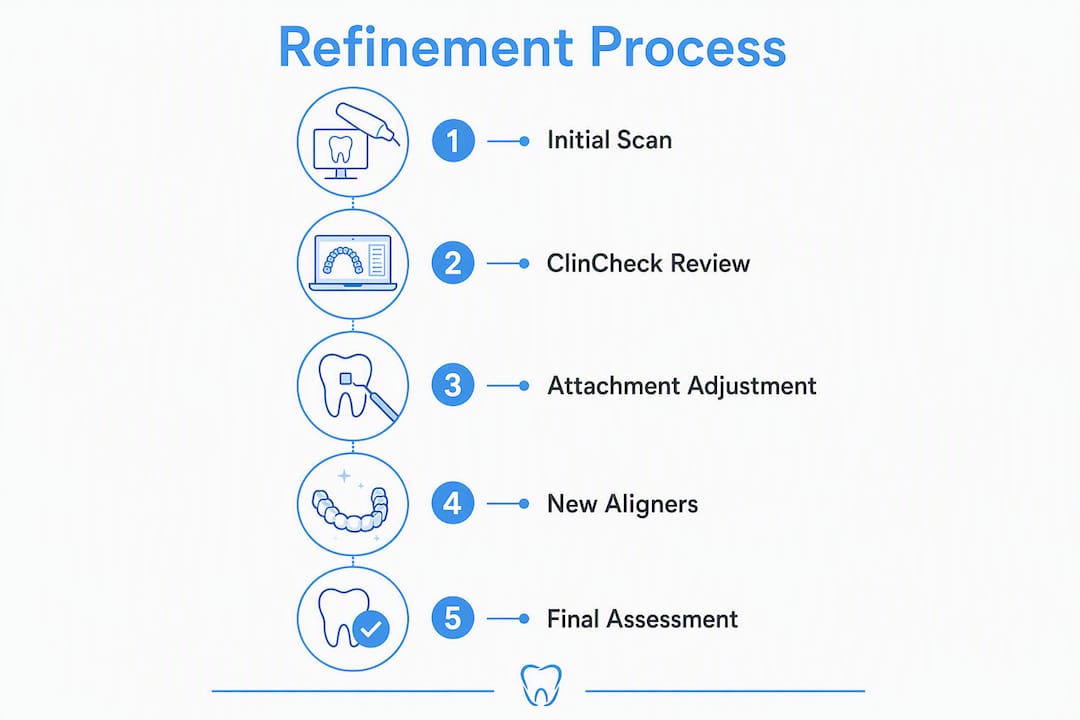
The refinement process, step by step
Understanding the sequence removes the anxiety from the wait. Here is what happens from evaluation to finished result.
Checkpoint evaluation. Your clinician examines your teeth at the end of your initial series, comparing actual tooth positions to the original ClinCheck plan. This visit determines whether refinements are needed and what movements remain.
Intraoral scan. A digital wand captures a precise 3D model of your current tooth positions. No impressions, no trays of putty.
Revised ClinCheck plan. Your clinician submits the scan to Align Technology. A new digital plan is generated showing the proposed movements. Your clinician reviews and approves this plan before manufacturing begins. The same clinician who planned your original case should review the new one.
Attachment and IPR adjustments. At a chairside appointment, old attachments may be removed and new ones bonded in updated positions. IPR may be performed if additional space is needed.
Manufacturing. Align Technology produces the new aligner series. This typically takes two to three weeks from plan approval.
Refinement wear schedule. You wear the new trays on the same schedule as your initial series, usually 20–22 hours per day, changing trays every one to two weeks per your provider’s instructions.
Final assessment. Once you finish the refinement series, your clinician evaluates the result. If teeth have tracked well, you move to retention. If minor issues remain, a second refinement round may be recommended.
Experienced clinicians may also adjust attachments or stage overcorrections mid-treatment to reduce the likelihood of a second refinement round. Minor refinements address one or two teeth with a short tray count. Major refinements involve a comprehensive new plan, more trays, and often significant attachment changes.
How long do refinements take, and how many rounds will you need?
A single refinement round typically involves additional trays and adds a few months to your total treatment time. The exact count depends on how many teeth need further movement and how complex those movements are.
Refinement scenario | Typical tray count | Estimated time added |
Minor (1–2 teeth, small correction) | 5–8 trays | 2–4 months |
Moderate (several teeth, rotation or spacing) | 8 trays | 2–4 months |
Major (comprehensive re-plan) | 15 trays | 2–4 months |
Most patients go through one to two rounds. Complex cases, particularly those involving significant rotations or bite correction, sometimes require more. Research confirms that most improvement occurs early in the refinement process, and beyond a certain number of rounds, additional treatments do not statistically improve occlusal outcomes. That finding is worth keeping in mind if a provider recommends a third or fourth round: ask specifically what movement remains and whether the expected gain justifies the added time.
Align Technology’s comprehensive plans include unlimited aligners within a five-year window. That covers the aligner manufacturing cost, but it does not automatically cover your provider’s chair time for extra appointments, new scans, or attachment adjustments. Those fees vary by clinic and contract.
Will you pay extra for refinements?
Whether refinements cost extra depends on two things: your Invisalign package type and your clinic’s fee structure.
Plan type | Refinements typically included? | What to confirm |
Comprehensive (full) | Yes, within 5-year window | Doctor fees for extra visits; lab fees if any |
Lite / Express | Often limited or excluded | Whether an upgrade is needed and its cost |
Retainer-only / minor correction | Usually not included | Full cost of any additional trays |
Many comprehensive plans include refinements within a five-year window; limited plans may restrict them and could lead to extra fees or an upgrade. Before you start treatment, ask for written confirmation of what is covered. FSA and HSA funds can generally be applied to orthodontic treatment, including refinements, but verify with your plan administrator. If your dental insurance covers orthodontics, ask whether it applies to refinement-related visits separately.
Billing questions to ask at your consult:
Does my plan include unlimited refinements, or is there a cap?
Are provider fees for refinement appointments included, or billed separately?
If I need more than one round, what is the upgrade cost?
What is your clinic’s policy if refinements are needed after the five-year window?
Can I get the coverage terms in writing before I sign?
How can you reduce the chance of needing extra refinement rounds?
Compliance is the single biggest controllable factor. Patient wear time is a major driver of whether trays track as planned, and most tracking failures trace back to aligners being out of the mouth too long.
Wear your aligners 20–22 hours per day. Remove them only to eat, drink anything other than water, and brush.
Use chewies daily. Biting on aligner chewies for five to ten minutes after inserting a new tray helps seat it fully against every tooth surface.
Report fit problems early. A tray that feels off on day three is easier to address than one you have worn for ten days without saying anything.
Follow attachment and IPR instructions exactly. Avoid hard foods that could dislodge attachments, and keep the attachment surfaces clean.
Never skip follow-up appointments. Your clinician catches tracking deviations at check-ins. Missing visits delays that catch.
Clinically, ask your provider whether overcorrection staging is built into your plan. This technique programs teeth to move slightly past the target position, accounting for the natural tendency to under-correct. For patients who are slower biological responders, a clinician may also recommend a slower tray-change schedule to give bone remodeling time to catch up.
Pro Tip: Ask your clinician whether your ClinCheck plan includes overcorrection staging for rotations. If it does not, and you have teeth with significant rotation, that is worth discussing before you begin, not after your last tray.
What happens after refinements are done?
Once your clinician confirms that teeth have reached their final positions, you move into retention. This is not optional. Teeth have a natural tendency to drift back toward their original positions, and retention is what holds the result long-term.
Two retainer types are common after Invisalign. Clear removable retainers, made from the same type of material as your aligners, are worn nightly or as directed. Bonded fixed retainers are thin wires bonded to the back surfaces of the front teeth, providing continuous passive retention without any patient action required. Many patients use both: a fixed retainer on the lower front teeth and a clear removable retainer on the upper arch.
Finishing refinements well, meaning teeth are fully tracked and in their planned positions, directly improves how stable that result is over time. A case that ends with residual gaps or rotations is more likely to shift during retention. After refinements, expect a follow-up visit at three to six months to confirm stability. Minor settling is normal and usually does not require additional aligners.
Questions to ask your provider, and red flags to watch for
Going into a refinement conversation prepared makes a real difference. Here is a short checklist:
What movements remain, and how many trays do you estimate?
Who will review the new ClinCheck plan?
How much time will this add to my treatment?
Will attachments change, and will IPR be needed?
What retainer protocol do you recommend after refinements?
What does my contract cover, and do I have anything in writing?
Red flags that suggest poor supervision or unclear billing:
Your provider cannot explain specifically which teeth are not tracking or why.
Billing answers are vague, or you cannot get coverage terms in writing.
There is no retention plan discussed at the end of treatment.
The provider has a rigid “no refinements” policy regardless of your tracking results.
You are told a third or fourth round is needed with no clear explanation of what movement remains.
Document answers by email after your appointment. A quick follow-up message (“Just confirming what we discussed today about refinement coverage…”) creates a written record without being confrontational.
What research and clinician experience say about refinements
The clinical picture on refinements is consistent across published evidence and experienced providers.
Research published in the American Journal of Orthodontics and Dentofacial Orthopedics00404-8/abstract) found that most measurable improvement in occlusal outcomes occurs in the early refinement rounds. Beyond a certain number of additional rounds, the statistical benefit diminishes. This does not mean refinements are ineffective; it means the first one or two rounds do the heavy lifting, and expectations for a third or fourth should be realistic.
Typical figures from clinician experience align with the research: 5–15 additional trays per round, with 2–4 months added per round. These numbers hold across a wide range of case types, though complex bite corrections can push toward the higher end.
That framing captures the clinical consensus well. A refinement is not a correction of a mistake. It is the planned finishing stage of a process that started with a best-available prediction and ends with a precise, real-world result.
Key Takeaways
Invisalign refinements are a normal, expected part of most supervised treatment plans, with each round typically involving 5–15 additional trays and adding 2–4 months to total treatment.
Point | Details |
Refinements are common | Most patients need at least one round; plan for it from the start. |
Timeline impact | Each round typically adds 2–4 months and 5–15 trays to total treatment. |
Cost depends on your plan | Comprehensive plans often include refinements; Lite/Express plans may not. |
Compliance reduces extra rounds | Wearing aligners 20–22 hours daily is the most controllable factor. |
Mersaldental handles refinements as supervised care | Our clinicians review every revised ClinCheck and include retention planning from the start. |
Refinements deserve more honesty than they usually get
Most articles about Invisalign refinements treat them as a footnote. They are not. For a significant share of patients, refinements are where the real finishing work happens, and how a clinic handles that phase tells you more about the quality of care than the initial sales conversation ever will.
The part that often goes unsaid: the five-year unlimited aligner window is a manufacturing benefit, not a clinical guarantee. Your provider’s chair time, scan fees, and attachment adjustments during refinements may not be covered, even when the trays themselves are. Patients who assume “unlimited refinements” means zero out-of-pocket cost sometimes face a surprise bill. Get the terms in writing before you start.
There is also a tendency to frame refinements as something that happens to patients who did not comply well enough. Compliance matters, but biology matters too. Some teeth are simply harder to move, and a well-planned case may still need a refinement round even when the patient wore their aligners perfectly. A good clinician will tell you that upfront. One who implies refinements are always the patient’s fault is worth questioning.
The research on diminishing returns after multiple rounds is worth knowing. If you are being recommended a third or fourth refinement, ask your provider to show you exactly what movement remains and why another round is expected to achieve it. That is a fair question, and a confident clinician will answer it clearly.
Invisalign care at Mersal Dental, Ottawa
At Mersaldental, refinements are part of supervised comprehensive care, not an afterthought. Every revised ClinCheck plan is reviewed by the same clinician who planned your original case, and we discuss retention from the very first appointment so there are no surprises at the end.
We offer free Invisalign consultations and direct insurance billing, including CDCP and IFHP programs. If you are mid-treatment and have questions about fit, tracking, or what your plan covers, that conversation is exactly what a consult is for. You can also review our full Invisalign service page to see how we approach each treatment stage.
Ready to talk through your specific case? Book your appointment and bring your questions about refinements, coverage, and timelines. We will give you straight answers.
Useful sources for further reading
Invisalign Refinements: Cost, Process, and Treatment Time Length — Dentaly.org A thorough patient-facing overview of why refinements happen, what the process involves, and what they typically cost. Good starting point for understanding the full picture.
Invisalign Refinements Explained — MySpecialtyDentist Covers typical tray counts, timeline additions, and the difference between comprehensive and limited plan coverage. Useful for cost and timeline planning.
Invisalign Refinements: What to Expect and How They Work — Limestone Hills Orthodontics Clinician-authored explanation of refinements as a planned finishing step, with practical guidance on what patients experience during the process.
What Are Invisalign Refinements? Will I Need Them? — CFAD Focuses on compliance as a key factor and explains how wear time affects whether trays track as planned. Practical for patients who want to minimize extra rounds.
Invisalign Refinements NYC: Why Final Adjustments Happen — Smiles NY Explains the clinical role of refinements in bite detailing and precision finishing, with clear language on what “tracking” means in practice.
Mersaldental Invisalign Service Page Describes how Mersaldental approaches Invisalign treatment, including supervision practices, direct insurance billing, and consultation options for Ottawa-area patients.
Recommended
I found this article very helpful because it clearly explains how treatment time can vary depending on each person’s needs. The stage-by-stage breakdown and practical tips make the process easier to understand and follow with confidence. Great informative resource for anyone considering Invisalign treatment today.