12–18 Months for Most Invisalign Cases, Clinic Data and What Delays Treatment

Most patients finish active Invisalign treatment in 12 to 18 months, though minor cosmetic corrections can wrap up in as little as 3 months and complex bite issues may run 24 months or longer. Your own invisalign treatment time depends on how crowded or misaligned your teeth are now, how consistently you wear your aligners, and whether you need refinements near the end. We’ll walk through the ranges, the phases, and the specific steps that keep your case on track.
TL;DR:
Invisalign treatment durations depend heavily on case complexity, with simple cosmetic cases taking around 3 to 6 months and complex corrections exceeding 24 months.
Patient compliance and wearing aligners for at least 20 hours daily significantly influence treatment speed, often shortening overall timelines.
Refinement rounds are common, with most patients requiring one or two, adding a few weeks to several months per round, but diminishing returns occur after three cycles.
Proper planning and routine maintenance, such as timely check-ins and avoiding aligner loss, can prevent delays and keep the treatment on schedule.
An accurate timeline can only be given after a digital scan and personalized assessment, with costs and expectations clarified before treatment begins.
Table of Contents
What Counts as an Average Invisalign Treatment Duration?
When you hear “12 to 18 months” thrown around, that figure usually covers the active aligner phase only, from your first tray to your last one, not including retention afterward. Refinements, when needed, are sometimes folded into that window and sometimes tacked on separately, so it’s worth asking your clinic exactly what their quoted number includes.
Here’s how the ranges typically break down by case type:
Touch-up or cosmetic-only cases: 3 to 6 months
Mild crowding or spacing: 6 to 12 months
Moderate misalignment: 12 to 18 months
Complex bite corrections (crossbite, significant crowding, bodily tooth movement): 18 to 24+ months
A 2024 retrospective study comparing outcomes in patients aged 12 to 18 found a mean Invisalign treatment time of 18 months, versus 24 months for conventional braces, with comparable success rates around 88 to 90%. Teens and adults tend to land in similar time brackets for equivalent severity, though adult cases sometimes take slightly longer if bone density has reduced tooth movement speed. The number that matters most isn’t the average. It’s which bracket your specific misalignment falls into.
What Factors Speed Up or Slow Down Invisalign?
Your Invisalign timeline moves in one direction based on a handful of variables, and most of them are things you can actually influence.
Case severity: Higher pretreatment PAR scores and composite degree-of-freedom (DOF) measurements correlate directly with more trays and longer treatment, according to a digital-scan cohort study of 116 patients that found this relationship statistically significant.
Extractions or bodily movements: Cases requiring tooth extraction or major root repositioning generally need more aligner stages than simple rotations or spacing fixes.
Wear time compliance: This is the single biggest lever patients control. Aligners are designed for 20 to 22 hours of daily wear, and consistently dropping below 18 hours often adds weeks to months to your total plan.
Age and biology: Younger patients with active bone remodeling sometimes see faster movement, though the gap narrows for straightforward cases.
Attachments and elastics: These auxiliary tools help with harder movements but can extend visit frequency and adjustment time.
Pro Tip: Set a daily aligner-swap reminder on your phone tied to a routine you never skip, like brushing your teeth before bed. Patients who tie compliance to an existing habit report far fewer missed wear hours than those relying on memory alone.
What Happens Month by Month During Invisalign?
Knowing the sequence helps you spot delays early instead of wondering why nothing seems to be happening.
Consultation and records (1 to 2 weeks): Your dentist takes digital scans, photos, and sometimes X-rays to map your bite and plan tooth movement.
Aligner fabrication and first fitting (2 to 3 weeks after plan approval): Your custom trays arrive, and you get fitted for the first set along with instructions on wear and care.
Active treatment phase (variable, typically 6 to 18 months): You switch aligners every 7 to 14 days, with checkups roughly every 6 to 8 weeks. Visible movement often becomes noticeable within the first 2 to 3 months.
Refinement phase (added weeks to months, if needed): Near the end of your original trays, your dentist checks whether teeth have tracked as planned. If not, a refinement round of new aligners corrects the gap.
Retention (immediate and long-term): Once active movement finishes, you’ll typically wear a retainer full-time for several months, then nightly for the long haul to hold your result in place.
That last phase confuses a lot of patients. Retention isn’t part of your treatment time. It’s a separate, often lifelong commitment that protects the work you just finished. Details on what that looks like day to day are covered in Mersal Dental’s guide to retainers after Invisalign.
Will You Need Invisalign Refinements, and How Much Time Do They Add?
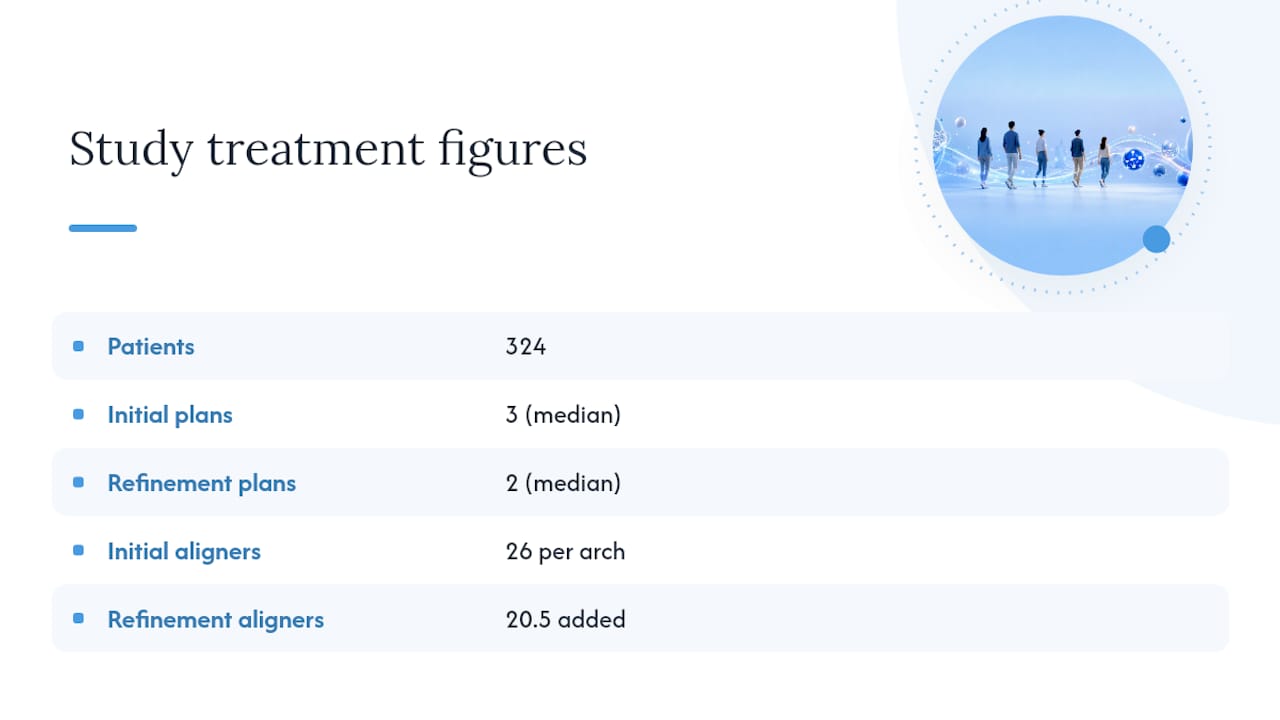
Refinements aren’t a sign something went wrong. They’re closer to the rule than the exception. A retrospective study of 324 patients found a median of three initial digital treatment plans and two refinement plans per patient, with initial aligner counts around 26 per arch and refinement rounds adding roughly 20.5 more. Nearly every patient in that cohort needed at least one round.
A single refinement round typically adds anywhere from a few weeks to a couple of months, depending on how many teeth still need adjustment and how quickly your clinic can turn around new trays.
Clinical commentary on refinement rounds and diminishing returns points out that pushing past three or four refinement cycles rarely produces proportional improvement. At that point, most clinicians weigh whether a minor cosmetic compromise is more sensible than chasing a marginal gain with another two months of trays.
How Do You Keep Your Invisalign Timeline on Track?
Delays almost always trace back to a handful of preventable causes, and you have more control over your invisalign timeline than most patients realize.
Build wear time into your routine: Plan meals so aligners come out only for eating and drinking, then go straight back in.
Keep a spare case and travel set: Losing an aligner mid trip is one of the most common causes of a stalled schedule.
Show up for every check-in: Many clinics now offer remote monitoring between visits, catching tracking issues before they snowball into a refinement.
Protect your oral hygiene: Cavities or gum issues discovered mid-treatment can pause your plan entirely while they’re treated.
Pro Tip: If you’re headed on a trip longer than your next scheduled visit, ask your dentist for extra aligner sets in advance with clear instructions on when to progress. It costs you nothing and prevents the kind of gap that turns into a missed appointment and a stalled plan.
Specific rules on what you can eat, drink, and how to handle your aligners day to day are laid out in Mersal Dental’s guide to eating and drinking with Invisalign.
How Does Mersal Dental Estimate and Manage Your Timeline?
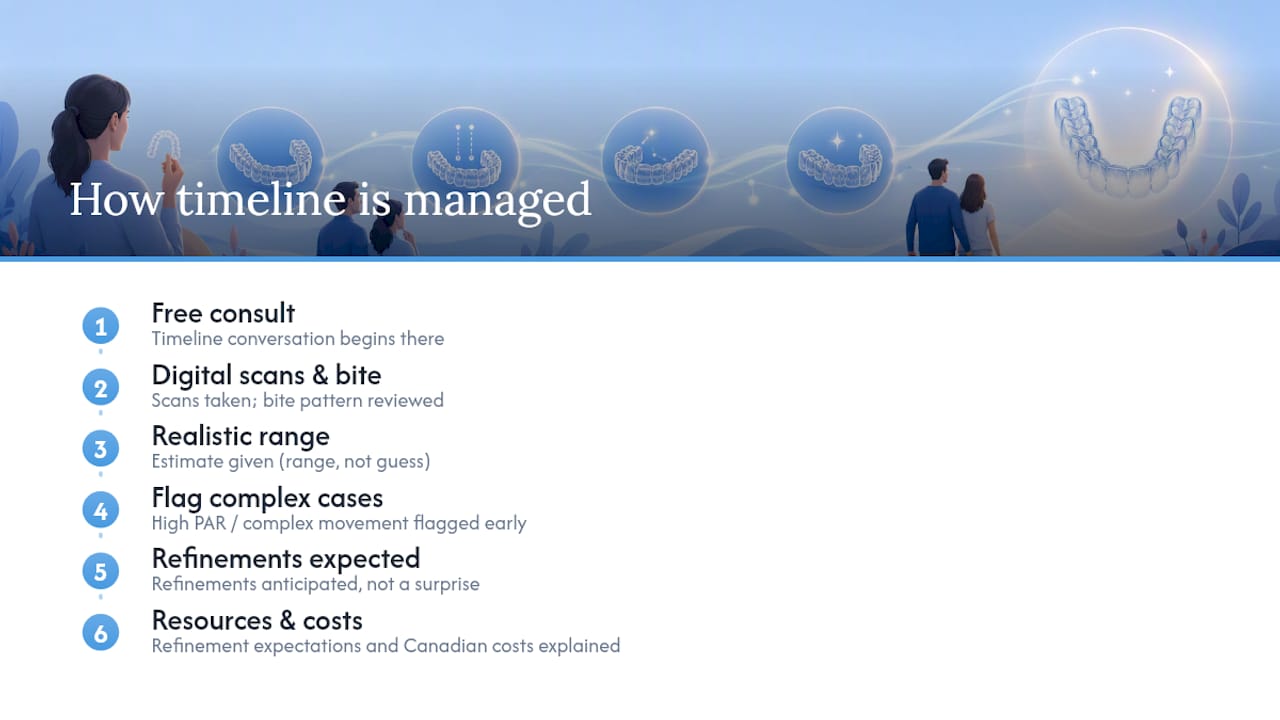
At your consult, digital scans are taken and your bite pattern is reviewed before providing a realistic range rather than a guess. Cases with higher PAR scores or more complex movement get flagged early so refinements are expected, not a surprise. The Invisalign page outlines the full workflow, and the free consult is where that timeline conversation actually starts. There are resources to walk you through refinement expectations and Canadian cost details upfront, so nothing catches you off guard mid-treatment.
Our Take: What Actually Determines Your Timeline
Your invisalign treatment time comes down to case severity and compliance, not luck. Most patients land in that 12 to 18 month window, but the honest answer only comes from scans and a real conversation about your bite. Bring any old records or photos to your consult. Booking a free consult gets you a number you can actually plan around.
— Mersal
Get a Personalized Invisalign Timeline at Mersal Dental
A generic average won’t tell you when your own smile will be done. What will is a digital scan, a real conversation about your bite, and a clinic that lays out cost and insurance options before you commit to anything.
At your consult, a digital scan is taken, and a realistic timeline estimate based on your case is provided along with cost and insurance details, including information on billing and CDCP eligibility, so there are no surprises halfway through treatment. If you’re weighing Invisalign against other dental priorities, the full services page covers other dental services available. Ready to see where your case actually falls on the timeline? You can book a consult to get a number specific to your smile, not a general estimate pulled from an average.
Selected Studies and Resources
Findings on treatment length, malalignment predictors, and refinement frequency cited above come from peer-reviewed orthodontic research; clinic-specific guidance is drawn from Mersal Dental’s Invisalign and consult pages.
This article is general information, not a substitute for advice from a qualified doctor. Consult a qualified healthcare professional about your own circumstances before acting on anything here.
Recommended
Comments