When to Replace Amalgam Fillings and How to Minimize Mercury Exposure


Routine removal of intact amalgam fillings is not recommended. The FDA and dental associations like the CDA advise replacing amalgam only when a filling is failing, causing symptoms, or when a clinician identifies a genuine medical reason. Safe removal protocols exist for when replacement is warranted, and some dental offices follow them.
TL;DR:
Replacing amalgam fillings should only occur if they are failing, causing symptoms, or if there is a genuine medical reason, not routinely.
The safest removal protocols include isolation, suction, sectioning the filling, cooling, and using proper filtration to minimize mercury vapor exposure.
Replacement choices depend on the tooth and bite force, with composite, glass ionomer, and ceramic being common options, each with specific benefits and limitations.
Costs vary significantly based on material and tooth location, and insurance coverage often distinguishes between medical necessity and cosmetic reasons.
Dentists should clearly explain their safe-removal process, recommend appropriate materials, and provide a written treatment plan before proceeding.
Table of Contents
When Should You Consider Replacing an Amalgam Filling?
A healthy, well-sealed amalgam filling doing its job does not need to come out. Removing it anyway strips away sound tooth structure and briefly raises your mercury vapor exposure during the procedure itself, according to the FDA’s patient guidance. That’s the opposite of what most people assume when they hear “removal reduces exposure.”
Replacement makes sense when the filling itself is telling you something is wrong. Watch for these signs:
Secondary caries forming underneath or around the edges of the old filling
Fracture of either the filling material or the surrounding tooth
Marginal ditching, where the metal has worn below the tooth’s surface and left a gap that traps plaque
Looseness or mobility of the restoration when you bite down
Persistent pain or sensitivity that doesn’t resolve on its own
Beyond clinical failure, plenty of people request replacement for aesthetic or prosthetic reasons. A large, dark amalgam filling visible in your smile line is a legitimate reason to switch to a tooth-colored material, especially if the tooth also needs a crown or larger rebuild. A study of 318 posterior restorations found aesthetic concern was actually the single most common reason patients asked for replacement, ahead of decay or fracture.
Medical reasons are less common but real. Documented mercury allergy, certain kidney conditions, or neurological concerns are worth discussing with your physician before deciding, and your dentist should coordinate that conversation rather than make the call alone. This is a decision you make together, not one your dentist hands down or you demand outright.
Weighing the Benefits and Risks of Replacement
Replacing a failing or unsightly amalgam filling can genuinely improve how your tooth looks, feels, and functions. A new composite or ceramic restoration bonds to the tooth rather than simply filling a mechanically cut space, which often means a tighter fit and a more natural bite once your dentist shapes it correctly.
There are real trade-offs, though, and they matter more than most patients expect.
In the numbers: Among the 318 restorations reviewed in one clinical evaluation, aesthetic need drove 98 replacement requests, ditching or discoloration accounted for 64, secondary caries for 57, and fracture for 44. Notably, amalgam in that sample showed longer longevity and lower secondary caries rates than composite, which cuts against the assumption that newer automatically means better.
Removal itself carries risks worth naming plainly:
Brief mercury vapor exposure during drilling, higher than the low baseline release from a stable, intact filling
Loss of additional healthy tooth structure beyond what the original filling required
A small chance of pulp irritation or injury, particularly on deep or old fillings
The possibility that removal reveals more decay than expected, requiring a bigger restoration than planned
The practical takeaway from the FDA and groups like the CDA is consistent: don’t remove a functioning filling purely to lower your mercury exposure. The math doesn’t favor it unless there’s a clinical or medical reason driving the decision.
What Does a Safe Amalgam Removal Protocol Look Like?
If replacement is the right call, how your dentist removes the old filling matters as much as what goes in afterward. Published protocols, including approaches associated with SMART and peer-reviewed clinical guidance, outline specific steps to keep mercury vapor and particulate exposure to a minimum during the procedure.
A safe-removal protocol typically includes:
Isolation with a dental dam to keep fragments and vapor away from your airway and the rest of your mouth
High-volume suction positioned close to the tooth to capture particulate and vapor as it’s generated
Sectioning the filling into chunks with a bur rather than grinding it down, which cuts drilling time and heat
Copious water spray to cool the site and limit vaporization
A fresh, sharp bur for the procedure, since a dull bur generates more heat and friction
Supplemental oxygen or a nasal mask for the patient, reducing inhalation risk
A filtration or evacuation system in the room to manage ambient vapor after the procedure
Each step targets a specific point where mercury vapor or amalgam particles could otherwise reach you or the clinical team. Skipping any one of them doesn’t make removal dangerous outright, but it does raise your exposure during a procedure that’s supposed to reduce it.
Pro Tip: Ask your dentist to walk you through their removal protocol before the appointment. A dentist who can describe each step and explain why it matters is following current, evidence-based practice. Vague answers or a shrug are worth noticing.
Before the appointment, confirm the plan and ask questions. During it, you shouldn’t be surprised by any step. Afterward, ask what was actually found once the old filling came out, since that often changes the final restoration plan.
Which Materials Replace Amalgam, and What Are the Trade-Offs?
There’s no single universal replacement for amalgam. The right material depends on the tooth, the bite forces it handles, and your own caries risk, a point the FDI World Dental Federation makes explicitly in its policy guidance on alternatives.
Composite resin bonds directly to tooth structure and blends in visually, making it the go-to for visible teeth. It’s technique-sensitive, though: moisture control during placement is critical, and some settings see higher secondary caries risk than well-placed amalgam, according to a Cochrane review comparing the two materials head to head.
Glass ionomer releases fluoride over time, which can help protect against new decay around the margins. It’s more forgiving to place but mechanically weaker, so it tends to suit smaller cavities or areas with less chewing force rather than a molar taking the brunt of your bite.
Ceramic onlays and crowns come in when the tooth has lost significant structure or the cavity is too large for a direct filling to hold up long term. They’re stronger and more durable for high-stress back teeth, at a higher cost and with an extra lab step.
Your dentist should match the material to the tooth, not apply one default choice across every replacement. A small anterior filling and a cracked lower molar rarely call for the same solution.
What Happens During the Replacement Appointment?
A replacement appointment follows a fairly predictable sequence, and knowing it ahead of time makes the visit far less stressful.
Your dentist examines the tooth and reviews radiographs to confirm the extent of decay or damage before touching anything.
You’ll discuss the plan and give informed consent, including which material is going in and why.
Local anesthesia numbs the area, and isolation (often a dental dam) goes in to protect your airway and keep the site dry.
The old amalgam comes out using the sectioning and suction steps described earlier, followed by a check for any decay underneath.
If decay runs deep, your dentist may place a protective liner or base before building up the new material.
The new filling, onlay, or provisional restoration goes in and gets shaped to your bite.
If decay turns out to be more extensive than expected, the plan can shift mid-appointment toward a crown or, in rare cases, a root canal. Expect some sensitivity to hot, cold, or pressure for a few days afterward, and stick to softer foods on that side until it settles. Over-the-counter pain relief is usually enough to manage any discomfort.
Does Timing Matter for Pregnancy or Medical Conditions?
Timing is one of the most overlooked parts of this decision, and it deserves more attention than most people give it.
Pregnancy and breastfeeding: Elective removal is generally deferred until after breastfeeding ends, since it’s not urgent and briefly raises exposure during a sensitive period. If removal becomes necessary for a genuine dental reason, your dentist should coordinate closely with your physician.
Kidney or neurological conditions: Talk with your physician before scheduling elective replacement, since these conditions can affect how your body handles even the temporary rise in mercury exposure during removal.
Integrative detox programs: If you’re following a medical detox protocol, coordinate the timing and monitoring with the provider running that program rather than scheduling removal independently.
Emergencies override all of this: A fractured tooth, an abscess, or uncontrolled pain doesn’t wait for ideal timing, and your dentist will treat it as the priority it is.
None of this is about fear. It’s about sequencing care sensibly when there’s no urgent reason to rush.
What Does Filling Replacement Cost, and Will Insurance Cover It?
Costs vary by material, tooth location, and how much of the tooth needs rebuilding, so any number you see online is a rough band, not a quote. Composite fillings generally cost more than the amalgam they replace, and a ceramic onlay or crown costs considerably more than either, largely because of the lab work involved.
Ask your insurance provider whether replacement is covered for medical necessity versus purely cosmetic reasons, since many plans treat the two very differently.
Request documentation from your dentist (radiographs, notes on decay or fracture) if your insurer requires proof the old filling was actually failing.
If your dentist finds more damage once the old filling is out, ask upfront how that changes the estimate, particularly if a crown becomes necessary.
Public programs and direct billing arrangements can offset costs significantly, so it’s worth asking your clinic what they accept before you assume a treatment is out of reach.
How Do You Choose a Dentist and What Should You Ask?
Not every dentist approaches amalgam replacement the same way, and the questions you ask before booking tell you a lot about the care you’ll get.
What clinical sign or symptom is driving the recommendation to replace this filling?
Can I see the radiograph or photo showing the issue?
What does your safe-removal protocol include, step by step?
Which replacement material do you recommend for this specific tooth, and why?
What’s the realistic outcome, and could this escalate to a crown?
What will this cost, and what will my insurance likely cover?
What does aftercare and follow-up look like?
How long should I expect the new restoration to last?
What happens if you find more decay than expected mid-procedure?
Can I get a written treatment plan before we start?
Watch for red flags: a dentist recommending removal of every amalgam filling regardless of condition, or one who can’t clearly describe their safe-removal steps when you ask.
Pro Tip: Request pre- and post-op photos along with a written plan before the appointment. It gives you a record of what was actually found and done, which is useful for insurance and for your own peace of mind.
Why We Treat This as a Clinical Decision, Not a Default
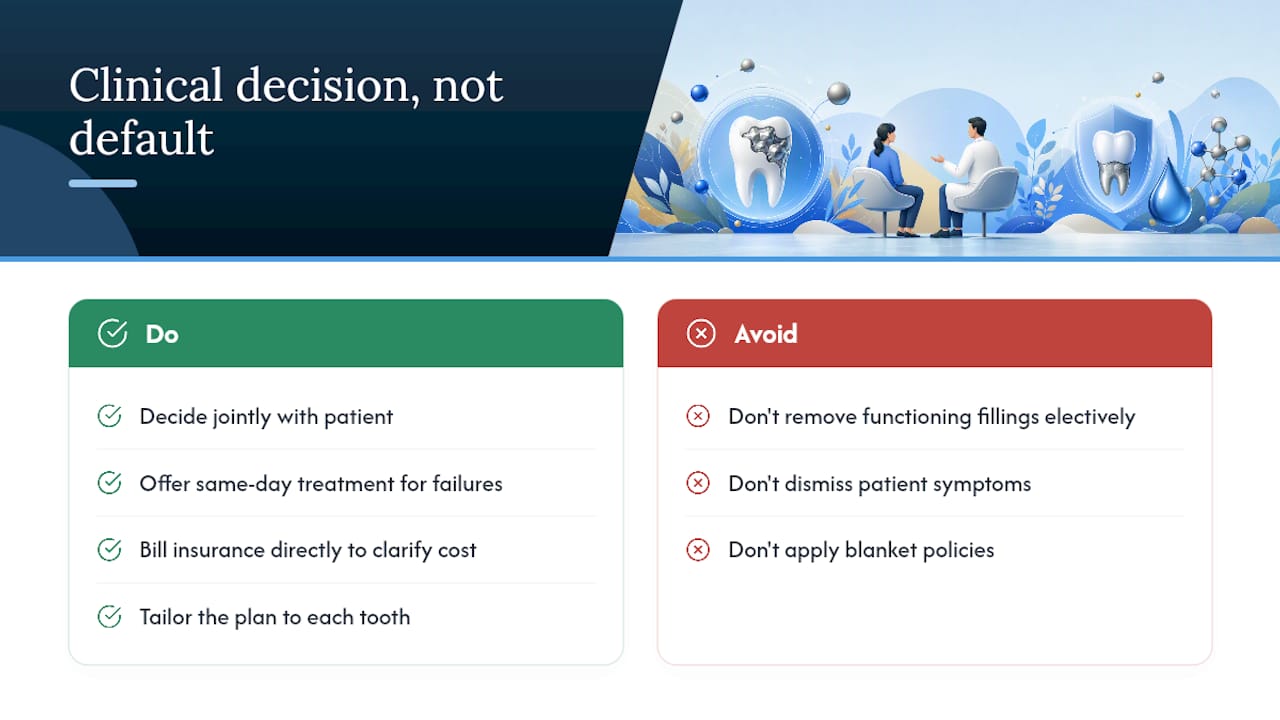
We built our approach around one principle: the decision to replace an amalgam filling belongs to the patient and dentist together, based on what’s actually happening in that tooth, not on a blanket policy in either direction. We don’t push elective removal on fillings that are doing their job, and we don’t dismiss real symptoms, either.
Practically, that means same-day treatment when a filling fails unexpectedly, direct insurance billing so cost isn’t a mystery, and acceptance of public dental coverage programs for eligible patients. Every plan we write out is specific to the tooth in front of us, not a template applied across the board.
— Mersal
How Mersaldental Can Help With Filling Replacement
If you’re weighing whether an amalgam filling needs attention, you can consult a full-service family dental office that handles everything from the initial exam and radiographs to safe removal and the new restoration in one coordinated plan.

Some dental offices accept direct insurance billing and public dental coverage programs, allowing patients to find out coverage before treatment starts. Same-day and emergency appointments may be available if a filling has already failed or you are in pain. Explore our restorative and general services or book an exam to get a clear, individualized plan for your tooth.
Sources
This article is general information, not a substitute for advice from a qualified doctor. Consult a qualified healthcare professional about your own circumstances before acting on anything here.
Recommended
Comments