Dental Implants or Dentures: Which Is Right for You?

Updated: Jul 22
Should you get dental implants or dentures?
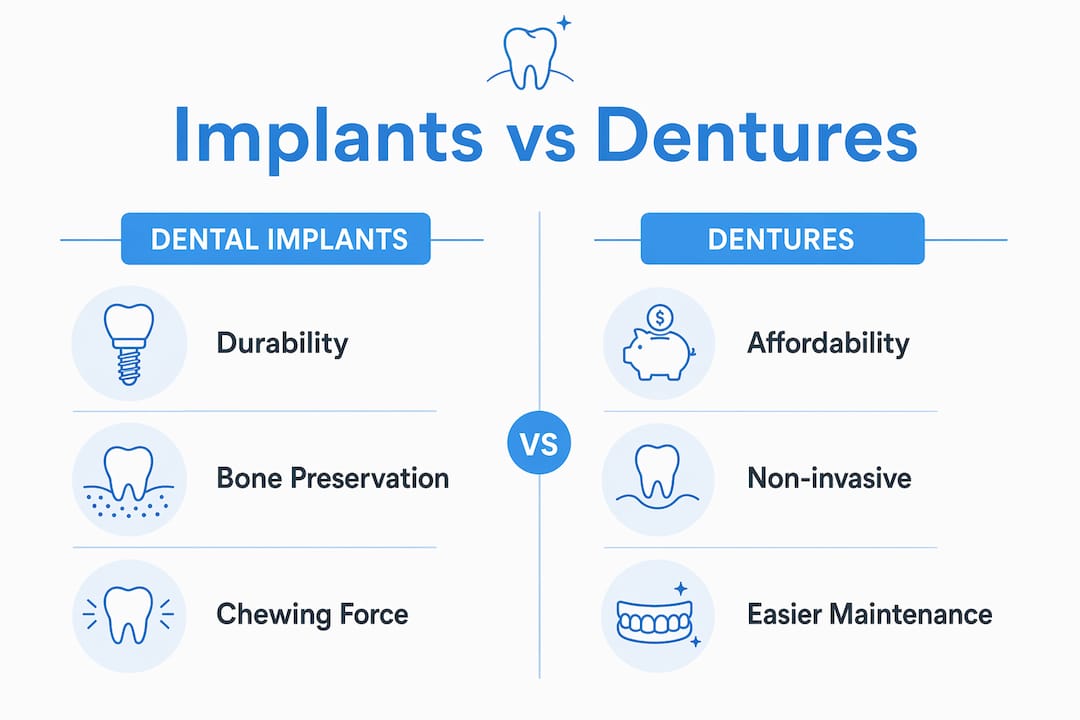
Dental implants are the stronger long-term choice for most adults who qualify. They restore close to natural chewing function, preserve your jawbone, and require no removal or adhesive. Dentures, by contrast, are faster to get, cost less upfront, and work well for patients who cannot undergo surgery or need an immediate solution.
Here is a quick side-by-side to orient your decision:
Function: Implants restore a high proportion of natural bite force; dentures restore a significantly lower proportion.
Appearance: Implants look and feel like natural teeth. Dentures can look natural at first but may shift visibly over time.
Surgery: Implants require a surgical procedure and months of healing. Dentures involve no surgery.
Bone health: Implants stimulate the jawbone and prevent bone loss; dentures accelerate it.
Longevity: Implants can last many years with proper care. Dentures typically need more frequent replacement.
Cost: Dentures cost less upfront. Over 20–25 years, the cumulative cost of replacements and maintenance can approach implant costs.
Maintenance: Implants are cleaned like natural teeth. Dentures must be removed, soaked, and cleaned daily.
Neither option is universally better. Your bone density, overall health, budget, and personal priorities all shape which path makes sense for you.
What does each procedure actually involve?
Understanding the process helps you set realistic expectations before you commit.
Dental implants
Implant placement is a surgical procedure performed under local anesthesia, often with sedation available for comfort. Your dentist or oral surgeon places a titanium post directly into your jawbone, where it acts as an artificial tooth root. After placement, you enter a healing phase called osseointegration, during which the bone fuses around the post. This process takes 3–6 months on average. Once healed, your provider attaches an abutment and a final crown, bridge, or implant-supported denture.
Requires a full oral health evaluation and imaging before surgery
May need bone grafting if jawbone density is insufficient
A temporary restoration can be placed during healing so you are not left with a visible gap
Full treatment from surgery to final crown typically spans several months
Traditional dentures
Dentures are a non-surgical option. After any necessary extractions heal, your dentist takes impressions of your gums and remaining teeth. A custom appliance is fabricated and fitted, often within a few weeks. Immediate dentures can be placed the same day as extractions, though they usually require adjustments as your gums change shape during healing.
No surgery, no general anesthesia, and no osseointegration period
Fitting and adjustments can take several appointments
Adaptation to speaking and eating with dentures takes days to weeks
Implant-supported dentures combine both approaches: implant posts anchor a removable or fixed denture for better stability
How do the costs compare over time?
Dentures cost less upfront, but the long-term financial picture is more complicated.
Traditional full dentures generally run a few hundred to a few thousand dollars per arch, depending on materials and your location. Dental implants carry a much higher initial cost, often several thousand dollars per tooth when you factor in the post, abutment, and crown.
Dentures require periodic relines as your jawbone changes shape
Over 20–25 years, dentures typically need 3–4 full replacements plus adhesives and relines
The cumulative cost of denture maintenance over many years can approach or exceed the original implant investment
Implants, once placed successfully, rarely need replacement beyond the crown component
Pro Tip: Ask your dentist for a 10-year cost projection, not just the day-one price. Many patients are surprised to find that implants become the more affordable option over a full decade of use.
Insurance coverage varies widely. Many dental plans cover a portion of denture costs but offer limited or no coverage for implants, which are often classified as elective. The Canadian Dental Care Plan (CDCP) covers certain restorative procedures for eligible patients. Financing plans and payment options are worth discussing with your dental office before ruling out implants on cost alone.
What does daily maintenance look like for each option?
Implants are the lower-maintenance choice in day-to-day life. You brush and floss them exactly as you would natural teeth, and you attend regular dental checkups. There is no removal, no soaking, and no adhesive required.
Dentures demand more of a daily routine:
Remove dentures every night to let your gum tissue rest
Soak them in a denture-cleaning solution or water overnight
Brush the appliance gently with a soft brush to remove food and bacteria
Apply adhesive each morning if your dentures do not fit snugly
Visit your dentist regularly for relines as your jawbone changes shape
The fit issue is worth highlighting. Because dentures rest on your gums rather than anchoring into bone, they gradually become loose as the jawbone shrinks beneath them. That loosening is not a sign of a poorly made appliance. It is a predictable result of bone resorption, and it means ongoing appointments and adjustments are part of denture ownership for life.

What are the risks and complications of each option?
Both options carry risks, and being clear-eyed about them helps you make a confident choice.
Implant risks
Surgical risks include infection, nerve irritation, and injury to surrounding tissue
Implants fail in approximately 5–10% of cases due to infection, poor osseointegration, or mechanical problems
Failure may require removal and a second surgical procedure
Smokers and patients with uncontrolled diabetes face higher failure rates
Post-surgical discomfort is normal but typically resolves within days to weeks
Denture risks
Chronic gum soreness from friction is common, especially with poorly fitting appliances
Slipping during eating or speaking can be embarrassing and affect confidence
Long-term bone resorption under the denture leads to a condition sometimes called “denture face,” where the lower third of the face appears sunken or collapsed
Patients who wear dentures for 10–20 years often experience significant facial shape changes as the jawbone shrinks beneath the prosthetic
Ongoing gum irritation can progress to sores or infections if the fit is not corrected promptly
The pain profile differs meaningfully between the two. Implant surgery causes temporary discomfort that fades as healing progresses. Dentures, by contrast, can cause chronic irritation that persists for years if the fit is not regularly adjusted. Many patients who switch from dentures to implants report that the short-term surgical recovery was far preferable to years of daily gum soreness.
Which option is right for you? Key factors to consider
Your personal health profile matters more than any general recommendation.
Bone density
Dental implants require sufficient jawbone volume to anchor the titanium post securely. If you have experienced significant bone loss, you may need a bone graft before implant placement, which adds time and cost. Patients with severe bone loss who are not candidates for grafting may find dentures or implant-supported overdentures more realistic. You can read more about bone loss and implant candidacy to understand your options before your consultation.
Age and overall health
There is no upper age limit for dental implants. The minimum is typically 18, once jaw growth is complete. What matters more than age is your overall health. Uncontrolled diabetes, active gum disease, certain autoimmune conditions, and bisphosphonate medications for osteoporosis can all affect healing and implant success. A thorough medical history review with your dentist is the only way to know for certain.
Hygiene habits
Implants reward good oral hygiene. If you brush and floss consistently and attend regular checkups, an implant can last a lifetime. Dentures require diligent daily cleaning too, but the consequences of poor hygiene differ. Neglected dentures harbor bacteria that irritate gum tissue. Neglected implants risk peri-implantitis, a gum infection around the implant that can lead to failure.
Function and quality of life
If eating comfortably and speaking clearly are priorities, implants offer a clear advantage. The bite force difference is substantial. Patients with dentures often avoid hard, crunchy, or sticky foods entirely. Implant patients generally eat without restriction. Speech adaptation is also faster with implants, since the appliance does not shift or slip.
Aesthetic preferences
Both options can look natural. Implants tend to maintain that appearance longer because they preserve the jawbone that gives your face its shape. Dentures look good initially but may contribute to a sunken facial appearance over years of use as the underlying bone resorbs.
Are there alternatives beyond implants and dentures?
Yes, and for some patients, a middle-ground solution fits better than either extreme.
Implant-supported overdentures: A removable denture that snaps onto two to four implant posts. This option provides far better stability than traditional dentures while costing less than a full fixed implant restoration. It also slows bone loss in the areas where implants are placed.
Dental bridges: A fixed prosthetic that anchors to adjacent natural teeth, replacing one or a few missing teeth without surgery. Bridges do not require implants, but they do involve reshaping healthy neighboring teeth. You can explore bridge versus implant options in more detail to see which fits your situation.
Temporary or transitional dentures: Worn during the implant healing period, these keep your smile intact while osseointegration completes. They are not a permanent solution but serve an important role in multi-stage implant treatment.
Partial dentures: For patients missing only some teeth, a removable partial denture is a lower-cost alternative to a bridge or multiple implants.
If you currently wear dentures and are wondering whether implants are still possible, the answer is often yes. Transitioning from dentures to implants is a well-established path, and your dentist can evaluate whether your remaining bone supports it.
What does the research say about long-term outcomes?
The clinical evidence consistently favors implants for functional and oral health outcomes, though dentures remain a legitimate option for the right patient.
The bite force difference alone has real consequences. Restoring 90–95% of natural chewing force with implants versus 20–25% with dentures affects not just comfort but nutrition. Patients who cannot chew effectively tend to avoid fibrous vegetables, lean proteins, and other foods that require real bite force, which can affect overall health over time.
Bone preservation is the other major clinical argument for implants. The jawbone requires stimulation from tooth roots to maintain its density. When a tooth is lost and not replaced with an implant, the bone in that area begins to resorb. Dentures rest on the gum surface and transmit pressure to soft tissue rather than bone, so they do not provide that stimulation. The Cleveland Clinic notes that implants actively prevent the bone shrinkage that leads to facial changes over time. Dentures, by contrast, accelerate that process.
Implant success rates are high. StatPearls and NCBI data cite 85% success at 5 years and 80% at 10 years as minimum benchmarks, with many patients experiencing success well beyond that. The FDA classifies dental implants as medical devices and notes that complications, while possible, are manageable when patients follow proper oral hygiene and attend regular checkups.
Pro Tip: Before your consultation, write down your top three priorities: cost, recovery time, long-term function, or appearance. Sharing that list with your dentist helps them tailor a recommendation to your actual life, not just your clinical profile.
Patients who are not good candidates for implants due to bone loss, systemic health conditions, or financial constraints are not left without options. Dentures, particularly implant-supported overdentures, can provide meaningful improvement in quality of life. The goal is always to find the solution that works best for your specific situation, not to push every patient toward the most expensive treatment.
Key Takeaways
Dental implants outperform dentures on function, bone preservation, and long-term durability, but dentures remain a practical and valid choice for patients with health, bone, or budget constraints.
Point | Details |
Bite force restoration | Implants restore a large proportion of natural chewing force; dentures restore much less. |
Bone health | Implants stimulate the jawbone and prevent resorption; dentures accelerate bone loss over time. |
Long-term cost | Dentures need multiple replacements over many years; cumulative costs can approach implant investment. |
Healing timeline | Implant osseointegration takes several months; dentures can be fitted within weeks of extraction. |
Implant success rate | Clinical benchmarks set implant success rates at five and ten years as standards. |
Ready to find out which option fits you?
At Mersaldental, we know this decision carries real weight. Our team in lower town Ottawa takes the time to review your bone density, health history, and goals before making any recommendation. We accept new patients, offer direct insurance billing, and work with the Canadian Dental Care Plan (CDCP) and IFHP programs to make care as accessible as possible.
Whether you are leaning toward implants, dentures, or something in between, we can walk you through your options at a pace that feels comfortable. Book a consultation with us today, or explore our full range of restorative dental services to learn more about what we offer.
Recommended
Comments