Toothache at Night? Clinician Steps to Sleep and Seek Same Day Care
- Mayde Mersal
- 2 days ago
- 7 min read

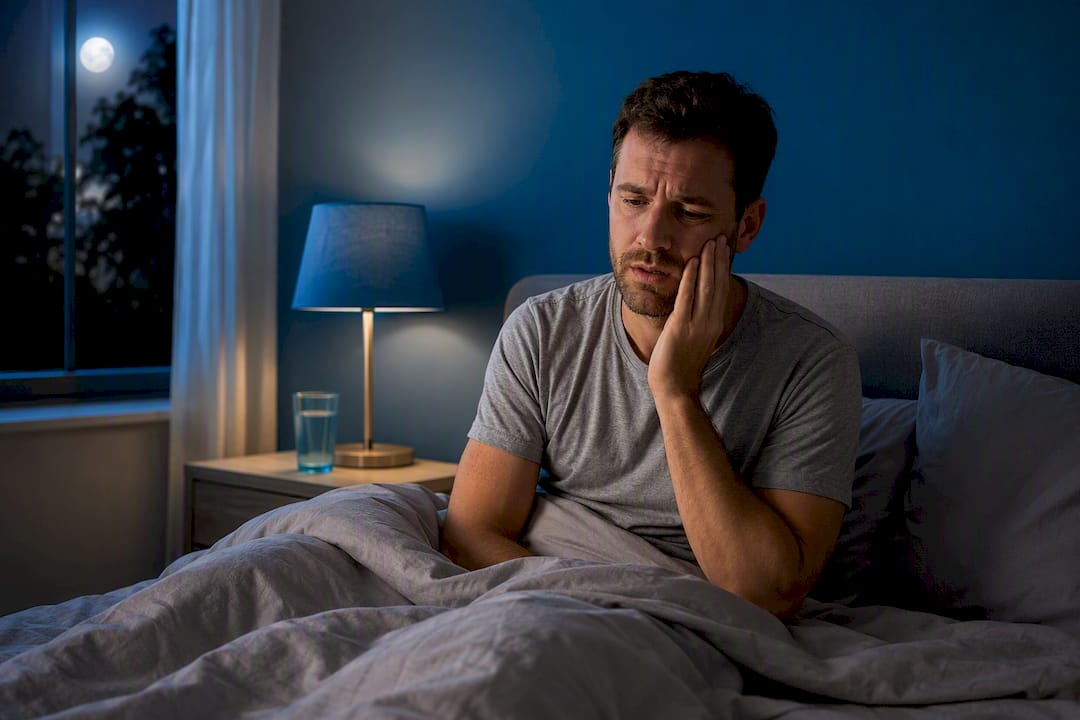
If a toothache is waking you up, the fastest safe steps are to prop your head up 20 to 30 degrees, take ibuprofen if you have no reason to avoid it, hold a cold compress against your cheek, and rinse with warm salt water. These measures buy you comfort until morning, not a cure. If you notice facial swelling, fever, or pain that shrugs off medication, call a dentist for same-day care. Mersaldental offers same-day emergency appointments for exactly this kind of night.
TL;DR:
Elevating the head reduces blood pressure in inflamed areas, alleviating pain caused by pressure buildup during sleep.
Taking ibuprofen before bed offers more effective pain relief than acetaminophen, especially for inflammation-related toothache.
Signs like spreading facial swelling, difficulty swallowing, or a high fever require immediate emergency care, not home management.
Diagnosing the cause of nighttime pain involves clinical exam and X-ray, with treatment options including fillings, root canals, or extractions.
Home remedies only provide temporary relief and may mask worsening infections, emphasizing the need for prompt dental evaluation.
Table of Contents
Why does a toothache get worse at night?
Lying down changes the physics of your head. Gravity no longer pulls blood away from your face, so pressure builds in the vessels around an inflamed tooth, and that pressure reads as throbbing. It is the same reason a headache can intensify when you bend over.
Nighttime brings other shifts working against you. Cortisol, the hormone that helps blunt pain during the day, drops in the evening hours, leaving nerve signals less muted. Distractions disappear too. Without conversation, screens, or work to occupy your attention, your brain has nothing to compete with the pain signal.
Saliva production also slows overnight, and that matters more than most people realize. A drier mouth gives bacteria more room to act and leaves exposed nerve endings more sensitive to temperature and pressure.
Blood pooling in the head raises pressure on inflamed nerves
Falling cortisol reduces your body’s natural pain control
Fewer distractions let pain dominate your attention
Lower saliva flow increases sensitivity and bacterial activity
What causes tooth pain to flare up overnight?
Not every toothache has the same root cause, and the pattern of pain often points to what’s going on underneath.
Deep decay and irreversible pulpitis cause spontaneous, throbbing pain that can wake you from a sound sleep, even without biting or touching anything. That spontaneous quality, pain with no trigger, is one of the clearest signals that the nerve inside the tooth is inflamed beyond recovery.
A dental abscess produces similar throbbing but adds swelling, sometimes a low fever, and a foul taste or odor from the affected area. Curiously, pain from an abscess can suddenly ease once it finds a path to drain, but that relief doesn’t mean the infection is gone — it still needs treatment.
A cracked or fractured tooth hurts sharply when you bite down or when hot and cold foods hit the crack line, then eases just as quickly once the trigger is removed.
Bruxism, or nighttime teeth grinding, shows up differently: soreness across several teeth and jaw stiffness that’s worse in the morning rather than a single throbbing tooth.
Pulpitis: spontaneous throbbing, often the worst overnight
Abscess: throbbing plus swelling, fever, or bad taste
Cracked tooth: sharp pain tied to biting or temperature
Bruxism: multi-tooth soreness and morning jaw fatigue
Gum infection or sinus pressure: dull ache that can mimic tooth pain but shifts with head position
How to sleep with a toothache tonight
Getting through the night comes down to controlling pressure, inflammation, and irritation, in that order.
Elevate your head 20 to 30 degrees. Use a foam wedge or sleep in a recliner rather than stacking regular pillows, which compress and flatten within an hour, undoing the effect you need. A stable incline reduces blood pressure at the site of pain far more reliably than a pile of cushions.
Take an NSAID if you can. Ibuprofen at 400 to 600 mg outperforms acetaminophen for inflammatory dental pain in clinical comparisons. If ibuprofen is off the table due to stomach issues, kidney problems, pregnancy, or a blood thinner, acetaminophen is the safer alternative. Some people alternate the two on a staggered schedule to maintain coverage through the night, but check with a pharmacist first if you’re on other medications.
Apply a cold compress. Hold it against the outside of your cheek, not directly on the tooth, for 15 to 20 minutes on and off to shrink swelling and dull the ache.
Rinse with warm salt water. Mix half a teaspoon of salt into 8 ounces of warm water and swish gently. This temporarily reduces bacteria and calms irritated gum tissue, and you can repeat it before bed and again if you wake up.
Be careful with topical numbing gels. Benzocaine products can mask a worsening infection and carry specific warnings against use in young children. Never place an aspirin tablet directly against the gum. It doesn’t numb anything and can burn the tissue.
Sleep on the opposite side, avoid pressing your cheek into the pillow, skip very hot or cold food and drink before bed, and floss gently around the sore tooth to clear out trapped debris.
Pro Tip: Take your pain reliever about 30 minutes before lying down. Swallowing it early gives the medication time to start working before the nighttime pressure buildup begins, instead of chasing pain that’s already peaked.
For sensitivity that lingers even after the acute flare calms down, our guide on treating cold sensitive teeth covers longer-term fixes.
When is nighttime tooth pain a dental emergency?
Some signs mean you should stop managing this at home and get help immediately.
Swelling that spreads toward your eye, neck, or is closing your eyelid
Difficulty breathing or swallowing
A high fever alongside facial swelling
Symptoms that are visibly worsening within hours
These point to an infection that could be spreading beyond the tooth, and they call for an emergency room or urgent dental visit, not a wait-and-see approach.
Other signs don’t require an ambulance but do mean you need a dentist that same day: throbbing that doesn’t ease with OTC medication, drainage or a persistent bad taste, or pain sharp enough that biting is unbearable. When you call, describe exactly what you’re feeling: which tooth, how long, whether it wakes you, and whether you see swelling. That detail helps the front desk get you into the right appointment slot faster. If you’re unsure whether your symptoms qualify, our page on same-day dental emergencies walks through what counts.
What happens at the dentist for a nighttime toothache?
A dentist will start with a clinical exam, often including a percussion test (a gentle tap to see which tooth reacts) and a bite test, followed by a periapical X-ray to see below the gumline and confirm whether decay, a crack, or an abscess is behind the pain.
From there, treatment depends on what’s found. A cavity that hasn’t reached the nerve usually just needs a filling. A tooth with an infected or dying pulp typically needs a root canal to remove the damaged tissue and save the tooth. When a tooth is too damaged to restore, extraction becomes the practical option. Antibiotics come into play only when there’s a spreading infection, not for pain relief on its own.
Diagnosis: exam, percussion/bite test, X-ray
Restorable decay: filling
Infected pulp or abscess: root canal
Non-restorable tooth: extraction
Spreading infection: antibiotics alongside treatment
Same-day visits often include drainage of an abscess, a temporary filling, or a prescription to control pain and infection until definitive treatment can be scheduled.
Why home remedies only buy you time
Cold compresses, salt water, and ibuprofen work because they interrupt the mechanisms making your pain worse right now, pressure, inflammation, bacterial load, not because they resolve what started the pain in the first place. That distinction gets lost in a lot of advice online, which tends to present home remedies as a plan rather than a bridge.
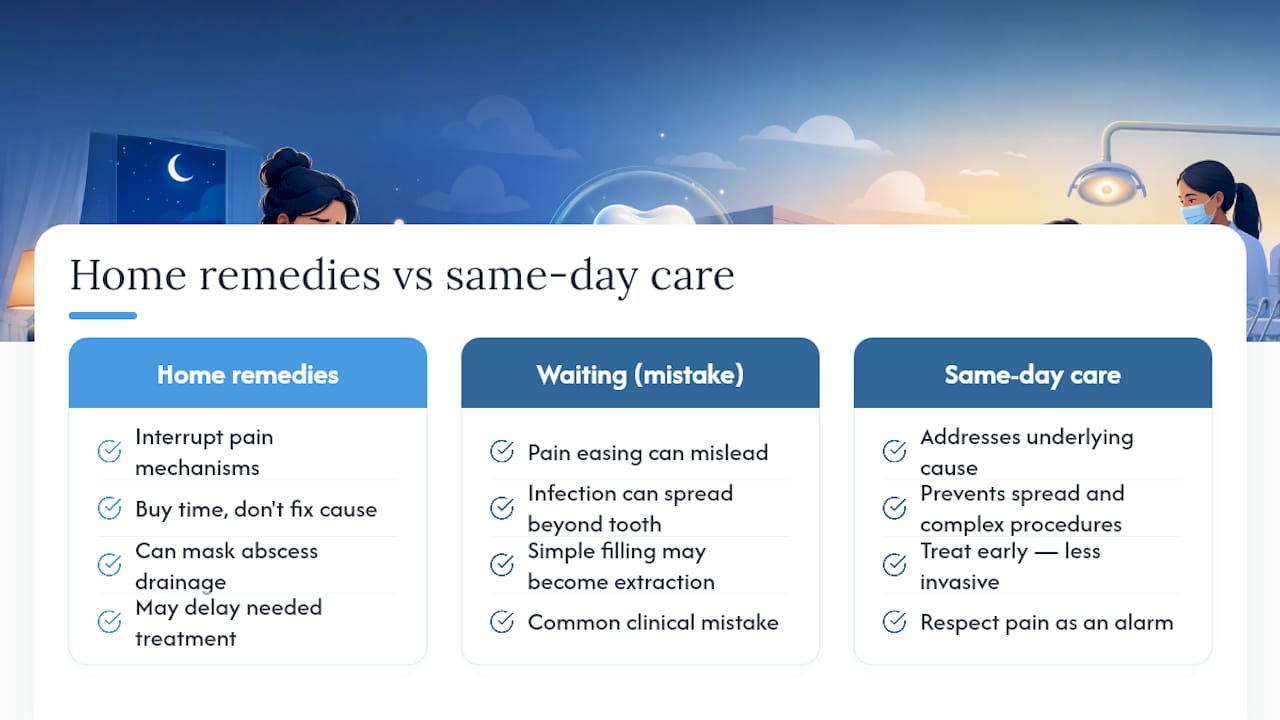
The pattern we see most often is a patient who managed a toothache for a week or two with medication and rinses, only to arrive with an infection that has spread beyond the tooth and now needs a more involved procedure than it would have a week earlier. Pain that eases suddenly is the trickiest case. An abscess finding a drainage path can feel like relief when the infection is actually still active underneath. Waiting because the pain “went away” is one of the more common mistakes we see turn a simple filling into an extraction.
The honest read is that nighttime pain is your body’s alarm system working correctly, not a nuisance to outlast. Respect it, manage it safely through the night, and get it looked at.
— Mersal
Book same-day emergency dental care
Home care gets you through the night. It doesn’t fix a cracked tooth, an infected nerve, or an abscess that needs drainage, and if you’re seeing any of the red flags covered above, waiting for the pain to pass on its own is the riskiest choice you can make. Mersaldental runs same-day emergency appointments for exactly this kind of situation, with direct insurance billing and CDCP acceptance so cost isn’t a barrier to getting seen quickly.

Before you call, have your insurance card or CDCP information ready, along with a quick summary of your symptoms, which tooth, how long, whether swelling is present. That’s enough for our team to triage the call and get you into a chair the same day when needed. If your pain fits the urgent category rather than the emergency category, our extraction and emergency services page outlines what to expect at the visit. And if cost or coverage is part of what’s holding you back, our CDCP and IFHP program page explains what’s covered before you ever walk in. Call, describe what you’re feeling, and let us take it from there.
This article is general information, not a substitute for advice from a qualified doctor. Consult a qualified healthcare professional about your own circumstances before acting on anything here.
Sources
Recommended
Comments