Can You Get Braces With Dental Implants? 2026 Guide


You can get braces with dental implants, but braces only move your natural teeth. The implants themselves stay fixed in place. This distinction shapes every part of your orthodontic treatment plan. Implants are fused directly to your jawbone through a process called osseointegration, which means they behave nothing like natural teeth under orthodontic force. Understanding this difference helps you set realistic expectations and work with your dental team to get the best possible result.
Can you get braces with dental implants? What the biology tells us
Dental implants cannot be moved by braces or any orthodontic appliance. That is the single most important fact for any patient considering orthodontics with implants already in place.
Natural teeth sit in your jawbone surrounded by a periodontal ligament. That ligament acts like a flexible cushion. When braces apply gentle, sustained pressure, the ligament allows the bone to remodel slowly, and the tooth shifts position over months. Implants have no periodontal ligament at all. They fuse directly to bone through osseointegration, which makes them as fixed as a bolt set in concrete.
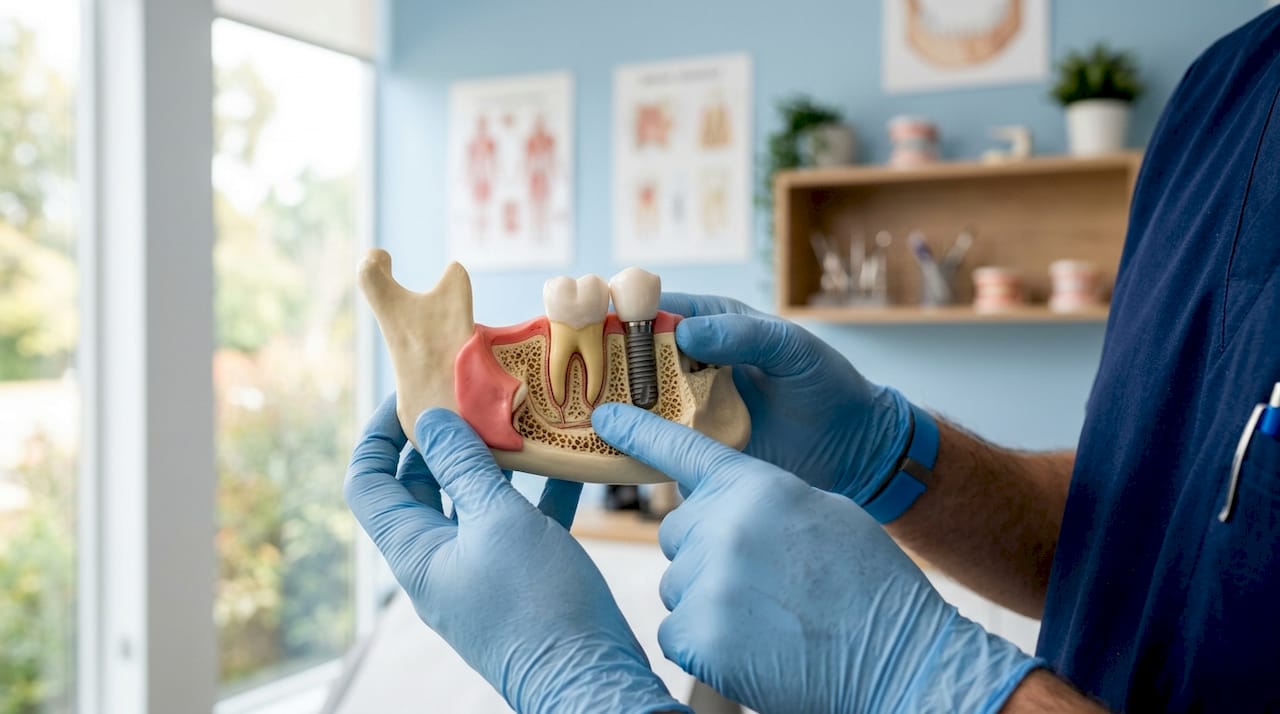
Applying orthodontic force directly to an implant risks implant failure, bone loss around the implant site, and crown fracture. That risk is not theoretical. It is the reason orthodontists treat implants as immovable anchors rather than teeth to be repositioned.
Feature | Natural teeth | Dental implants |
Attached by | Periodontal ligament | Direct bone fusion (osseointegration) |
Can braces move them? | Yes | No |
Response to force | Gradual repositioning | No movement; risk of failure |
Role in braces treatment | Moved to target position | Fixed reference point |
This biological reality does not make orthodontic treatment impossible. It makes careful planning non-negotiable.
Orthodontic strategies for getting braces with implants already in place
Orthodontists use several well-established techniques to work safely around fixed implants. The goal is always to move natural teeth without loading the implant with any orthodontic force.
Segmental orthodontics
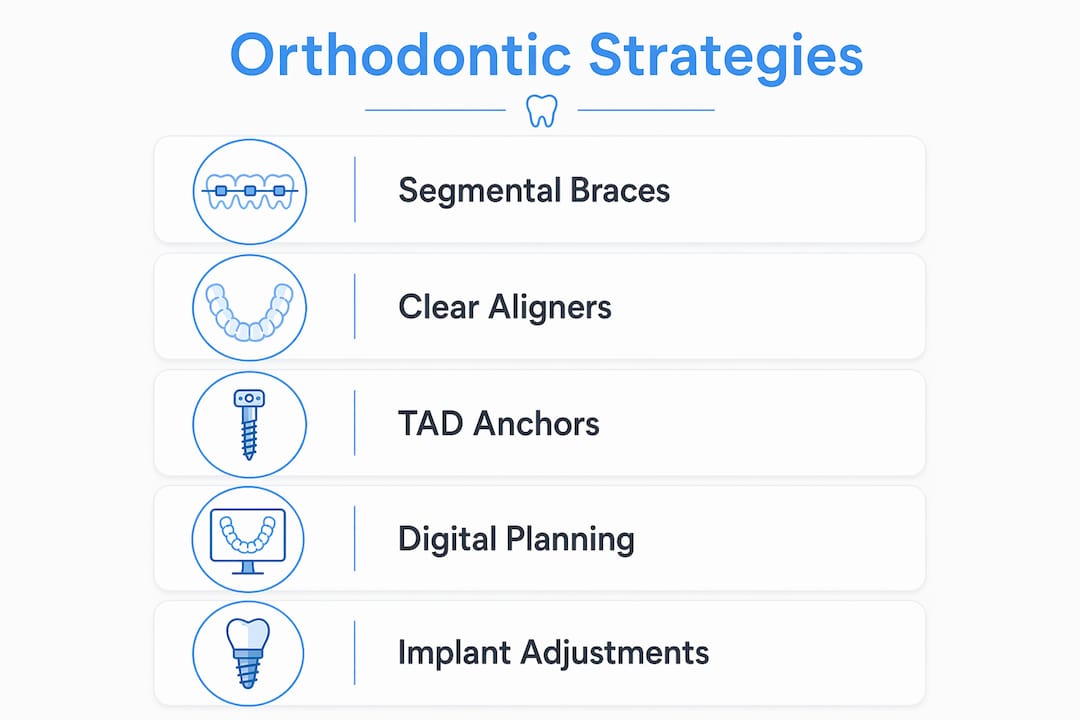
Segmental orthodontics is the most common approach. Instead of running a continuous wire across every tooth, the orthodontist places brackets only on selected segments of natural teeth. The implant crown is left out of the bracket system entirely. This isolates the movement zones and protects the implant from any force transfer.
Clear aligners near implants
Clear aligners are often preferred when implants are present. Aligners apply gentler, intermittent forces compared to the continuous tension of metal braces. That lower force level reduces the risk of accidentally stressing the implant or adjacent bone. Invisalign and similar aligner systems can also be designed to skip the implant crown entirely, treating it as a fixed point in the digital treatment plan. Mersaldental offers free Invisalign consultations so you can explore whether aligners suit your specific situation.
Appliance comparison for implant patients
Here is how the main appliance types compare for patients with existing implants:
Metal braces: Effective for complex tooth movement but require careful wire management to avoid loading the implant. Segmental archwires are typically used.
Ceramic braces: Same mechanical principles as metal braces with a more discreet appearance. The same segmental precautions apply.
Clear aligners: Preferred near implants for gentler forces and easier exclusion of the implant crown from the treatment sequence.
Lingual braces: Placed on the inner surface of teeth. Useful for patients who want discretion, though access for adjustments near implants requires extra care.
Pro Tip: Ask your orthodontist to show you the digital treatment simulation before you start. Seeing exactly which teeth will move and how the implant crown is handled gives you a clear picture of what to expect and flags any concerns early.
After your natural teeth reach their final positions, the implant crown may need minor reshaping or replacement to match the new bite and spacing. Crown adjustments after orthodontics are common and straightforward when planned in advance.
Why braces should come before dental implants when possible
The clinical gold standard is to complete orthodontic treatment first, then place the implant. This sequence gives the most predictable results and avoids the complications that come with working around a fixed implant.
Orthodontists strongly favor completing all tooth movements before implant placement. The reason is simple: once an implant is in, the surrounding teeth cannot be moved into positions that would conflict with the implant site. Placing the implant after braces allows the surgeon to position it precisely in the space your orthodontist has created, with the correct angulation and depth for the final crown.
The recognized 2026 clinical sequence for combined orthodontic and implant treatment follows these steps:
Comprehensive evaluation. X-rays, 3D scans, and a full treatment plan involving both the orthodontist and restorative dentist.
Orthodontic treatment. Braces or aligners move natural teeth to their ideal positions and open or close space as needed.
Retention phase. Retainers hold teeth in place while the bone stabilizes. Retention must be fully stabilized before implant surgery.
Implant placement. The titanium post is placed into the prepared site with precise positioning.
Osseointegration period. The implant fuses to bone over several months.
Crown restoration. The final crown is fitted to match the surrounding teeth in size, color, and bite.
Starting with implant placement before orthodontics creates costly, complex follow-up procedures. The implant locks a position in place that may no longer be ideal once teeth move. Correcting that situation can require surgical implant removal and reimplantation, which adds time, cost, and recovery.
One exception worth knowing: temporary anchorage devices, or TADs, are small titanium screws placed in the jaw to help move teeth. TADs are distinct from permanent implants. They are removed after treatment and do not create the same planning constraints.
Challenges and solutions when braces come after implants
Patients who already have implants and want orthodontic treatment face real but manageable challenges. The difficulty depends heavily on where the implant sits relative to the teeth that need to move.
Implant in a non-critical location. If the implant is far from the teeth being moved, treatment complexity is low. The orthodontist simply excludes the implant crown from the bracket system and proceeds with standard mechanics.
Implant between teeth that need repositioning. This significantly increases complexity. Moving adjacent teeth around a fixed implant requires precise force calibration and close monitoring to avoid unintended pressure on the implant.
Implant in the wrong position for the desired final result. If the implant blocks the planned tooth movement or sits in a position that will look wrong after orthodontics, surgical removal and reimplantation may be the only path forward.
Pro Tip: Before starting orthodontic treatment with existing implants, ask for a multidisciplinary consultation that includes both your orthodontist and your restorative dentist in the same planning session. A shared treatment plan prevents conflicting decisions that cost you time and money later.
Proper coordination between your orthodontist and restorative dentist is not optional in these cases. It is what separates a smooth treatment from a complicated one. Patients with braces after implants should also expect longer monitoring intervals and the possibility of minor crown adjustments at the end of treatment. Planning for that from the start removes the surprise.
If you are weighing whether an implant is even the right solution for your missing tooth, understanding bridge vs. implant options can help clarify the decision before orthodontic planning begins.
Key Takeaways
Braces can work alongside dental implants, but implants are fixed anchors that require specialized techniques and careful sequencing to achieve safe, lasting results.
Point | Details |
Implants cannot move | Osseointegration fuses implants to bone, making them immovable under orthodontic force. |
Braces first is the standard | Completing orthodontics before implant placement gives the most predictable outcomes. |
Segmental orthodontics protects implants | Brackets placed only on natural teeth keep force away from the fixed implant. |
Aligners are often the safer choice | Clear aligners apply gentler forces and can exclude the implant crown from the treatment plan. |
Multidisciplinary planning is required | Coordinating your orthodontist and restorative dentist prevents costly complications. |
What I’ve learned from treating patients with both implants and braces
The most common mistake I see is patients treating their implant and their orthodontic needs as two separate problems to solve one at a time. They get an implant to fill a gap, then come back a year later wanting braces. By that point, the implant has locked a position in place that may not align with where the surrounding teeth need to go. What felt like a practical short-term fix becomes a significant planning constraint.
The patients who get the best outcomes are the ones who bring both questions to the table at once. When we know from the start that someone needs both orthodontic work and an implant, we can sequence everything deliberately. The braces create the right space. The implant goes in exactly where it needs to be. The final crown fits perfectly from day one.
The other thing I want patients to understand is that “getting braces with implants” is not a simple yes or no situation. It is a spectrum. Some cases are straightforward. Others require surgical revision of the implant before orthodontics can even begin. The only way to know which category you fall into is a proper evaluation that looks at the full picture, not just the teeth that seem crooked.
If you are already in a situation where implants are in place and you want orthodontic treatment, do not assume it is too complicated to pursue. It usually is not. But go in with realistic expectations about timeline, monitoring, and the possibility of crown refinements at the end.
— Mersal
Mersaldental can help you plan braces and implants together
Navigating orthodontics with existing or planned dental implants takes coordinated care from the start. At Mersaldental in lower town Ottawa, we work with patients to build treatment plans that account for both their orthodontic goals and their implant needs together, not as separate afterthoughts.

We accept new patients, offer direct insurance billing, and accept the CDCP program. Whether you are considering clear aligners, traditional braces, or need guidance on sequencing your implant and orthodontic treatment, our team is ready to help. Book a consultation through our patient services page and get a clear picture of what your treatment path looks like before committing to any single step.
FAQ
Can you get braces with dental implants already in place?
Yes. Braces can move your natural teeth even when implants are present. The implants themselves will not move, so your orthodontist designs the treatment plan around them.
Do dental implants affect how braces work?
Implants act as fixed anchors during orthodontic treatment. They limit which teeth can be moved and require techniques like segmental orthodontics or clear aligners to avoid applying force to the implant.
What happens if an implant is in the wrong position for braces?
If an implant blocks the planned tooth movement, surgical removal and reimplantation may be necessary. This is why completing orthodontics before implant placement is the recommended sequence.
Are clear aligners better than metal braces when you have implants?
Clear aligners are often preferred near implants because they apply gentler, intermittent forces and can be designed to exclude the implant crown from the treatment sequence entirely.
How long does orthodontic treatment take with dental implants?
Treatment with existing implants typically takes longer than standard orthodontics due to more frequent monitoring and possible crown adjustments at the end. Your orthodontist will give you a timeline based on your specific case.
Recommended
Comments