Parents, Don't Wait Until Age 4: When Thumb Sucking Harms Teeth


Thumb sucking on its own rarely harms a child’s teeth. Most kids drop the habit during early childhood, well before it can shift a smile out of place. The real risk begins if sucking continues once permanent front teeth start coming in, and it climbs sharply with how long, how often, and how hard your child sucks, especially if the thumb rests in the mouth for many hours a day. Watch for bite changes after age 3 to 4, and see a dentist if the habit lingers or a gap starts to show.
TL;DR:
Thumb sucking is unlikely to cause dental issues before age 3 but can lead to bite problems if it exceeds six hours daily once permanent teeth emerge.
Prolonged thumb pressure mainly affects the palate and front teeth, often resulting in open bites, overjet, and a high-arched palate.
Behavioral strategies, including positive reinforcement and substitution, are most effective for stopping the habit before considering appliances.
Pacifiers pose similar risks but are easier to control and wean off in early childhood, especially by age 12 months.
Regular dental exams by age one, with detailed habit history, help monitor development and determine if intervention is needed.
Table of Contents
How Thumb Sucking Teeth Effects Show Up in the Mouth
The damage from thumb sucking isn’t really about the thumb. It’s about where it sits and how long it stays there. A thumb resting against the roof of the mouth pushes upper front teeth forward and tips lower front teeth backward, and if that pressure holds for hours at a time, day after day, the jaw and palate start to grow in response.
We see a predictable pattern of thumb sucking teeth effects in practice, and it tends to follow the same script:
Anterior open bite: the front teeth don’t touch when your child bites down, leaving a visible gap.
Increased overjet: upper front teeth protrude noticeably past the lower ones.
Proclined upper incisors and retroclined lower incisors: top teeth flare out, bottom teeth tilt in.
Posterior crossbite: back teeth on one or both sides bite inside the opposite row instead of lining up.
Narrowed, high-arched palate: constant thumb pressure can reshape the roof of the mouth over time.
Duration matters more than force here. A light, brief suck several times a day does far less than a firm suck held for hours, which is why two kids with “the same habit” can end up with very different bites. Research on nonnutritive sucking habits backs this up directly: duration, frequency, and intensity all predict malocclusion, with duration usually carrying the most weight.
Sucking beyond about six hours a day, counting the hours a thumb simply rests in the mouth without active sucking, meaningfully raises the odds of dental problems, according to British Orthodontic Society guidance. That resting pressure is easy for parents to miss because it looks passive, but the jaw doesn’t know the difference between active sucking and a thumb parked in place all night.
Beyond the bite itself, prolonged sucking can also cause a callus or chapped skin on the thumb, occasional skin infections from constant moisture, and, less often, some social teasing once a child reaches school age.
When to Worry, and What a Dentist Actually Checks
Most children age out of thumb sucking naturally somewhere between 2 and 4, and that timeline lines up with pediatric dentistry reviews on nonnutritive sucking habits. Intervention becomes more urgent once the habit persists past early childhood, especially as permanent front teeth begin erupting.
A few signs should move you from watching to acting:
A visible gap or open bite appears when your child closes their mouth normally.
Chewing looks lopsided, favoring one side of the mouth.
The thumb shows a callus, cracked skin, or signs of infection from constant sucking.
Your child sucks more than six hours a day, combining waking habits with sleep.
At an exam, your dentist takes a history of the habit (how long, how often, day versus night), checks the palate shape, bite alignment, and tooth position, and sets a monitoring schedule if the habit is still active but the child is young. Treatment almost always starts with behavior strategies before any appliance gets discussed, and orthodontic correction typically waits until after the habit stops, since teeth often drift back on their own once the pressure is gone.
Helping Your Child Stop: A Step-by-Step Plan
Start by figuring out why your child sucks their thumb before you try to stop it. Boredom, sleep transitions, and anxiety are the three most common triggers, and each one responds better to a different fix. A bored toddler needs a distraction. An anxious one needs reassurance. A child who sucks to fall asleep needs a new bedtime routine, maybe a soft toy or a weighted blanket to hold instead.
Behavioral tools work best when your child feels included rather than corrected:
Use a reward chart with small, achievable daily goals rather than an all-or-nothing target.
Let your child help pick the rewards, since ownership matters more than the prize itself.
Offer gentle verbal reminders instead of scolding, and praise progress out loud.
Replace the habit with a safer substitute, like a textured toy or a chewy necklace for sensory needs.
The American Dental Association’s guidance on thumbsucking is blunt about this: praise and positive reinforcement outperform punishment, and shaming a child over the habit tends to backfire by increasing anxiety, which can actually reinforce the sucking.
If behavior strategies stall, some parents turn to physical deterrents like a night bandage over the elbow, a thumb guard, or bitter-tasting nail polish. These can help, but they work best paired with the behavioral approach above, not as a stand-alone fix. Cochrane-reviewed evidence on habit-breaking suggests appliances and structured behavioral interventions both outperform doing nothing, particularly for children who haven’t responded to reminders alone.
Give any home plan four to six weeks before judging it. If there’s no real progress by then, or if you notice a bite change, or the sucking continues heavily at night even after daytime habits improve, it’s time to loop in a dentist about an appliance or referral.
Pro Tip: Keep a simple log for a week, day sucking versus night sucking, and roughly how many hours each. That single detail tells a dentist more about risk and appliance need than almost anything else you could describe from memory.
Pacifiers vs. Thumb Sucking: Which Poses More Risk?
Both habits can produce the same open bite and crossbite patterns if they go on long enough. The mechanics are nearly identical, since it’s sustained pressure against the palate and front teeth that does the damage, not which object is causing it.
Pacifiers do have one practical edge: they’re easier to phase out. You control when it’s offered and when it disappears, while a thumb is always available. Some pacifier designs, often labeled physiological or orthodontic, are associated with fewer open bites and less overjet than conventional shapes in comparative studies, though researchers still want stronger trials before calling that settled.
A few practical guardrails on pacifier use:
Begin a gradual wean between 6 and 12 months, balancing the SIDS-reduction benefit of pacifier use in infancy against dental risk as teeth start coming in.
Avoid regular pacifier use beyond early childhood.
Cut daytime use first, and let nighttime use fade last.
Choose a flatter, physiological pacifier design where available, and pair the wean with the same behavioral strategies you’d use for thumb sucking.
How Mersaldental Approaches Thumb Sucking in Young Patients
We recommend bringing your child in for their first dental visit by the time their first tooth appears, or by 12 months at the latest, so we can start tracking dental development early rather than reacting late.
During a visit, we take a clear history of the habit, how long it’s been going on, how often it happens, and whether it’s mostly daytime or nighttime, and pair that with an intraoral exam checking palate shape, bite alignment, and tooth position. Our approach stays conservative first in almost every case.
We start with monitoring and behavior guidance for younger children still within normal timelines.
We discuss escalation only when the habit persists past the ages where it typically resolves on its own.
We time any appliance referral around whether permanent teeth are erupting.
A short habit history and a straightforward look at the bite tell us more than a parent’s worry level alone, which is exactly why we ask about hours per day and day-versus-night patterns before we ever discuss an appliance.
If you’re unsure when to schedule that first exam, our guide on when to bring your child in walks through the timing in plain terms.
Thumb Sucking and Speech: What Parents Often Miss
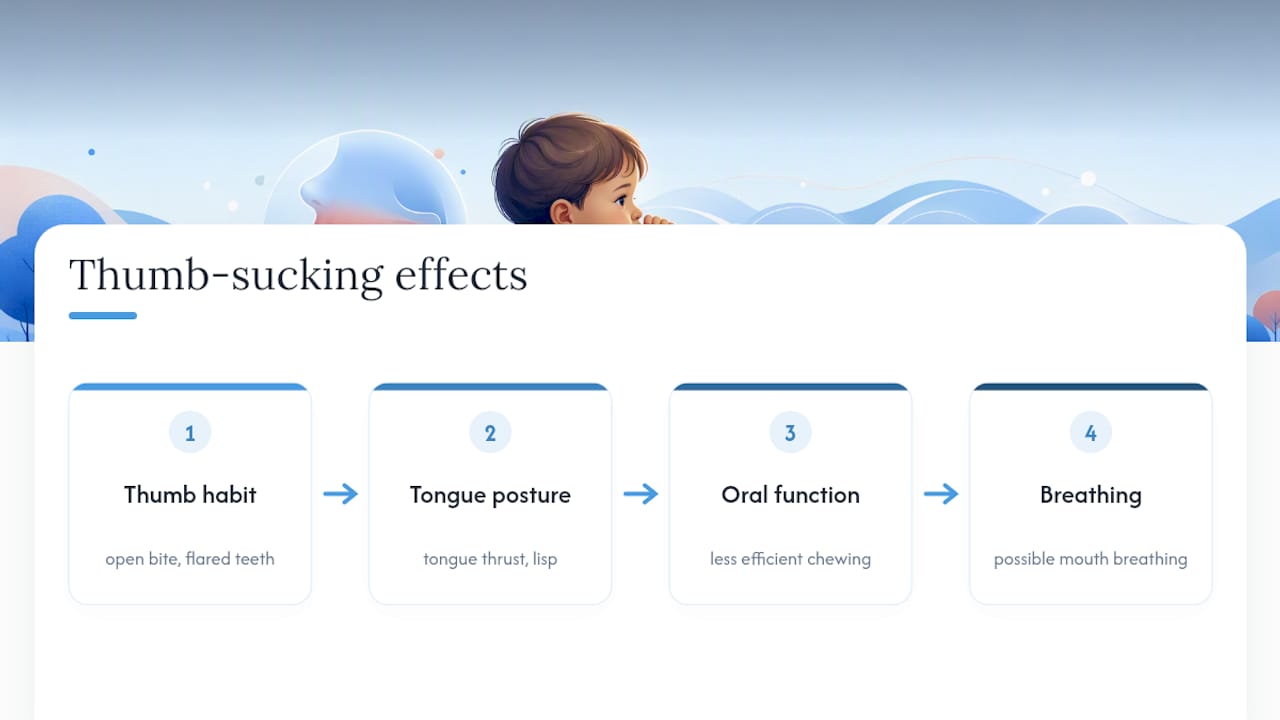
A shifted bite doesn’t just change how a smile looks. It can change how sounds get formed. Sounds like “s,” “z,” “t,” and “d” depend on the tongue meeting the front teeth in a specific spot, and an open bite or flared upper teeth can throw that placement off.
Children with a pronounced open bite sometimes develop a subtle tongue thrust, pushing the tongue forward between the teeth during speech instead of up against the palate, which can produce a lisp-like sound on certain letters. This isn’t universal. Plenty of children who suck their thumbs have completely normal speech, and plenty of speech patterns have nothing to do with sucking habits at all. But when a toddler’s speech therapist and dentist compare notes, a lingering thumb habit is one of the first structural factors they’ll rule in or out together.
Oral function beyond speech matters too. A narrowed palate or altered bite can affect how efficiently a child chews, and in more pronounced cases, can contribute to mouth breathing if nasal airflow feels less comfortable through a changed palate shape. None of this means every thumb-sucking toddler needs a speech evaluation. It does mean that if a preschooler’s speech seems delayed or unclear at the same time the thumb habit is still active past age 4, mentioning both to your dentist and pediatrician in the same conversation is worth doing, since the two issues sometimes travel together and sometimes resolve together once the habit stops.
Why Some Kids Suck Their Thumbs More Than Others
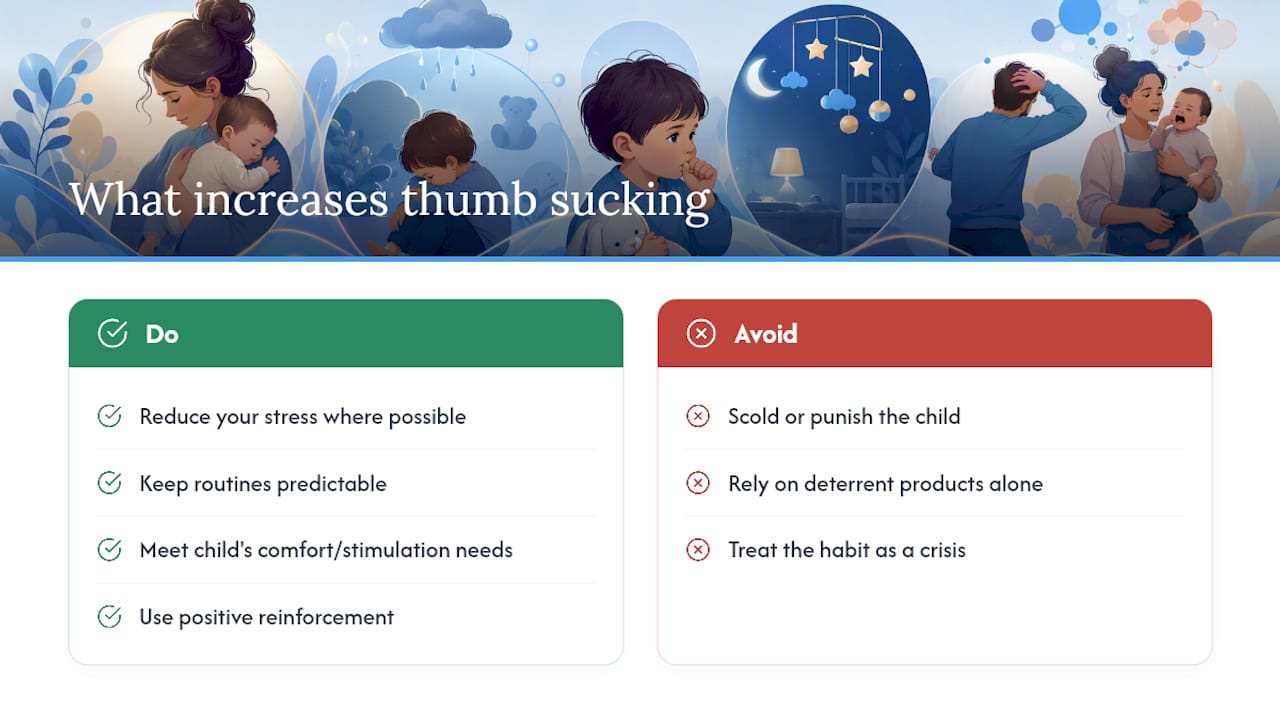
Thumb sucking is, at its core, a self-soothing behavior, and how much a child leans on it often mirrors what’s happening around them. A toddler who senses tension at home, a new sibling, a move, a change in routine, may reach for the thumb more often simply because it’s the most reliable comfort tool they have.
Parental stress plays into this in a way that’s easy to overlook. A stressed household tends to produce a more anxious child, and an anxious child sucks more, not less. It’s also worth noting that pressure from parents to stop, if it comes across as frustration or punishment, usually backens the anxiety that’s driving the habit in the first place. That’s part of why the American Dental Association steers so firmly toward positive reinforcement and away from scolding.
Environment matters in smaller ways too. Boredom during long car rides, transitions like starting daycare, or simply being tired can all trigger a reach for the thumb. A parenting resource on supporting early language and comfort milestones makes a similar point: self-soothing behaviors in toddlers often fade faster when parents address the underlying need for comfort or stimulation rather than targeting the behavior itself. Reducing your own stress where you can, keeping routines predictable, and staying calm about the habit rather than treating it as a crisis, tends to do more for a young child’s thumb sucking than any deterrent product on its own.
Our Take: Watch the Habit, Not the Age Alone
The conventional advice tells parents to worry once a child hits a certain birthday. That’s backwards. Age matters less than what the habit actually looks like: how many hours a day, whether it’s active sucking or passive resting pressure, and whether permanent teeth have started erupting. A five-year-old sucking lightly for ten minutes at bedtime is a different case than a three-year-old resting a thumb against the palate for eight hours overnight.
We’d also push back on the instinct to reach for a deterrent product first. Bitter polish and thumb guards can help, but they treat the symptom, not the trigger. Figuring out why your child sucks their thumb, boredom, anxiety, sleep transition, tends to solve more of the underlying problem than any product applied to the thumb itself.
What actually matters most: track the pattern for a week, watch for the six-hour threshold, and don’t wait past age 4 if the habit shows no sign of slowing. That’s the single detail worth acting on before anything else.
— Mersal
Booking a Dental Check for Your Child
If your child’s thumb sucking has you wondering whether it’s already affecting their bite, a straightforward exam is the fastest way to get a real answer instead of guessing from home. A local dental office offers family dental care with early childhood exams, same-day and emergency appointments when something looks urgent, direct insurance billing, and acceptance of public programs including CDCP and IFHP.

Bringing a child in for a first assessment doesn’t require much prep. Just come with a rough sense of the habit’s timeline, roughly how many hours a day, and whether it happens more during the day or at night, since that detail shapes what we recommend. You can look over our full range of services beforehand, or head straight to our home page to find booking details and office hours.
There’s no pressure to commit to treatment before you understand what’s going on. An exam simply gives you a clear picture of whether your child’s bite is developing normally or whether it’s time to start a monitoring plan.
This article is general information, not a substitute for advice from a qualified doctor. Consult a qualified healthcare professional about your own circumstances before acting on anything here.
Sources
Recommended
Comments